Categories
News

Paper in Diversity and Distributions

Jelena, Sébastien and Cleo have published a study on thermoregulatory traits and climatic niches in Cataglyphis ants in collaboration with Spanish and French researchers. see Link.

Predictions of future species distributions rest on the assumption that climatic conditions in the current range reflect fundamental niche requirements. Here, we measured heat tolerance, chill coma recovery, body size and phylogenetic relationships in 19 desert specialist ants in the genus Cataglyphis to test if these important determinants of fundamental niches are good predictors of species realized niches. We modelled species climatic niches using 19 bioclimatic variables from WorldClim for recorded occurrence of each species. None of the determinants of the species’ fundamental niche were linked to their realized climatic niche, modelled using species distribution models. However, both heat tolerance and chill coma recovery were highly correlated with body size andall three thermoregulatory traits were phylogenetically constrained, suggesting they reflect fundamental requirements of each species.Thes results challenge the basic assumption of climatic niche modelling, that the realized niche can be used as a proxy for determining fundamental nicherequirements. These findings are particularly concerning for studies that use the species’ current realized niche to predict their responses to climate change.

Bujan, J., Ollier, S., Villalta, I., Devers, S., Cerdà, X., Amor, F., Dahbi, A., Bertelsmeier, C.*, Boulay, R.* (2022) Can thermoregulatory traits and evolutionary history predict climatic niches of thermal specialists? Diversity and Distributions,  https://doi.org/10.1111/ddi.13511, *equal contribution
Categories
News

Success at Biology22!

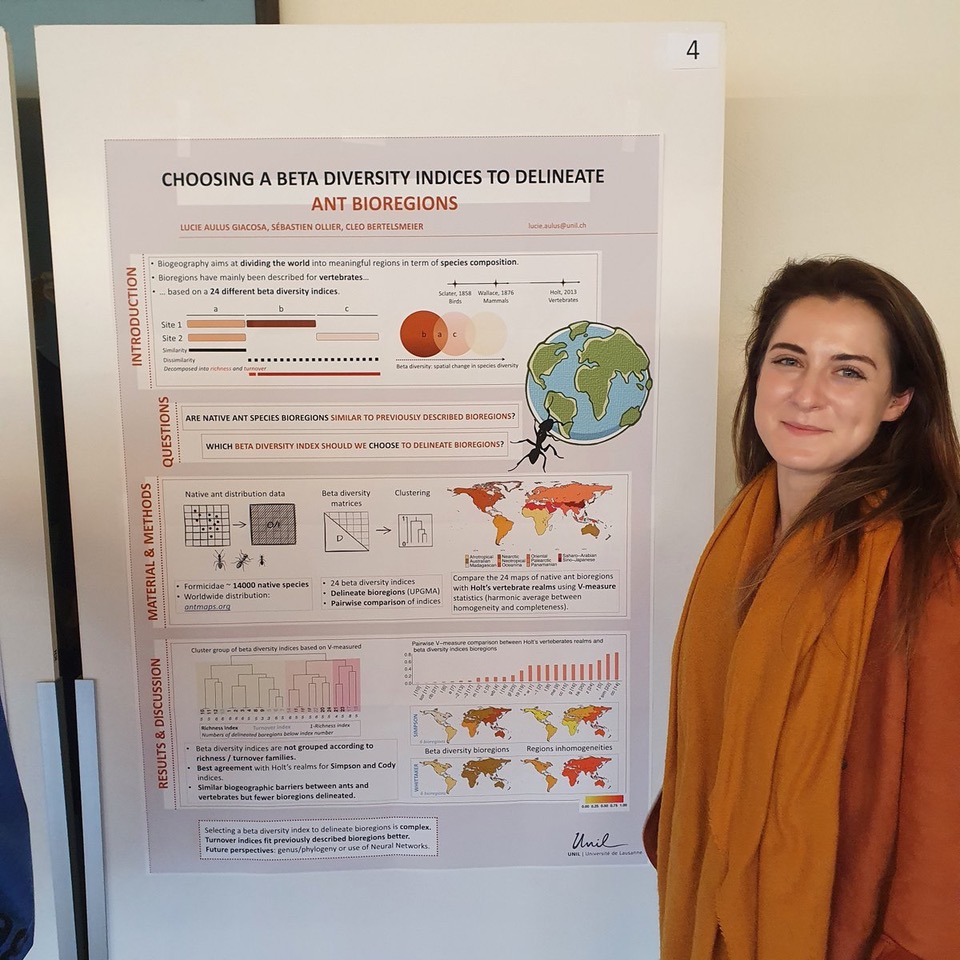
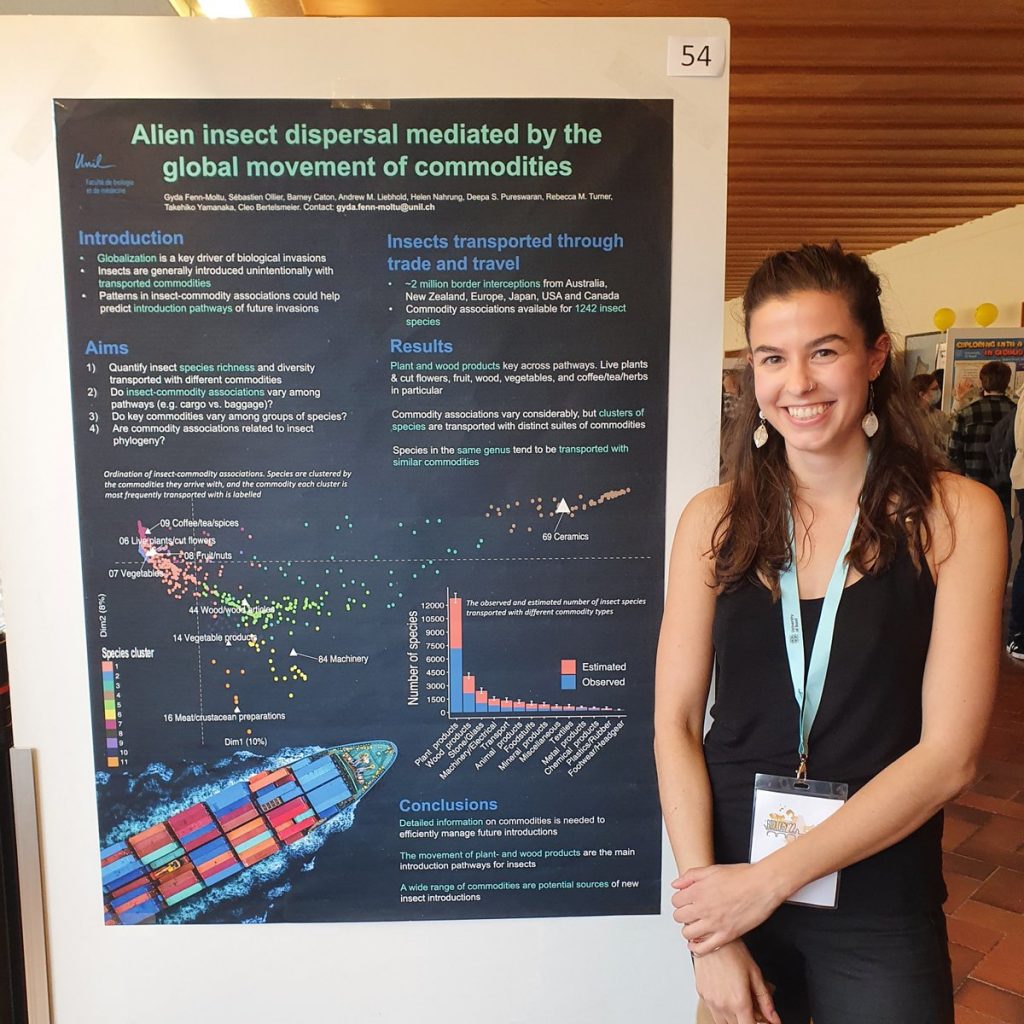
Congratulations to Jelena Bujan , Gyda Fenn-Moltu and Lucie Aulus for their presentations at Biology22 Basel! Particular congratulations go to Lucie, who bagged a second place prize for her beautiful poster (see below)!

Lucie at Biology22
Gyda at biology 22
[ssba-buttons]
Categories
News

Interview/article in Neue Züricher Sonntagszeitung

See new article ‘Krieg im Sozialstaat’ in which Cleo was interviewed about her ant research and knowledge! (in German)

Categories
News

New Paper!!

Congratulations to Jerome and Lorena for publishing a new paper entitled “Local coexistence of native and invasive ant species is associated with micro-spatial shifts in foraging activity” in Biological Invasions!! The paper details how microclimate heterogeneity can help coexistence between native and invasive species!

see https://doi.org/10.1007/s10530-021-02678-2 for the full paper!!

ABSTRACTInvasive species often displace native species by outcompeting them. Yet, some native species can persist even in heavily invaded areas. The mechanisms mediating this local coexistence are still unclear. Fine-scale microclimatic heterogeneity could promote the local coexistence of native and invasive animal competitors. We tested if native ant species could coexist with a recent ant invader, Tapinoma magnum, by shifting their foraging activity in time or space to different microclimatic conditions. We compared the foraging activity of native epigeic ant species among invaded and uninvaded sites. We collected ants at baits in green spaces on the north, east, south and west sides of buildings in the morning, at noon and in the afternoon to test if native species foraged under different microclimatic conditions in invaded sites. Invaded sites had lower ant species richness, diversity, and relative abundance. The native black garden ant Lasius niger – one of the most widespread Palearctic ant species – persisted at high densities in invaded areas but foraged less on the east side of buildings and more on the west side. Microclimatic heterogeneity might promote native and invasive species coexistence by allowing some native species to shift their foraging behaviour to locally avoid or outcompete invasive competitors. Better understanding how fine-scale micro-environmental heterogeneity affects native species’ persistence in invaded areas could help to predict and locally mitigate the negative impacts of biological invasions.

Categories
News

Review paper on assessing of niche shfits in introduced species

Congratulations to Olivia who published her second first-author paper with Cleo, entitled ‘Climatic niche shifts in introduced species’ in Current Biology!

Predictions of future biological invasions often rely on the assumption that introduced species establish only under climatic conditions similar to those in their native range. To date, 135 studies have tested this assumption of ‘niche conservatism’, yielding contradictory results. Here we revisit this literature, consider the evidence for niche shifts, critically assess the methods used, and discuss the authors’ interpretations of niche shifts. We find that the true frequency of niche shifts remains unknown because of diverging interpretations of similar metrics, conceptual issues biasing conclusions towards niche conservatism, and the use of climatic data that may not be biologically meaningful. We argue that these issues could be largely addressed by focussing on trends or relative degrees of niche change instead of dichotomous classifications (shift versus no shift), consistently and transparently including non-analogous climates, and conducting experimental studies on mismatches between macroclimates and microclimates experienced by the study organism. Furthermore, an observed niche shift may result either from species filling a greater part of their fundamental niche during the invasion (a ‘realised niche shift’) or from rapid evolution of traits adapting species to novel climates in the introduced range (a ‘fundamental niche shift’). Currently, there is no conclusive evidence distinguishing between these potential mechanisms of niche shifts. We outline how these questions may be addressed by combining computational analyses and experimental evidence.

see: https://doi.org/10.1016/j.cub.2021.08.035 for the full paper!