Categories
News

Paper published about “Invasion Disharmony”

Invasion disharmony in the global biogeography of native and non‐native beetle species

Liebhold, A. M., Turner, R. M., Blake, R. E., Bertelsmeier, C., Brockerhoff, E. G., Nahrung, H. F., Pureswaran, D. S., Roques, A., Seebens, H., & Yamanaka, T. (2021).  Diversity and Distributions, ddi.13381. https://doi.org/10.1111/ddi.13381

The concept of “island disharmony” has been widely applied to describe the systematic over- and under-representation of taxa on islands compared to mainland regions. Here, we explore an extension of that concept to biological invasions. We compare biogeographical patterns in native and non-native beetle (Coleoptera) assemblages from around the world to test whether beetle invasions represent a random sample of species or whether some families are more prone to invade than others.
https://onlinelibrary.wiley.com/doi/10.1111/ddi.13381

Categories
News

Paper on global interceptions in Ecological Applications

Thanks to a fruitful collaboration with several international researchers, we have published new research on

“Worldwide border interceptions provide a window into human-mediated global insect movement”

https://europepmc.org/article/med/34255404:

As part of national biosecurity programs, cargo imports, passenger baggage and international mail are inspected at ports of entry to verify compliance with phytosanitary regulations and to directly intercept potentially damaging non-native species to prevent their introduction. Detection of organisms during inspections may also provide crucial information about the species composition and relative arrival rates in invasion pathways that can inform the implementation of other biosecurity practices such as quarantines and surveillance. In most regions, insects are the main taxonomic group encountered during inspections. We gathered insect interception data from nine world regions collected from 1995 – 2019 to compare the composition of species arriving at ports in these regions. Collectively, 8,716 insect species were intercepted in these regions over the last 25 years, with the combined international dataset comprising 1,899,573 interception events, of which 863,972 were identified to species level. Rarefaction analysis indicated that interceptions comprise only a small fraction of species present in invasion pathways. Despite differences in inspection methodologies, as well as differences in the composition of import source regions and imported commodities, we found strong positive correlations in species interception frequencies between regions, particularly within the Hemiptera and Thysanoptera. There were also significant differences in species frequencies among insects intercepted in different regions. Nevertheless, integrating interception data among multiple regions would be valuable for estimating invasion risks for insect species with high likelihoods of introduction as well as for identifying rare but potentially damaging species.

Categories
News

Welcome Lucie!

Lucie Aulus has joined the team as a postdoc. She will work on invasion biogeography at a global scale.

Categories
News

Cleo on comedy show “les Dicodeurs”

The RTS radio show hosts 4 comedians and a guest who has to play a guessing game – and can also tell stories themselves. So, naturally there are a lot of jokes, anecdotes and stories about ants. The five episodes have been on air on March 15-19 2021.

click here to listen to “les Dicodeurs” with Cleo.

[ssba-buttons]
Categories
News

Review published

“Globalization and the anthropogenic spread of invasive social insects” has been published in Current Opinion in Insect Science.

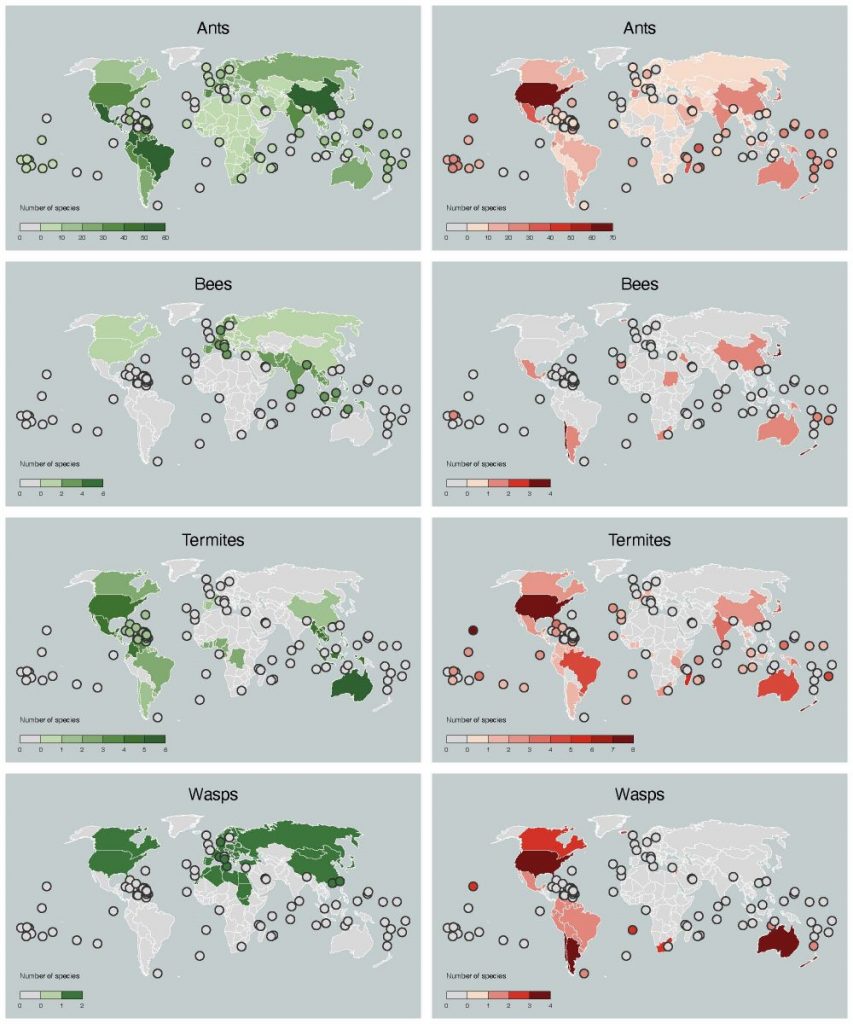
Social insects are among the worst invasive species and a better understanding of their anthropogenic spread is needed. Here, I highlight recent research demonstrating that social insects have been dispersed since the early beginnings of globalized trade and in particular after the Industrial Revolution, following two waves of globalization. Many species have complex invasion histories, with multiple independent introduction events and frequent secondary spread. The major source and recipient regions differ markedly across ants, wasps, termites and bees, probably linked to their different introduction pathways. At a more local scale, anthropogenic factors such as irrigation, urbanization or the presence of railways facilitate invasions. In the future, social insect invasions could further accelerate due to intensifying global trade and novel introduction pathways.

The full paper can be found here: https://www.sciencedirect.com/science/article/pii/S2214574521000079

[ssba-buttons]