See new article ‘Krieg im Sozialstaat’ in which Cleo was interviewed about her ant research and knowledge! (in German)
Category: News
Bertelsmeier Group News, from new publications, public outreach, press, to new members
Categories
New Paper!!
Congratulations to Jerome and Lorena for publishing a new paper entitled “Local coexistence of native and invasive ant species is associated with micro-spatial shifts in foraging activity” in Biological Invasions!! The paper details how microclimate heterogeneity can help coexistence between native and invasive species!
see https://doi.org/10.1007/s10530-021-02678-2 for the full paper!!
ABSTRACTInvasive species often displace native species by outcompeting them. Yet, some native species can persist even in heavily invaded areas. The mechanisms mediating this local coexistence are still unclear. Fine-scale microclimatic heterogeneity could promote the local coexistence of native and invasive animal competitors. We tested if native ant species could coexist with a recent ant invader, Tapinoma magnum, by shifting their foraging activity in time or space to different microclimatic conditions. We compared the foraging activity of native epigeic ant species among invaded and uninvaded sites. We collected ants at baits in green spaces on the north, east, south and west sides of buildings in the morning, at noon and in the afternoon to test if native species foraged under different microclimatic conditions in invaded sites. Invaded sites had lower ant species richness, diversity, and relative abundance. The native black garden ant Lasius niger – one of the most widespread Palearctic ant species – persisted at high densities in invaded areas but foraged less on the east side of buildings and more on the west side. Microclimatic heterogeneity might promote native and invasive species coexistence by allowing some native species to shift their foraging behaviour to locally avoid or outcompete invasive competitors. Better understanding how fine-scale micro-environmental heterogeneity affects native species’ persistence in invaded areas could help to predict and locally mitigate the negative impacts of biological invasions.
Congratulations to Olivia who published her second first-author paper with Cleo, entitled ‘Climatic niche shifts in introduced species’ in Current Biology!
Predictions of future biological invasions often rely on the assumption that introduced species establish only under climatic conditions similar to those in their native range. To date, 135 studies have tested this assumption of ‘niche conservatism’, yielding contradictory results. Here we revisit this literature, consider the evidence for niche shifts, critically assess the methods used, and discuss the authors’ interpretations of niche shifts. We find that the true frequency of niche shifts remains unknown because of diverging interpretations of similar metrics, conceptual issues biasing conclusions towards niche conservatism, and the use of climatic data that may not be biologically meaningful. We argue that these issues could be largely addressed by focussing on trends or relative degrees of niche change instead of dichotomous classifications (shift versus no shift), consistently and transparently including non-analogous climates, and conducting experimental studies on mismatches between macroclimates and microclimates experienced by the study organism. Furthermore, an observed niche shift may result either from species filling a greater part of their fundamental niche during the invasion (a ‘realised niche shift’) or from rapid evolution of traits adapting species to novel climates in the introduced range (a ‘fundamental niche shift’). Currently, there is no conclusive evidence distinguishing between these potential mechanisms of niche shifts. We outline how these questions may be addressed by combining computational analyses and experimental evidence.
see: https://doi.org/10.1016/j.cub.2021.08.035 for the full paper!
Congratulations to Aymeric Bonnamour for his first paper in his PhD!!! It was published today in Ecology Letters. https://onlinelibrary.wiley.com/doi/10.1111/ele.13863#
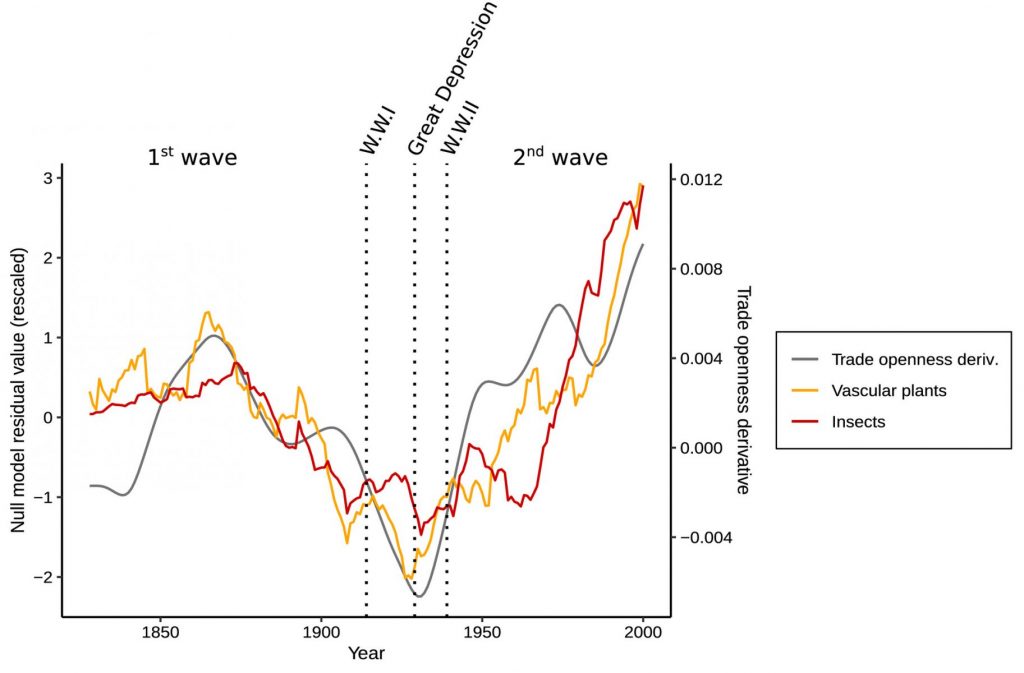
Insect and plant invasions follow two waves of globalisation
Globalisation has facilitated the spread of alien species, and some of them have significant impacts on biodiversity and human societies. It is commonly thought that biological invasions have accelerated continuously over the last centuries, following increasing global trade. However, the world experienced two distinct waves of globalisation (~1820–1914, 1960-present), and it remains unclear whether these two waves have influenced invasion dynamics of many species. To test this, we built a statistical model that accounted for temporal variations in sampling effort. We found that insect and plant invasion rates did not continuously increase over the past centuries but greatly fluctuated following the two globalisation waves. Our findings challenge the idea of a continuous acceleration of alien species introductions and highlight the association between temporal variations in trade openness and biological invasion dynamics. More generally, this emphasises the urgency of better understanding the subtleties of socio-economic drivers to improve predictions of future invasions.
Categories
On the Radio!
Cleo has participated in a radio show (2nd August 8h30 – 11h « Le grand air ») to discuss her research on on RTS
[ssba-buttons]