
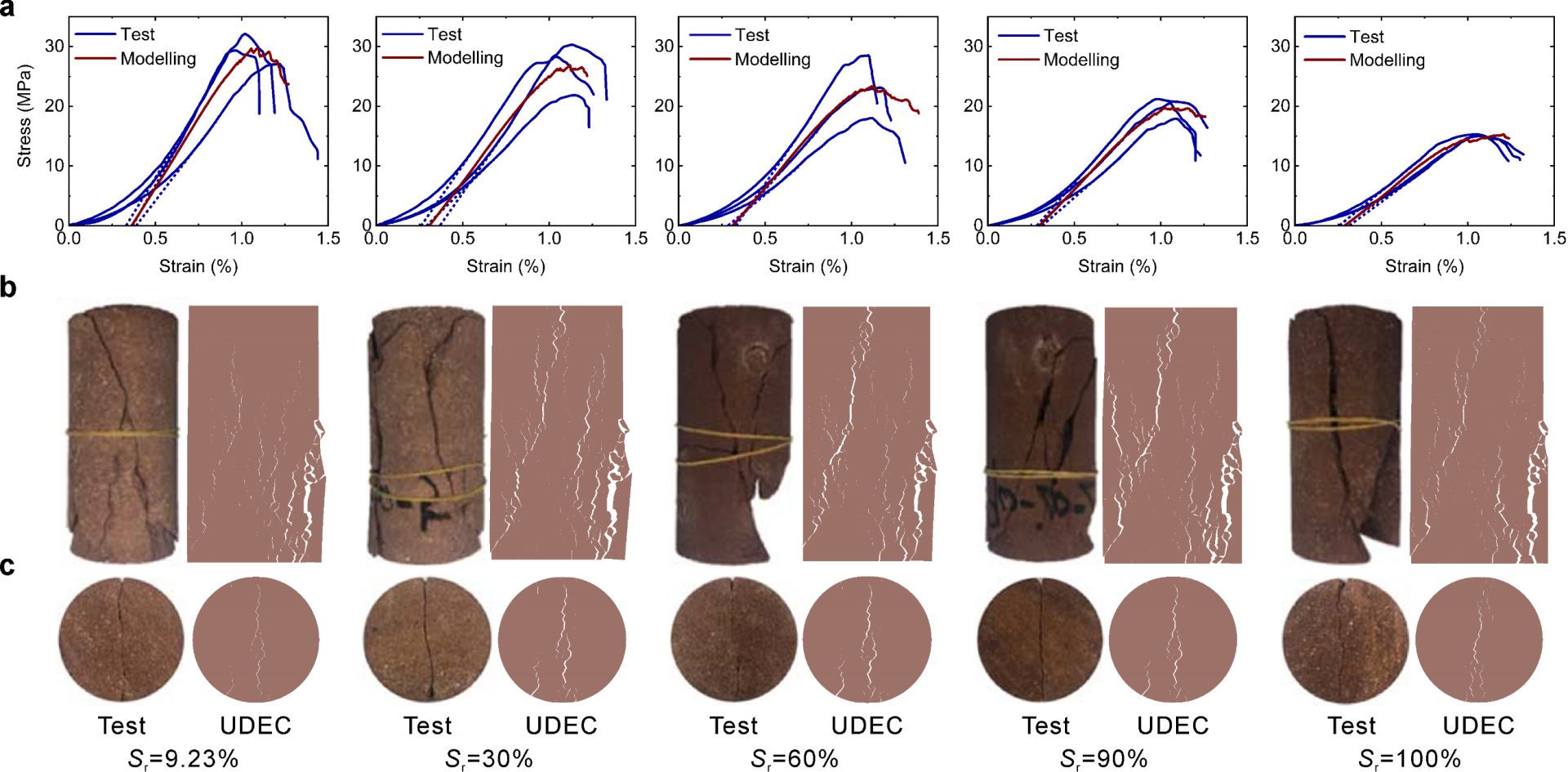
Comparisons between numerical and tested results. (a) Stress-strain curves, in which the nonlinearity of tested curves at the beginning of loading is rephrased as the blue dotted lines because the nonlinearity derived from pre-existing defects is difficult to reproduce in the simulation; (b) Failure configurations in unconfined compression; and (c) Failure configurations in Brazilian tensile between geomechanical tests and UDEC modelling under the condition of different Sr.
(Figure source: Bu, F., Jaboyedoff, M., Derron, M.-H., Xue, L., Cui, Y. & Xu, C. 2025. Parametric study to implement a water-weakening process in UDEC. Journal of Rock Mechanics and Geotechnical Engineering, 17(3), 1378–1386. https://doi.org/10.1016/j.jrmge.2024.05.030.)
Fengchang Bu
Director: Prof. Dr. Michel Jaboyedoff,
Jury: Prof. Dr. Davide Elmo, Prof. Dr. Muriel Gasc-Barbier and Prof. Dr. Beatriz Quintal
Keywords: Rock bridge, rock bridge mechanics, rock bridge failure criterion, Mohr’s circle, failure envelope, resistance magnitude, failure mode, fracture mechanics, crack initiation, crack propagation, crack coalescence, rock mechanics test, failure precursor, weakest-link theory, renormalisation group theory, universal distinct element code (UDEC), parameter calibration, machine learning, UPCal, water-weakening simulation, rock slope, rockslide triggering, fault linkage
Doctoral dissertation in Earth Sciences, defended on July 10, 2026, by Fengchang Bu, affiliated with the Institute of Earth Sciences (ISTE) at the FGSE.
ABSTRACT
Natural joints and faults are often not fully continuous. The disconnected segments, referred to in different disciplines as rock bridges, gaps, stepovers, and similar terms, are here broadly termed rock bridges. Despite over half a century of research on the behaviour of rock bridges resisting joint and fault connections across field and lab scales, due to the absence of a rock bridge mechanics framework, mainstream geoscientific thought treats rock bridges as conceptual entities rather than analysable objects. Consequently, the current rock bridge research faces impasses across multiple dimensions, including the definition, measurement, analytical method, resistance magnitude, failure mechanism, fracture morphology, stress-orientation dependence, determinants, and field incorporation, constraining our understanding and management of the associated geological phenomena and rock engineering, such as landslide triggering, fault linkage, and earthquake termination.
To establish the rock bridge mechanics framework, Chapter 3 provides analytical solutions for crack initiation, propagation, and coalescence in bridging regions within the framework of fracture mechanics, with the innovation being the theoretical formula for curvilinear crack propagation that has remained challenging for decades. Despite experimental validation for crack initiation and propagation, the analytical solution for crack coalescence is questionable, as fracture mechanics has fundamental difficulties describing such a highly nonlinear complex mechanical process and interpreting how a rock bridge resists connections as a whole, necessitating alternative conceptual lines.
Furthermore, Chapter 4 provides rock bridge failure criteria built upon foundational concepts of a Mohr’s circle and a failure envelope. Since the conceptualisation of a rock bridge by Müller and Terzaghi in 1962, the rock bridge failure criteria present a conceptual advance by elevating a rock bridge from a conceptual entity to an analysable object, therefore serving as the fundamental framework for rock bridge mechanics. Theoretical resistance magnitudes and failure modes of rock bridges have been validated by extensive experimental databases across various conditions, including diverse discontinuity arrangements (discontinuity spacing, continuity, inclination, bridging angle, etc.), different stress regimes (unconfined/confined compression, tension, shear, etc.), diverse field conditions (surface loading, subsurface excavation, weathering, saturation, rock bridge reduction, plate motion, etc.), different lithologies (rock-like material, sandstone, limestone, granite, etc.), and discontinuity infillings. Chapters 5–7 provides in-depth extensions of the rock bridge failure criteria alongside experimental validations across different stress regimes, including compression, tension, shear, and their combinations.
To predict rock bridge failure, Chapter 8 couples the rock bridge failure criteria with the weakest-link theory and renormalisation group theory, with the innovation being the deterministic laws of the progressive failure of rock bridges. Theoretical failure precursors have been validated by unconfined compressive tests and direct shear tests on granites.
To support subsequent universal distinct element code (UDEC) simulations where the rock bridge failure criteria are applied to the field, Chapters 9 and 10 develop a technique for the parameter calibration in UDEC for modelling intact rocks using machine learning, which has been validated by an experimental database containing 99 types of rocks. This technique is further integrated into the open-source software UPCal, solving the challenge of the parameter calibration since the release of UDEC in 1983. Moreover, Chapter 11 develops a technique to implement a water-weakening process in UDEC by parametric study, enabling a water-weakening simulation.
Chapters 12–14 apply the rock bridge failure criteria and the developed UDEC techniques to the field. In general rock slope models, theoretical predictions of rock bridge failure modes and rockslide triggering have been validated through UDEC simulations. In the potential Boot Flake rockslide case in California, current and future rockslide risks under extreme precipitation and rock bridge reduction are analysed by the theory, which have been confirmed by UDEC simulations. In the Southern San Andreas Fault–Imperial Fault hard linkage case, current and future fault connectivity is analysed by simulating the relative motion between the Pacific plate and the North American plate and the theory, providing the prediction of timescales required for future fault linkage. These applications across the geosciences demonstrate the implications of the rock bridge failure criteria to the field incorporation of rock bridges.
This thesis establishes the rock bridge mechanics framework, especially the rock bridge failure criteria as the primary engine, elevating a rock bridge from a conceptual entity to an analysable object.