
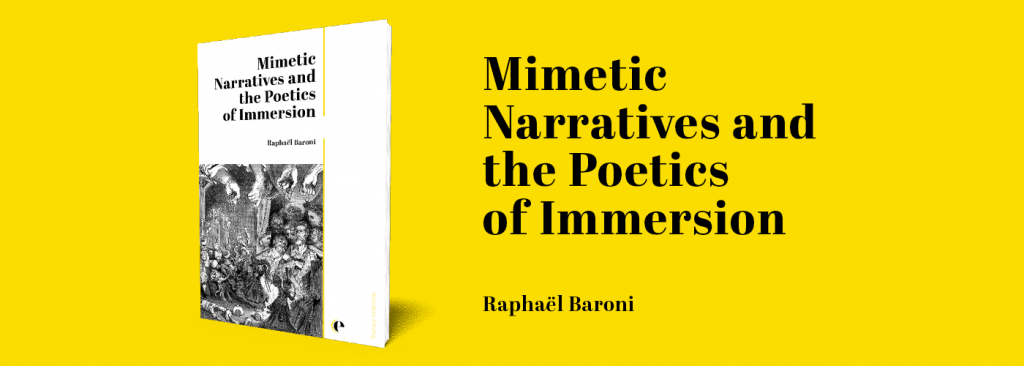
From ancient epics to television series and from novels to immersive documentaries, certain narratives transport us to a different world. This book explores the specificity of these mimetic narratives, where the audience is plunged into an “imaginary scene” in which characters take shape, time thickens, and the future remains open.
Drawing on the latest research in cognitive, rhetoric, transmedial, and cultural narratology, Raphaël Baroni shows how mimetic narratives awaken our empathy and trigger suspense, curiosity, or surprise, and why they constitute a laboratory for ethical and existential experiences.
This book is not just a theoretical contribution, it is a deep-dive into the social and emotional power of stories, shedding light on both our need for fiction and the force of certain factual narratives.
Open Acess eBook (PDF), DOI: https://doi.org/10.55430/8084MNPIRB
—
“In this book, Baroni offers original insights into highly relevant questions in narratology” (Marie-Laure Ryan)
—
Introduction
Part 1. Mimetic Storytelling
1 The Relevance of Being Irrelevant
2 To Intrigue or to Explain? How to Convey What Happened
3 Fact and Fiction: Pragmatic Constraints on Mimetic Nonfiction
Part 2. Mimetic Time
4 Analepsis and Flashback: Dramatizing Anachronyms
5 Scenes and Summary: Dramatizing Rhythm
6 The Musicality of Plot: Dramatizing Duration
Part 3. Mimetic Storyworlds
7 Thickness, Inscrutability, and Freedom of Characters
8 Virtualities: A Forking Path for Narrative Progression
9 Knowing but Hoping: The Dynamics of Rereading
Conclusion. Powers and Limits of Mimetic Narratives