
Zenan Huo
Director: Prof. Dr. Michel Jaboyedoff,
Co-director : Prof. Dr. Yury Podladchikov
Jury: Prof. Dr. Giovanni Crosta, Prof. Dr. Johan Gaume, Dr. Ivan Utkin
Standing at the intersection of rapidly advancing computing hardware and emerging scientific programming languages such as Julia, numerical simulation development is undergoing a significant transition. This thesis presents a high-performance, end-to-end framework for post-failure landslide simulation based on the Material Point Method (MPM), integrating geometric preprocessing, backend-agnostic solver design, and real-case application into a unified workflow. To address the bottle-neck of structured particle generation, a multi-context framework is developed, providing identification of heterogeneous zones, with theoretical error analysis.
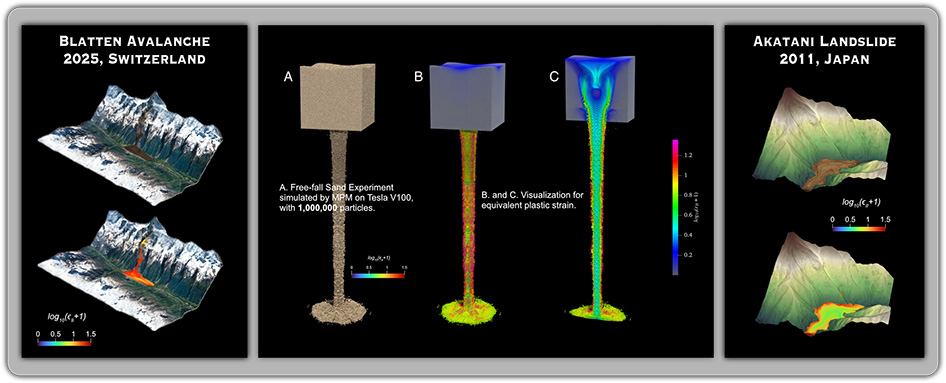
Typical models with over one hundred million material particles can be produced within seconds, enabling efficient, flexible, and reproducible high-resolution MPM preprocessing. To ensure performance portability across heterogeneous hardware, a backend-agnostic explicit solver is introduced, allowing a single code base to run efficiently on CPUs and diverse hardware accelerators. An effective memory-throughput metric is proposed to quantify the memory-bound characteristics of MPM relative to hardware peak bandwidth, providing a measurable connection between algorithmic structure and hardware performance. The integrated workflow is applied to the 2011 Akatani landslide in Japan, where a realistic failure surface is reconstructed from pre- and post-event DEMs using the sloping local base level (SLBL) method. Apparent basal friction parameters are selected using the empirical Δ𝑌/𝑍–volume relation, and 56 high-resolution simulations are performed to systematically examine the roles of volume, basal friction, and strength parameters in controlling runout dynamics and deposition patterns.
Quantitative evaluation demonstrates that SLBL-derived failure geometry combined with Δ𝑌/𝑍-based apparent parameters can effectively reproduce the observed landslide kinematics, offering a practical modeling strategy when only pre-event DEMs are available. Overall, this thesis establishes an efficient, scalable, and reproducible paradigm for high-resolution MPM-based landslide simulation and provides a solid methodological and computational foundation for extending MPM toward real-world hazard assessment.
Doctoral dissertation in Earth Sciences, defended on February 11, 2026, by Zenan Huo, affiliated with the Institute of Earth Sciences (ISTE) at the FGSE.