Conference site :
26-28 November 2025 – University of Lausanne
Recent catastrophic rock, rock-ice or rock-debris avalanches highlight the urgent need to improve detection, monitoring, and modeling of large-scale rock slope instabilities. With rapidly changing mountain environments, it is essential to advance empirical and numerical methods for better hazard forecasting and propagation prediction. Predictive models will be key to reducing disaster risks and protecting communities allowing the proper use of monitoring techniques and early warning systems.
The objective of this conference is to unite scientists engaged for a long time in research on large rock slope hazards and phenomena such as rock, rock-ice, or rock-debris avalanches. This includes experts working in the field, performing modelling, conducting laboratory studies or undertaking monitoring activities linked to risk management.
Several invited keynote speakers will deliver a series of featured presentations.
📣 Other contributions are accepted in the form of 15-minute oral presentations or poster sessions. This provides an opportunity to present research and interact with members of the scientific community.
📘A special issue of a peer-reviewed journal (to be confirmed) is planned to publish selected contributions from the conference.
We look forward to your participation!
Important dates:
| Opening preregistration | July 16, 2025 |
| Opening of the full registration: | August 15, 2025 |
| Abstract submission deadline: | September 29, 2025 |
| Abstract acceptance: | October 13, 2025 |
Fees:
| Option | Price (CHF) | Details |
| 3-Day Conference onsite | 300.– | Includes coffee breaks and lunch |
| Conference Dinner | 80.– | Optional evening event |
| 1-Day Pass onsite | 120.– | Includes coffee breaks and lunch |
| 3-Day Conference online | 100.- |
Illustration of the purpose
The scientific communities dealing with large rock instability and rock avalanches are under stress since the recent deep-seated rock-topple, followed by a 5×10⁵ m3 rock avalanche occurred in Pusa village in the County of Nayong (Guizhou Province, China), which was monitored and filmed. The runout of the event was underestimated, leading to the burial of a village and several casualties (Fan et al., 2019).
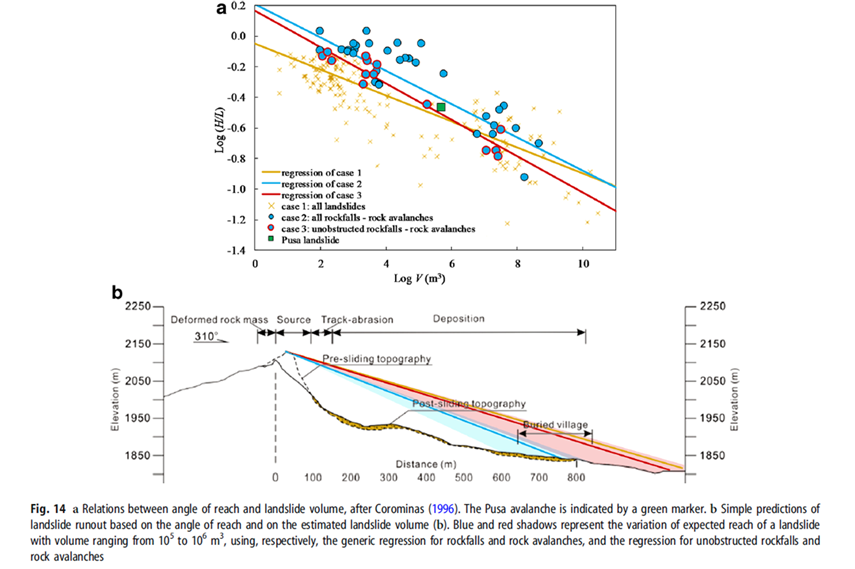
In 1987, a misprediction caused by the presence of a lake that increased the mobility of the Val Pola rock avalanche in Italy destroyed a village, killing unevacuated people (Azzoni et al., 1992). The mobilized Val Pola rock mass was located in a prehistoric landslide and was favored by fault and wedge structures. Heavy rainfall and rapid snowmelt triggered the event (Crosta et al., 2004).
In the Brienz (Switzerland) case, multiple propagation scenarios based on different volumes of rock-debris avalanches were considered to inform the evacuation decision, using the scenario representing the greatest potential impact, which ultimately did not happen, but was likely.
In 2025, at least three rock avalanches resulted in fatalities:
- On February 8, 2025, the Junlian landslide occurred in China (Zhao et al., 2025). It was a catastrophic rock avalanche with a volume of 0.37 x 10⁶ m³ and ended at 0.6 x 10⁶ m³ with an H/L ratio of 0.37 (~20°).
- On May 22, 2025, the Guowa rockslide – rock avalanche occurred in Guizhou Province’s Dafang County, China, killing 21 people (Chinadaily, 2025).
- On May 28, rock-ice debris avalanches occurred in Blatten, Switzerland, killing one person. The avalanches consisted of 8 to 11 million m³ of rock and ice mixed debris, with a H/L ratio of approximately 0.34 (19°), measured from the expected top of the debris cone lying on the glacier.
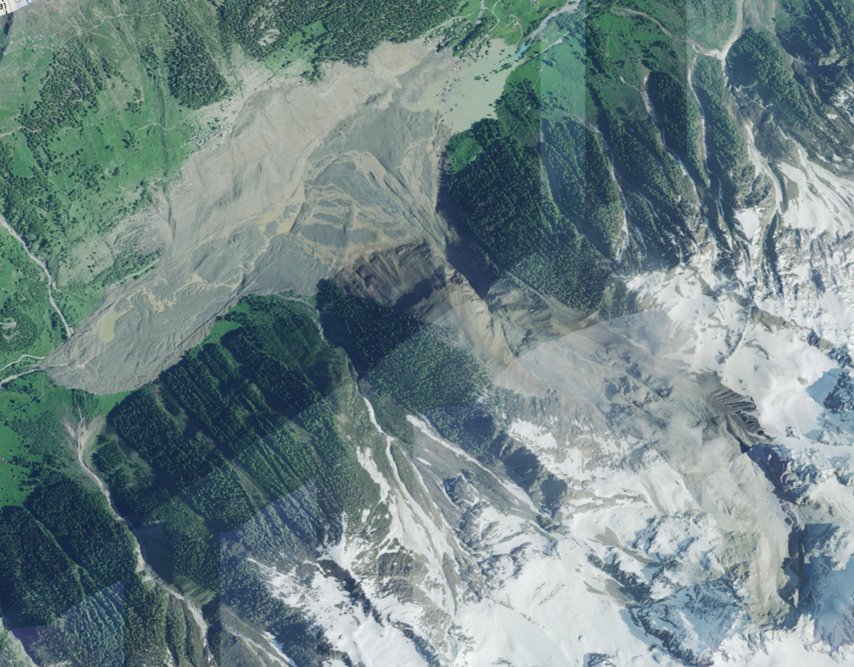
The latter has received widespread publicity. A few days prior, the Kleines Nesthorn rock instability was detected and showed rapid movement and settlement, which avoided a collapse of the rock mass at once but created a large scree slope on the Birch Glacier. The scree slope and the glacier collapsed a few days later.
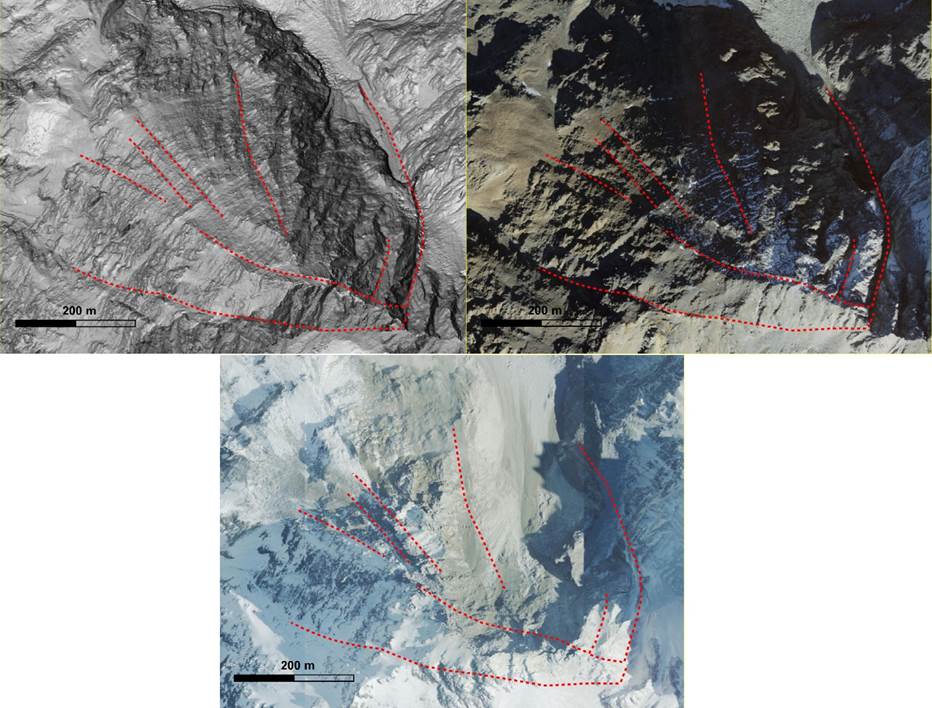
Kleines Nesthorn rock instability and features that can be expected to be identify before the event (maybe not), deduced from the pre-DEM an images (swisstopo background)
A similar event occurred in Randa in 1991, where two events also failed by “small” compartments, creating a huge scree slope of around than 30 million m³. However, the debris fell at the toe of the slope without a glacier, which prevented a subsequent rock-avalanche debris flow. The structure of the Randa cliff may have favored the progressive dismantling of the rock massif.
These selected illustrative examples highlight the significance of large instability source structures in failure initiation, as well as the influence of material composition—such as the presence or absence of ice, exemplified by the Chamoli event (Shugar et al., 2021)—on propagation conditions. Additionally, substratum characteristics have a notable effect on rock avalanche dynamics, as demonstrated by the comparison between the Baiyan and Baiwu events, where differences in substratum state impacted the Fahrböschung despite similar environmental contexts (He et al., 2025). The remaining questions are related to worsening and triggering factors. Nowadays, the challenge is to evaluate their relationship to human activity and global warming and determine their impact on rock slope stability and how to design reliable monitoring and EWS (Löw et al., 2015).
Location Vortex:

References
Azzoni, A., Chiesa, S., Frassoni, A. & Govi, M. 1992. The Valpola landslide. Engineering Geology, 33, 59-70, doi: https://doi.org/10.1016/0013-7952(92)90035-W.
Chinadaily, 2025: https://www.chinadaily.com.cn/a/202505/23/WS682fcfe2a310a04af22c1177.html
Crosta, G.B., Chen, H. & Lee, C.F. 2004. Replay of the 1987 Val Pola Landslide, Italian Alps. Geomorphology, 60, 127-146, doi: https://doi.org/10.1016/j.geomorph.2003.07.015.
Fan, X., Xu, Q., Scaringi, G., Zheng, G., Huang, R., Dai, L. & Ju, Y. 2019. The “long” runout rock avalanche in Pusa, China, on August 28, 2017: a preliminary report. Landslides, 16, 139-154, doi: 10.1007/s10346-018-1084-z.
He, J., Zhang, Y., Sun, P., Zhu, K., Sun, J. & Jin, K. 2025. Investigation of deposition characteristics using a novel super-resolution method: a case study of Baiyan rock avalanche in Guizhou, China. Landslides, doi: 10.1007/s10346-025-02512-z.
Loew, S., Schneider, S., Josuran, M., Figi, D., Thoeny, R., Huwiler, A., Largiadèr, A. & Naenni, C. 2025. Early warning and dynamics of compound rockslides: lessons learnt from the Brienz/Brinzauls 2023 rockslope failure. Landslides, 22, 283-298, doi: 10.1007/s10346-024-02380-z.
Shugar, D.H., et al. 2021. A massive rock and ice avalanche caused the 2021 disaster at Chamoli, Indian Himalaya. Science, 373, 300-306, doi: doi:10.1126/science.abh4455.
Zhao, B., Zhang, Q., Wang, L., Tian, H., Li, Z., Sun, G., Pan, Y., Xie, Q. & Su, L. 2025. Preliminary analysis of failure characteristics of the 2025 Junlian rock avalanche, China. Landslides, doi: 10.1007/s10346-025-02556-1.