Li Fei
Director: Prof. Dr. Michel Jaboyedoff
Jury: Dr. Marc-Henri Derron, Prof. Dr. Anna Giacomini, Dr. Christine Moos, Prof. Dr. Paolo Frattini
Rockfall-induced retreat of rock walls plays a critical role in shaping landforms across diverse geographical environments. These events pose significant threats to infrastructure, pedestrian safety, and residential areas, causing considerable damage to both human settlements and natural habitats located below these rock walls. In alpine environments, factors such as accelerating glacier retreat and permafrost degradation driven by global warming are expected to increase rockfall activity, thus accelerating the retreat rate of rock walls. Similarly, in coastal settings, localized intense extreme climatic events, such as heavy storms (resulting in strong wave action) and intense precipitation under climate change, increase the frequency of rock wall collapses at cliff bases, leading to accelerated cliff retreat. However, the dynamics of rock walls in sub-alpine environments have received less attention compared to those in high alpine regions. The lack of research involving short-to-long term and detailed rockfall data at both the rock wall scale and regional level limits our understanding of potential trends in increasing rockfall activity driven by global warming.
To investigate the retreat of rock walls caused by rockfalls and the associated risks across alpine to sub-alpine environments under climate change, this doctoral dissertation first focuses on rock wall retreat (a historical rockslide scar) caused by rockfalls and defines potential failure scenarios in an alpine environment affected by accelerating global warming (Brenva Spur, Mont Blanc Massif, Italy). Using helicopter-borne Structure-from-Motion (SfM) photogrammetry over a five-year period, a comprehensive rockfall source database was established following a major sliding event in 2016. This database, combined with data from the largest historical rockslide events, facilitated the evaluation of the volume-frequency relationship and the estimation of rock wall retreat rates. The volume-frequency relationship, based on the rock failure inventory, was fitted using a power-law distribution while considering relevant uncertainties. By employing structural analysis and the Slope Local Base Level (SLBL) approach, seven potential future rock failure scenarios were delineated and used for risk assessment.
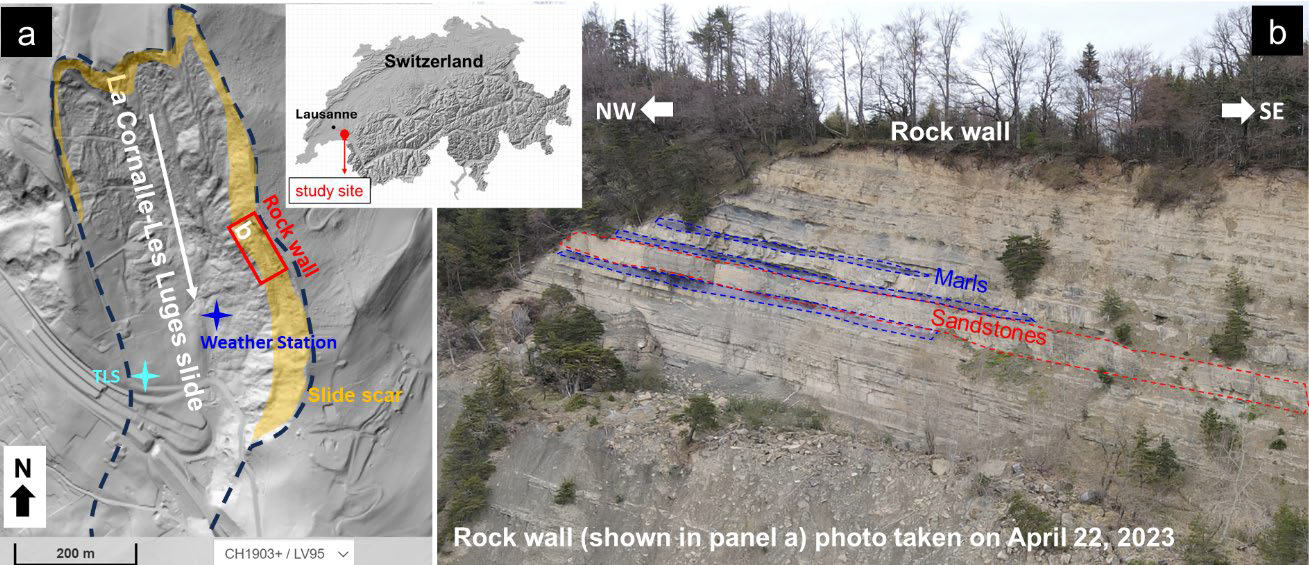
The second part of the thesis shifts focus to the retreat of a rock wall (a lateral scarp of a historical landslide) caused by rockfalls in a sub-alpine environment. This section explores whether local extreme climatic events, such as intense rainfall and heatwaves, affect rockfall activity in a manner similar to that observed in alpine environments under global warming. A molasse rock wall in a Swiss sub-alpine mountain was selected for monthly remote sensing surveys using drone-borne SfM photogrammetry and terrestrial laser scanning (TLS). These surveys enabled the establishment of a detailed rockfall database, capturing frequency, volume, and location information for each survey period. Concurrently, meteorological data, including rainfall, snowmelt, evapotranspiration (ET), and air temperature, were collected from nearby weather stations to analyze the effects of external environmental factors and/or local climate variations on the occurrences of rock detachments.
Characterized by interlayered soft (marl) and hard (sandstone) rocks, the La Cornalle rock wall exhibited differential erosion features, underscoring the significant role of faster retreat of soft rock layers in the overall rock wall retreat process. Thus, in the third part, to specifically examine small-scale detachments and micro-crack activity in the soft marl layers using multi scale observation methods, 26 hours of short-distance TLS monitoring at two-hour intervals were conducted during late winter (March). These efforts were supplemented with 20-minute interval Infrared Thermography (IRT) for rock surface temperature monitoring, solar radiation measurements, and hourly digital microscope-based micro-crack displacement monitoring. The comprehensive results from these multi-scale observation methods provided insights into the spatiotemporal distribution of small detachments and micro-crack movements on the rock wall face.
The findings from these three parts reveal that local climate anomalies significantly influence rockfall trends and related rock wall retreat rates in both alpine and sub-alpine environments. The rapid surface permafrost degradation during the 2015 summer heatwave likely altered rock wall retreat of Brenva Spur by triggering numerous superficial rock detachments with months or years of delay, as evidenced by two rockslides in 2016 and the highest retreat rate observed between 2017 and 2018. Estimations of return periods for defined failure scenarios in the future are subject to large uncertainties, particularly under ongoing global warming. In sub-alpine regions, rockfall activity in molasse rock walls is strongly predisposed by rock wall structure and lithology. Temporal variations in rockfall events and retreat rates are closely correlated with local changing meteorological conditions. Rockfall events were more frequent during rainy periods, such as the winter and humid spring and summer of 2021, while activity diminished during the extremely dry summer of 2022 (characterized by less rainfall and high ET). A marked increase in rockfall was observed during transitions from warm drought to cold humid conditions (dry-wet), indicating that local climate anomalies can significantly influence rockfall dynamics in this sub-alpine setting.
Daily observations of marl layers within the rock wall highlight the role of thermal weathering in driving micro-crack displacement and subsequent small-scale detachments (with volume less than 0.001 m3) of soft rock. Repeated daily temperature fluctuations (cooling-heating) and variations in solar radiation exacerbate rock mass degradation and small-scale debris flaking. The primary degradation mechanism involves tensile stress from thermal expansion and contraction, alongside the expansion effects of swelling minerals within the marl. However, the latter played a lesser role during the monitoring period, as the observations were conducted in clear and non-rainy weather conditions.
In summary, comprehensive monitoring of rock wall retreat using SfM photogrammetry, TLS, IRT, and digital microscopy, integrated with external environmental variables, demonstrates that local extreme climate anomalies substantially influence rockfall frequency in both alpine and sub-alpine environments. Unexpected extreme weather events challenge the ability to predict and assess rockfall hazards accurately, especially under ongoing climate change. For soft rock, the degradation caused by thermal weathering is crucial, as it promotes debris flaking and can lead to high-frequency, large-scale rockfall events (e.g., the failure of sandstone overhangs) over long periods.
Keywords: rockfall, retreat, rock wall, climate change, remote sensing, thermal weathering