Federico Franzosi
Director: Prof. Dr. Agliardi Federico, Prof. Dr. Michel Jaboyedoff
Jury: Prof. Dr. Giovanni Crosta, Prof. Dr. Riccardo Castellanza, Prof. Dr. Anindita Samsu, Dr. Marc-Henri Derron
The fracturing state of rocks is a fundamental control on their hydro mechanical properties at all scales In fact, reliable in situ quantification of rock mass fracturing and its engineering quality is critical for slope stability, surface mining and rock engineering applications Fracturing state can be quantified in the laboratory by non destructive geophysical techniques that are hardly applicable in situ, where biased mapping and statistical sampling strategies are usually exploited. Infrared thermography (IRT) has been used to infer the fracturing state of rock masses by measuring their thermal response to perturbations, but a physically based predictive approach is lacking. Our work focused on the investigation of the process of thermal perturbation in rock volumes at different scales to answer to different research question :(a) i s it possible to find a physical link between degree of fracturing and thermal response of the fractured put to perturbations (e.g., heating, cooling) cooling)? ( Is it possible to meaningfully measure differences in behavior between media characterized by different degree of fracturing using ITR? (c) i s it possible
to quantify these differences to develop quantitative diagnostic methodologies
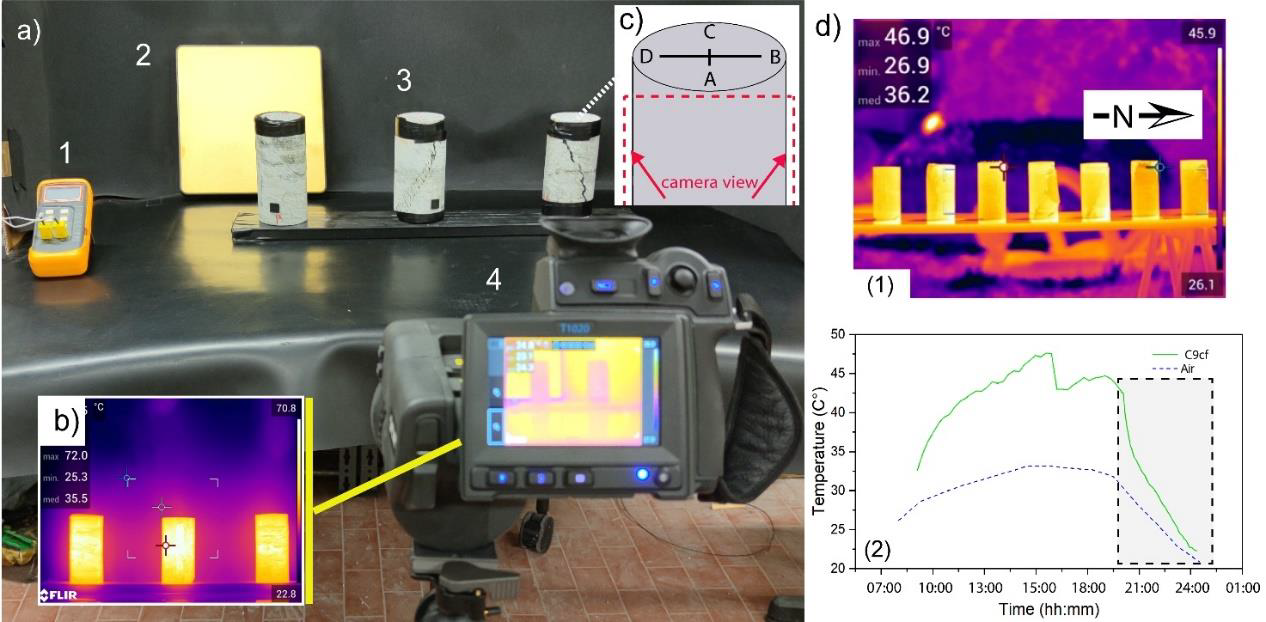
To this end , we started perform ing an experimental study on the cooling behavior of pre fractured gneiss and mica schist samples, whose 3D fracture networks were reconstructed using Micro CT and quantified by unbiased fracture abundance measures. We carried out cooling experiments in both controlled (laboratory) and natural (outdoor) conditions, monitoring temperature with a thermal camera. Multi temporal thermograms were processed to extract temperature distribution patterns and cooling temperature time histories, described in terms of synthetic descriptors that show statistically sig nificant correlations with fracture abundance measures. More intensely fractured rocks cool at faster rates and outdoor experiments shows that differences in thermal response can be detected even in natural environmental conditions. 3D FEM models reproducing laboratory experiments outline the fundamental control of fracture pattern and convective boundary conditions on cooling dynamics. Based on a lumped capacitance approach, we provided a synthetic description of cooling curves in terms of a Curve Shape Parameter (CSP )), independent on absolute thermal boundary conditions and lithology. This provides a
starting point toward the development of a quantitative methodology for the contactless in situ assessment of rock mass fracturing.
Then, starting from a robust theoretical framework and laboratory experimental
investigation, we were able to explore the potential of the innovative IRT technique in predictive studies of the fractur ing state of rock mass. To do this, it was necessary to export the experience, theoretical aspects, and experimental approach developed in the laboratory to the in situ scale, through the characterization of the cooling behavior of rock mass outcrops using the C SP as a descriptor of outcrops cooling curves a nd function of fracturing. We based our approach to the problems on a systematic, sequential solution of the main upscaling issues, including: a) definition of suitable rock mass quality descriptors, b) scale effects affecting the definition of fractured rock masses; c) environmental factor and disturbances controlling the applicability of Infrared Thermography to rock mass characterization in outdoor settings, and d) reconstruction and modelling of experimental cooling curves acquired in outdoor, unconstrained environmental conditions.
That’s how we propose a method to quantify and map the slope scale geomechanical quality of fractured rock masses using infrared thermography (IRT). We use the Mt. Gorsa quarry (Trentino, Italy) as a field laboratory to upscale the physics based approach developed in the laboratory to in situ conditions, including the effects of fracture heterogeneity, environmental conditions and IRT limitations. We reconstructed the slope in 3D by UAV photogrammetry, characterized rock mass qualit y in the field at selecte d outcrops in terms of Geological Strength Index (GSI), and measured their cooling behavior through 18h time lapse IRT surveys. With ad hoc field experiments, we developed a novel procedure to correct IRT data in outdoor environments with complex topograph y. This allowed a spatially distributed quantification of rock mass surface cooling behavior in terms of a Curve Shape Parameter (C SP ). Using nonlinear regression, we established a quantitative C SP GSI
relationship allowed translating C SP into GSI maps. Ou r results demonstrate the possibility to apply infrared thermography to the slope scale mapping of rock mass fracturing using a physics based experimental methodology potentially useful in slope stability related risk for wide ranging engineering problems.