Emmanuel Wyser
Director: Prof. Dr. Michel Jaboyedoff, Prof. Dr. Yury Podladchikov
Jury: Prof. Dr. Stefan M. Schmalholz, Prof. Dr. Johan Gaume, Prof. Dr. Thibault Duretz
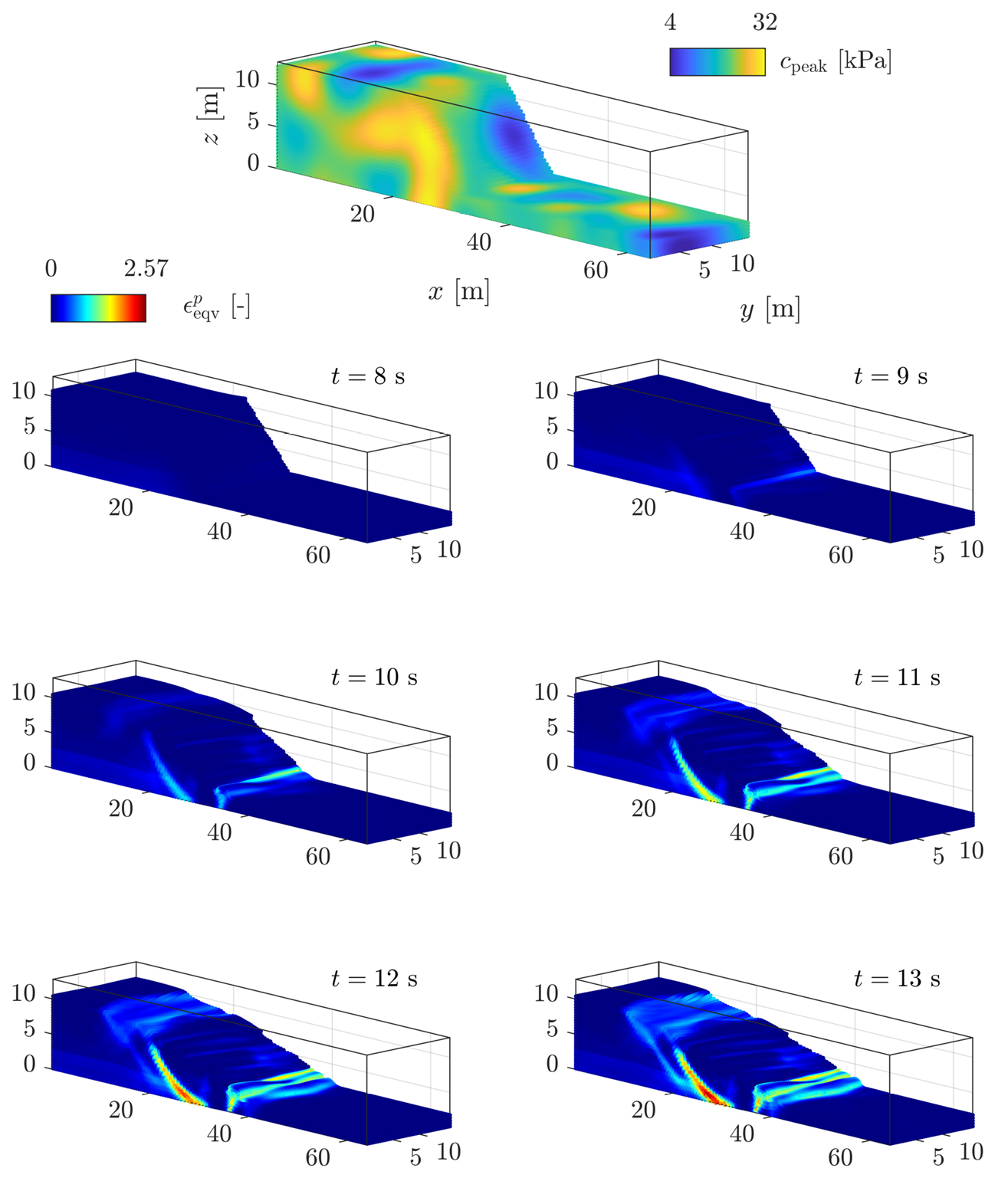
Plastic strain localization is an important process on Earth. It strongly infuences the mechanical behaviour of natural processes, such as fault mechanics, earthquakes or orogeny. At a smaller scale, a landslide is a fantastic example of elasto-plastic deformations. Such behaviour spans from pre-failure mechanisms to post-failure propagation of the unstable material. To fully resolve the landslide mechanics, the selected numerical methods should be able to effciently address a wide range of deformation magnitudes.
Accurate and performant numerical modelling requires important computational resources. Mesh-free numerical methods such as the material point method (MPM) or the smoothed-particle hydrodynamics (SPH) are particularly computationally expensive, when compared with mesh-based methods, such as the finite element method (FEM) or the nite difference method (FDM). Still, mesh-free methods are particularly well-suited to numerical problems involving large elasto-plastic deformations. But, the computational efficiency of these methods should be rst improved in order to tackle complex three-dimensional problems, i.e., landslides.
As such, this research work attempts to alleviate the computational cost of the material point method by using the most recent graphics processing unit (GPU) architectures available. GPUs are many-core processors originally designed to refresh screen pixels (e.g., for computer games) independently. This allows GPUs to delivers a massive parallelism when compared to central processing units (CPUs).
To do so, this research work rst investigates code prototyping in a highlevel language, e.g., MATLAB. This allows to implement vectorized algorithms and benchmark numerical results of two-dimensional analysis with analytical solutions and/or experimental results in an affordable amount of time. Afterwards, low-level language such as CUDA C is used to effciently implement a GPU-based solver, i.e., ep2-3De v1.0, can resolve three-dimensional problems in a decent amount of time. This part takes advantages of the massive parallelism of modern GPU architectures. In addition, a rst attempt of GPU parallel computing, i.e., multi-GPU codes, is performed to increase even more the performance and to address the on-chip memory limitation. Finally, this GPU-based solver is used to investigate three-dimensional granular collapses and is compared with experimental evidences obtained in the laboratory.
This research work demonstrates that the material point method is well suited to resolve small to large elasto-plastic deformations. Moreover, the computational effciency of the method can be dramatically increased using modern GPU architectures. These allow fast, performant and accurate threedimensional
modelling of landslides, provided that the on-chip memory limitation is alleviated with an appropriate parallel strategy.