Our latest review online now:
“Small but thick enough – the Arabidopsis hypocotyl as a model to study secondary growth”
Our latest review online now: Read More…et quid amabo nisi quod vita enigma est?
“Small but thick enough – the Arabidopsis hypocotyl as a model to study secondary growth”
Our latest review online now: Read MoreThis talk was part of the “Fachtagung Grüne Gentechnik” organized by the Zurich-Basel Plant Science Center. Also check out the other presentation videos of that day here, and additional materials …
Christian’s talk on Gene Green Technology & Education now online Read MoreCareer prospects in the molecular plant sciences, including Christian’s 5¢
Online now: Read MoreOur former sabbatical visitor Tom Juenger & co-workers on expression QTLs in response to drying soils, and regulatory gene evolution implications from this work. Includes a modest collaborative contribution from …
Latest collaboration paper out: Read MoreGoodbye & Good Luck to Laura in her new position as an independent group leader at the Center for Plant Molecular Biology, Tuebingen – and welcome to Cynthia, our new …
Two in, one out. Read More… so our summer student goes back home to Chile. Thank you Constanza for your excellent work, and thank you to the SUR program for financial & organizational support! We …
The summer is about to end… Read More…naturally born genotyper and Summer Undergraduate Research student from Chile.
Welcome to Constanza… Read MoreFinally, our first paper on Brachypodium root development out! David Pacheco-Villalobos, Martial Sankar, Karin Ljung and Christian S. Hardtke (2013): Disturbed local auxin homeostasis enhances cellular anisotropy and reveals alternative wiring of auxin-ethylene crosstalk …
Hormones are hormones, but Brachypodium is not Arabidopsis… Read More…Marta and Pietro. Looking forward to work with you on Brachypodium and Arabidopsis root growth control.
Welcome to our new graduate students… Read More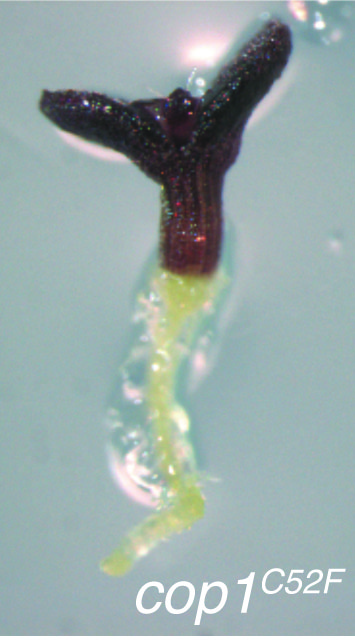
From our graveyard of unpublished but interesting results: an Arabidopsis cop1 mutant allele isolated in our lab carries a G to T base change that results in a C52F amino acid change. …
Yes, the COP1 RING finger is important for function! Read More