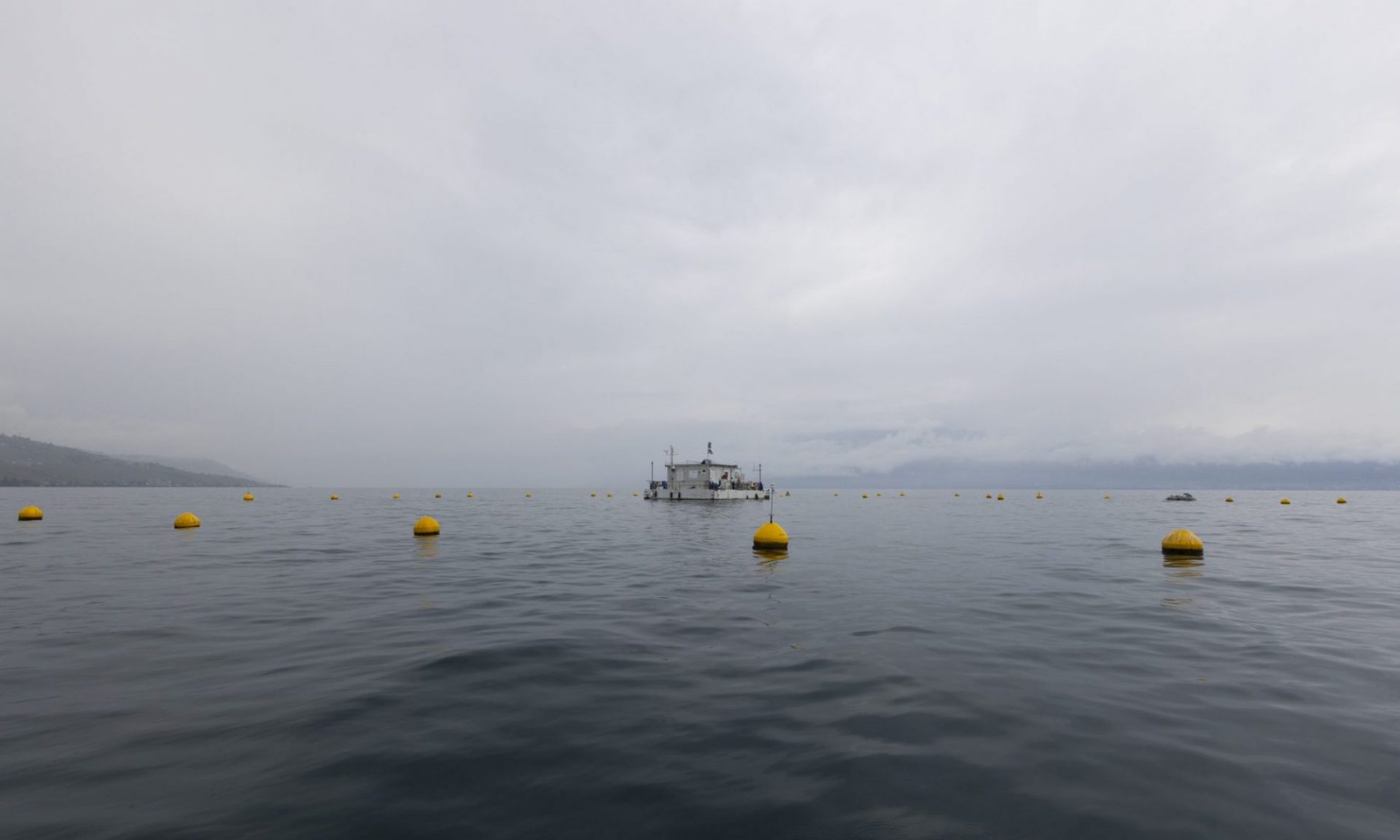
Lake Geneva : the one you see now is quite different from the one Forel saw

Thought large lakes could not endure regime shifts? Our latest study by Rosalie Bruel used long-sediment cores to show that the luxuriant macrophytes forests described by Forel were lost just before the long-term monitoring program started. The lake we have monitored since then is an alternate stable state away from the one Forel was observing. The previous state was quite stable to 3°C changes in annual ambient atmospheric temperatures, the new state is, in contrary, quite sensitive. The legacy of past eutrophication is an hyper-sensibility to climate changes.

https://link.springer.com/article/10.1007/s10933-021-00176-y

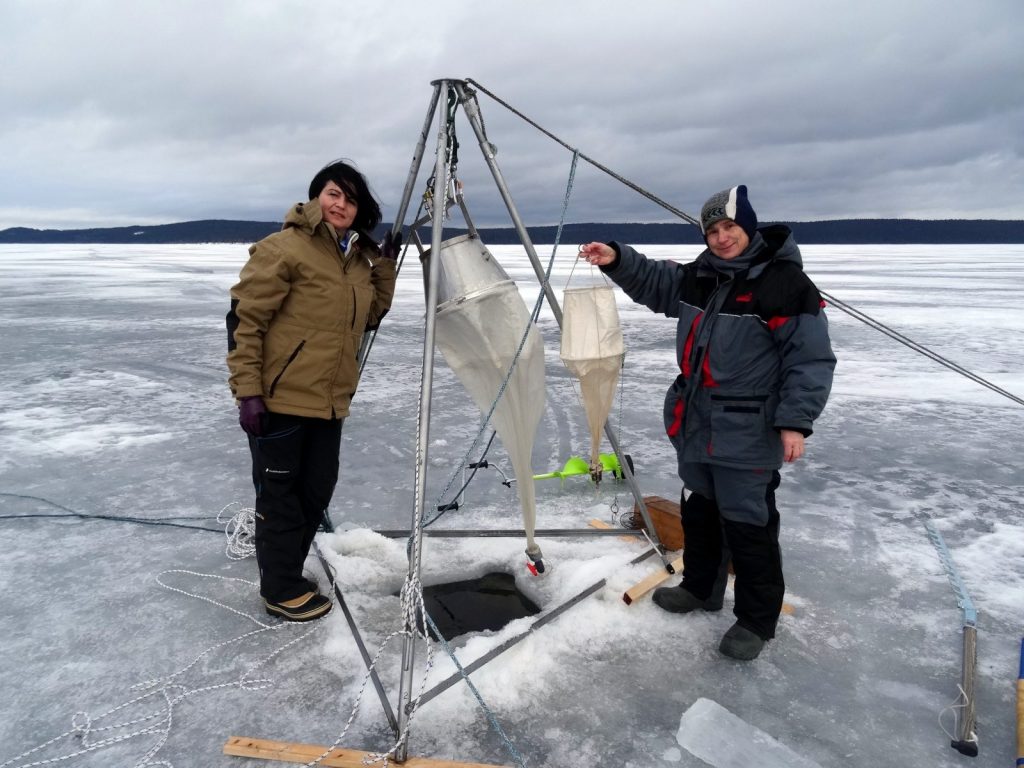
Do food webs persist under lake ice?

Don’t be mistaken. Things are not so quiet underneath the ice of frozen lakes… Some zooplankton species can persist under lake ice, but how do they cope with the extremely limiting food resources? Do they actually feed, but on what? Do they keep activity at minimal rate, to survive only from exhausting their fat stored during the previous good season? in which case, persistance of active species would not be equivalent to the persistance of an active food web under the ice…

Some answers in our paper soon to be published in Freshwater Biology: Fasting or feeding: a planktonic food web under lake ice.

New publication : delimiting the epilimnion depth is not that easy

Epilimnion is the surface layer of a lake typically characterised as well-mixed and is decoupled from the “metalimnion” due to a rapid change in density. The depth of this layer is used to understand air-water exchanges and the vertical distribution of biological variables. The concept seems easy, and is one of the first notions you get taught when starting your limnology class. And yet, placing the limits of the epilimnion is not that easy. Check this new paper lead by Harriet Wilson! the product of a collaboration with CEH, initiated by a master’s thesis, years ago…

Wilson, H. L., Ayala, A. I., Jones, I. D., Rolston, A., Pierson, D., de Eyto, E., Grossart, H.-P., Perga, M.-E., Woolway, R. I., and Jennings, E.: (in print) Variability in epilimnion depth estimations in lakes, Hydrol. Earth Syst. Sci. Discuss., https://doi.org/10.5194/hess-2020-222.