Ever wondered what kind of tiny animals are found in Lake Geneva? And, what importance they hold in the bigger picture of the lake ecosystem? – Let’s explore the world of zooplankton in Lake Geneva through this blog article.
Deep lakes like Lake Geneva release methane, a powerful greenhouse gas, and our new study shows that swirling currents inside the lake help spread it around. Using underwater sensors and simulations that track how water moves, we found that methane coming in from the Rhône River gets caught up in these currents and carried well beyond where it entered. The takeaway: to really understand how much methane a lake is emitting, you need to account for how water circulates inside it, not just where the gas is produced. A beautiful group work.
Khatun, S., Grilli, R., Rahaghi, A.I., Doda, T., Bouffard, D., Schubert, C.J., Chappellaz, J. and Perga, M.-E. (2026), Tracing the origins of metalimnetic methane in a stratified large lake: Insights from high-resolution mapping and three-dimensional hydrodynamic modeling. Limnol. Oceanogr. Lett, 11: e70158. https://doi.org/10.1002/lol2.70158
We’ve welcome Elsa, Angelina and Florian over the Spring.
Elsa joined us as an intern in her final year of a technical bachelor’s, and became the new princess of the Zooscan within the GEN-Z project. Florian (PAT) and Angelina (Msc) both came to work on the QUAGGA-MUFFIN project.
2026 is shaping up to be Isabel’s consecration year! First PhD paper now published!
Mountain lakes are usually qualified as “sentinels of climate change”. Ironically, however, for these so-called sentinels, the effects of climate warming on water temperature, the most direct and fundamental limnological variable, are poorly documented and may be less pronounced than what their exposure and sensitivity might initially suggest.
mt180 6
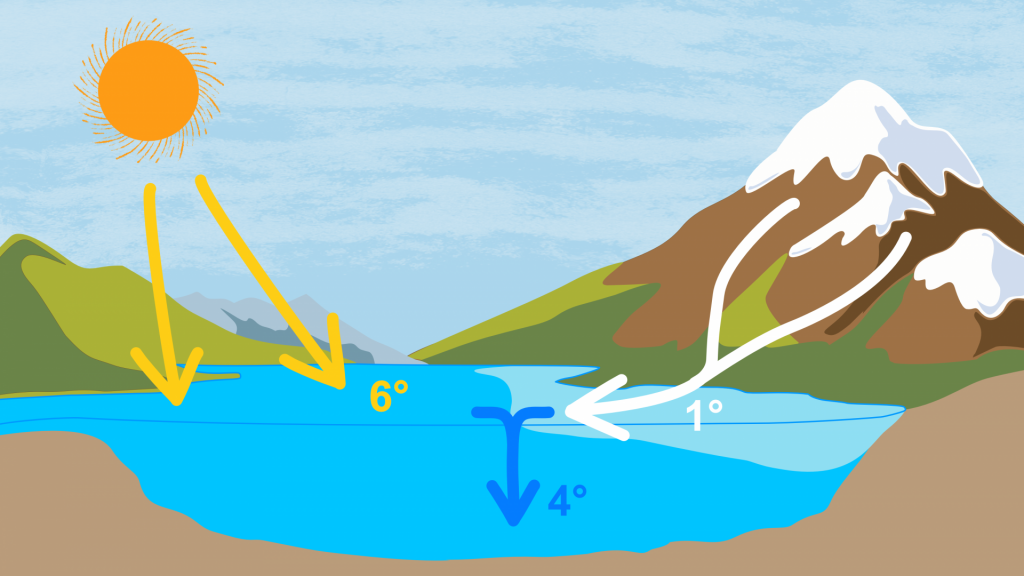
In “Decoupling Air and Water: How Throughflow Shapes Alpine Lake Temperatures.” , Isabel shows that cold meltwater flowing into mountain lakes during snowmelt can carry away much of the heat they receive, keeping them cooler than expected. In Lake Lioson that she used as a pilot site, up to 40% of incoming heat was lost this way, with snow conditions strongly affecting how and when the lake warms. Snowpack therefore plays a major role in controlling lake temperatures under climate change.
Herr, I. E., Bouffard, D., & Perga, M. E. (2026). Decoupling Air and Water: How Throughflow Shapes Alpine Lake Temperatures. Inland Waters, 1–36. https://doi.org/10.1080/20442041.2026.2634018
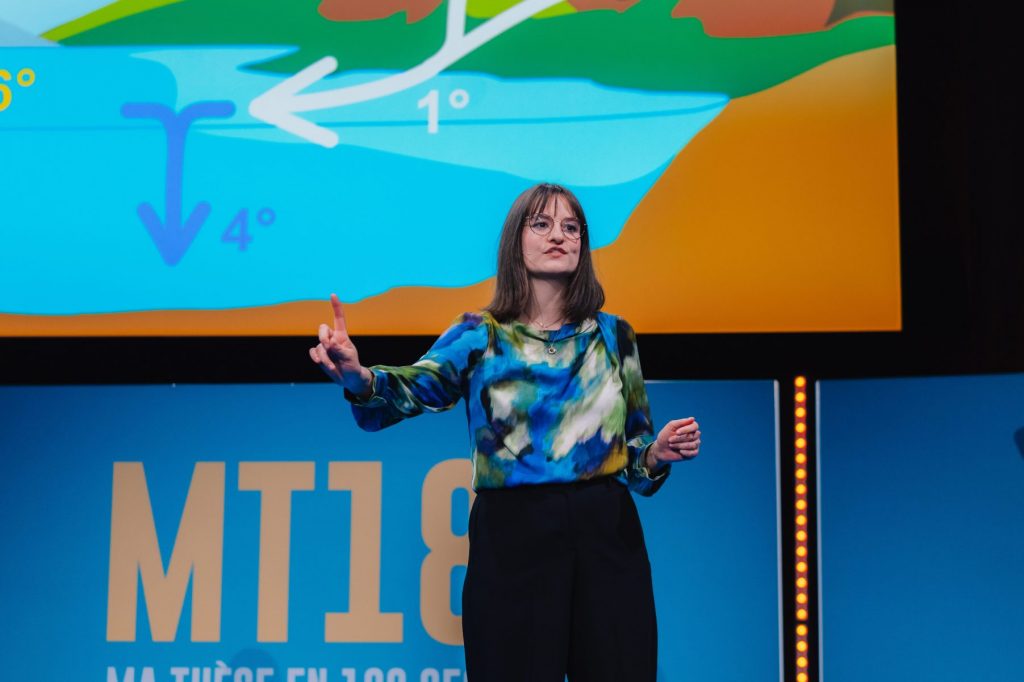
On March 26, Isabel competed for the UNIL Prize for MT 180. As she wrote “I have always been interested in the communication aspect of research and believe it is an essential tool in a researcher’s toolbelt. MT180 takes this principle to its extreme: three minutes, one slide. Every word must earn its place. “
What a show-woman! A brilliant performance (a top 5!) in front of an audience of 700 people “which is not a small feat for someone who gets nervous presenting at our weekly group meeting. The contest also offered a valuable opportunity to discover the diversity of research across disciplines and, perhaps most importantly, to connect with students from other faculties. The atmosphere was supportive, and the process deeply rewarding. “