Conferencing is an integral part of academic life, but it also comes with significant gender and social inequalities. and a major carbon footprint.
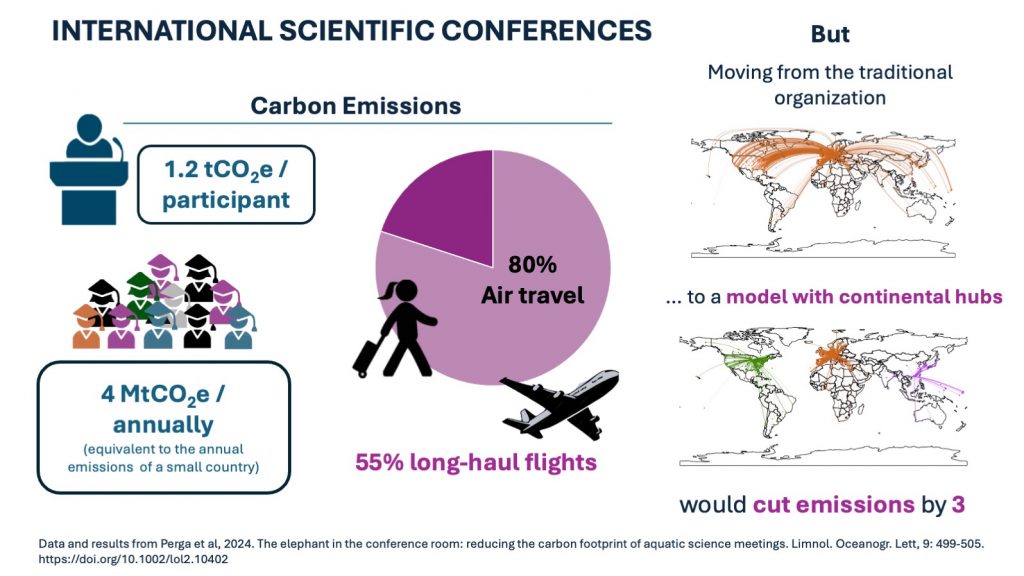
While the unsustainability of conferencing remains a scientific taboo, multi-hubbing* is a demonstrated solution by which we can preserve conferencing activities for a fraction of their current footprint.
*The principle of multi-hub conferences implies that meetings take place in several locations at the same time. Attendees go to their closest hub. Face-to-face interactions are maintained within hubs, while hubs are connected by virtual links.
But this is on paper. To succeed with multi-hubbing, there are pressing logistical issues to solve. Yet, we want to work on solving them as well. For that purpose, we were thinking of organizing a dry-run, taking the opportunity of the ASLO-SIL joint meeting to conduct an experiment at a very small scale.
Targetting those who were not planning to attend the ASLO-SIL joint meeting in Montreal 2026, we are seeking volunteers. We have a project to establish a 100-person European Hub, with reciprocal connections to the mother ship in Montreal. We view this experiment as a proof-of-concept and a learning ground for future conferences.
As of today, here is the status of volunteers.
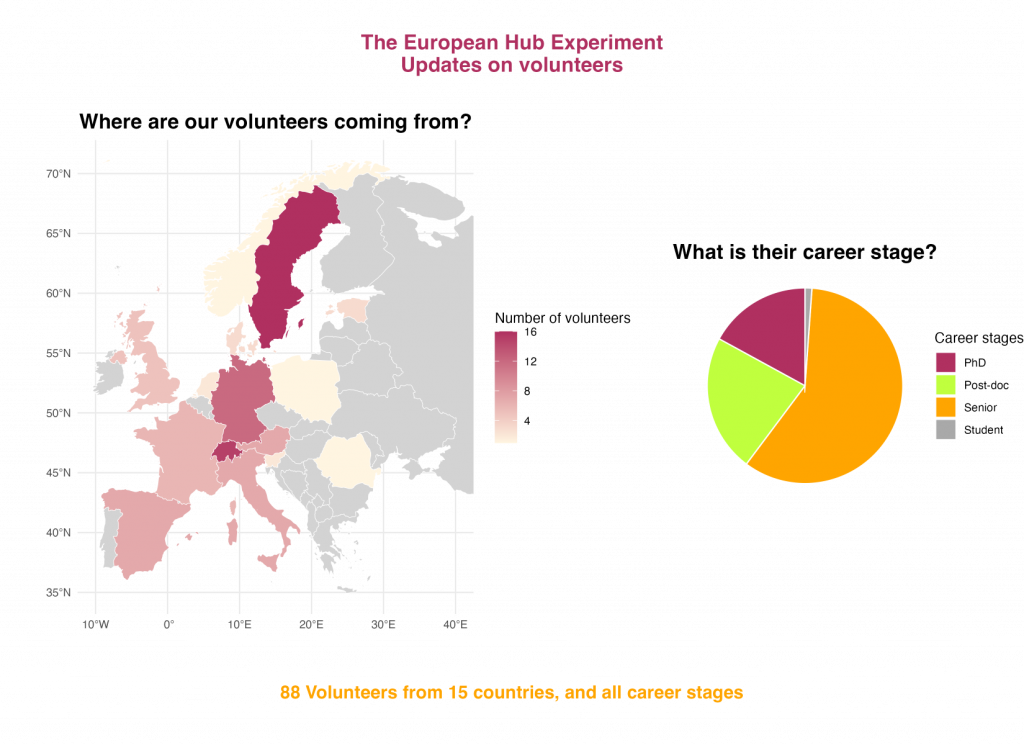
We are now trying to build a case to the organizing boards of the ASLO-SIL meeting in Montreal, defending that we have enough volunteers, that the experiment is not a competing venue and how our communities could benefit from it.
In no particular order:
Emma Kritzberg, Lund University, Sweden,
Damien Bouffard, EAWAG, Switzerland,
Thorsten Dittmar, University of Oldenburg, Germany
Marie-Elodie Perga, University of Lausanne, Switzerland