Do we communicate in a way that may generate pro-environmental behaviors?
As more scientists are actively communicating research findings in climate change science and newsrooms are eager to report on such findings, there is an ideal opportunity to reach the public, especially those for whom news media remain highly trusted sources of information. But does the current approach to such communication achieve its goals of engaging, educating, and mobilizing audiences?
We showed that current approaches for deciding what science is covered in the media portray only a narrow slice of climate change research and aren’t well suited for stoking climate action.
The editorial choices of high-profile multidisciplinary journals largely dictate what news readers hear about climate change research. Remarkable initiatives taking hold in journalism that name and aim to overcome limitations of traditional media models for climate coverage are encouraging signs of progress.
Perga, M.-E., Pessina, L.-A., Lane, S., Butera, F. 2024. From Newsworthiness to News Usefulness in Climate Change Research. Eos, 105, https://doi.org/10.1029/2024EOS240051.
Perga, M.-E., O. Sarrasin, J. Steinberger, S. N. Lane, and F. Butera. 2023. The climate change research that makes the front page: Is it fit to engage societal action? Global Environmental Change 80: 102675.
The elephant in the conference room
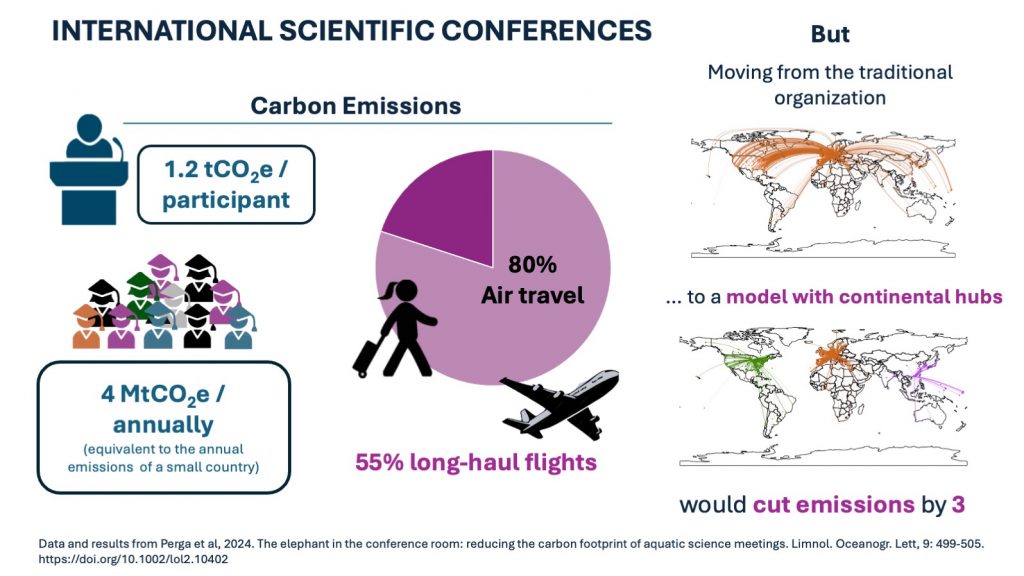
The unsustainability of conferences, whose carbon footprint is mostly made of air travel, has remained an academic taboo, even more so that virtual conferences, despite being carbon-efficient, have revealed their limitations. This concern bears an even greater significance for the Association for the Sciences of Limnology and Oceanography (ASLO), considering its emphasis on climate change-related issues. This essay seeks to raise awareness and stimulate action within the ASLO community, building upon well-established scientific approaches. We perform an estimation of the travel-related CO2 emissions of the aquatic science meetings (2004–2023), further used as a benchmark to explore alternatives to significantly reduce emissions while retaining physical attendance. Taking the leap toward such alternatives would make ASLO a role model of a genuinely sustainable and committed scientific society.
Perga, M.-E., T. Dittmar, D. Bouffard, and E. Kritzberg. The elephant in the conference room: reducing the carbon footprint of aquatic science meetings. Limnology and Oceanography Letters n/a. doi:https://doi.org/10.1002/lol2.10402