Are QUAGGA MUssels Filter-FeedINg on Zooplankton?
a SNSF-funded project (2026-)
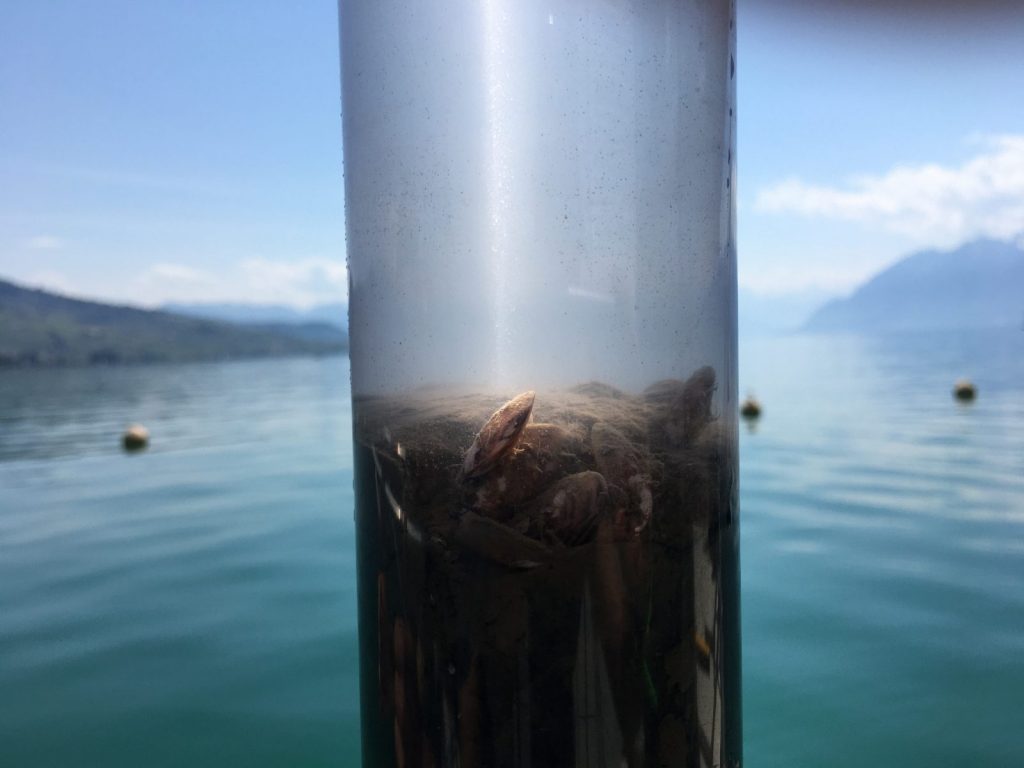
After decades and billions of CHF invested to control and decrease the phosphorous concentrations of Swiss lakes, some stakeholders now fear a “blue desert” effect, i.e., a phosphorous limitation of the zooplankton production, with further repercussions on fish stocks and fisheries. If crustacean zooplankton has recently plummeted in some lakes, we argue that the decline, such as the one observed in Lake Geneva, is inconsistent with a phosphorus, bottom-up limitation. We hypothesise that (i) the new invaders, the quagga mussels, are the culprit, and (ii) due to the deep morphology of Swiss lakes, the quagga’s impact on zooplankton is through direct predation rather than competition. We aim to test this hypothesis through a threefold research plan. (1) Competition for food implies that herbivorous zooplankton and mussels have similar trophic positions, while in the direct predation scenario, the trophic position of mussels should exceed that of zooplankton.
Demonstrating that zooplankton represents a significant share of the quagga mussels’ diet, and that direct quagga’s predation is a substantial factor of the zooplankton demographics, would first have repercussions for the local management. Second, positive results would invite us to revisit the conceptual model of quagga mussels ‘ re-engineering of the food webs of large lakes invaded worldwide.