The Economics Student Who Loved Theatre and Ended Up as the Leader of Tamil Nadu: C. N. Annadurai and his book Panathottam (1946)
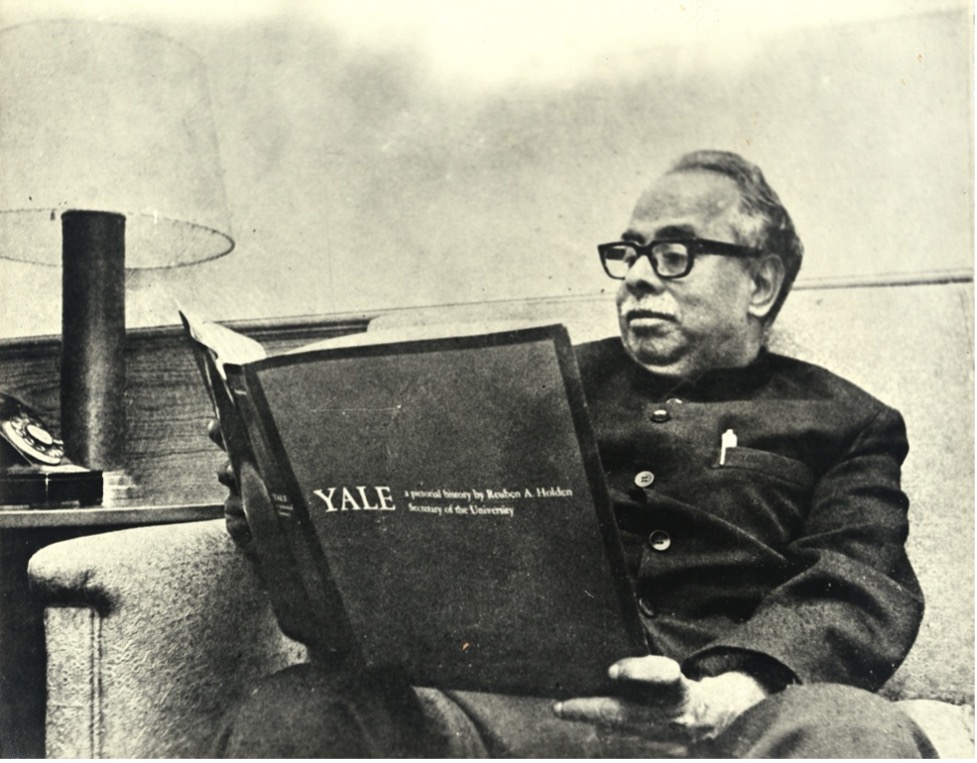
In my previous article, I discussed Joseph Cornelius Kumarappa, the economic thinker of Tamil Country, who conceptualized Gandhian Economic Thought and dedicated himself to rural development and agricultural reformations. In this article, I would like to introduce a contemporary of his, who engaged with Gandhism but stayed with Thanthai Periyar (who was a staunch critic of Gandhi): Conjeevaram Natarajan Annadurai. He was a promising college student, who ended up becoming the Chief Minister of Tamil Nadu. Except for the present government, Tamil Nadu, the rebel state of India, was ruled by either the party started by him (DMK) or the party which was named after him (AIADMK) after the fall of the Congress regime.
Early Life and Theatre
C. N. Annadurai, or Anna, was born on September 15, 1909, in Kanchipuram to a weaver’s family. He pursued his schooling in Pachaiyappan School (Kanchipuram) and later pursued his B.A. (Honours) from Pachaiyappan College. He also completed his M.A. in Economics and Politics. He was drawn into the Justice Party (a party which countered the dominance of Brahmin communities, particularly in education and employment spheres). Though he propounded anticolonial ideas within the Justice Party, his ideological placement against colonialism and Brahminism was key to change Justice Party into Dravidar Kazhagam.
Not just Anna, but from the early days of the Dravidian Movement till today, art, particularly street theatre and cinema, played a major role in Tamil Nadu politics. Anna was passionate about street theatre performances since his childhood. Anna stood as an icon of Tamil theatre writing. He wrote Chandramohan, or Sivaji Kanda Hindu Rajiiyam (‘The Hindu kingdom viewed by Sivaji’), as well as acted as the antagonist in that play. It was in this play that the Tamil actor V. C. Ganesan became ‘Sivaji’ Ganesan. V. C. Ganesan was the first Indian actor to be received as Chevalier of the Ordre des Arts et des Lettres by the French Ministry of Culture.
Arignar Anna, Trade Unions, and Communists
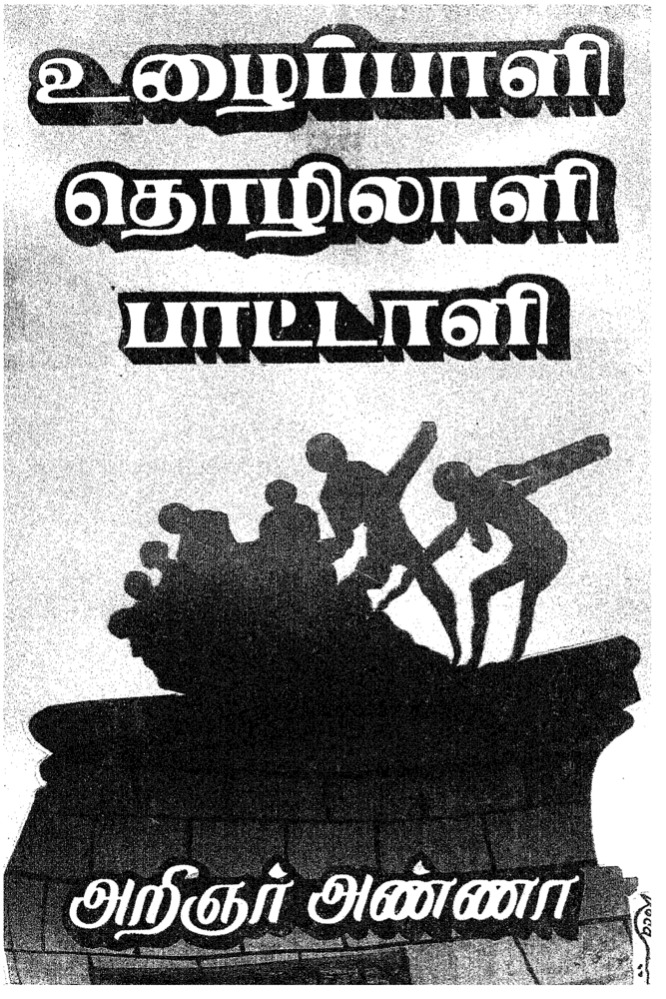
Cover of Uzhaippali, Thozhilali, Pattali (1999)
Anna engaged with trade union activities in his early days (this is discussed in Annadurai, 1999). He was nominated as an executive committee member in the All India Trade Union Congress at the Letchumanapuri Congress. He considered that industrial growth and workers’ rights are intertwined. He wrote: “Industries will grow as much as we protect the rights and welfare of the workers.”[1] Anna mentioned the contradictions between him and Periyar, within Dravidar Kazhagam, on the question of supporting Railway Workers Strike. Periyar was against the idea of supporting the strike, but Anna wanted to support the strike (Annadurai, 1999, pp. 70–71).
As an ardent reader, he was able to bring the elements of various thinkers and outline the socioeconomic future of South India, particularly for Tamil Nadu. He emphasized the importance of worker’s rights, capital investments, financial autonomy, and democratization of Union institutions. The edited volume also contains an essay on capitalism, where Anna asked to impose more tax on capitalists, and to ‘break the spine of capitalism’ (Annadurai, 1999, pp. 52–53).
Panathottam (1946) and North–South Economic Tensions in India
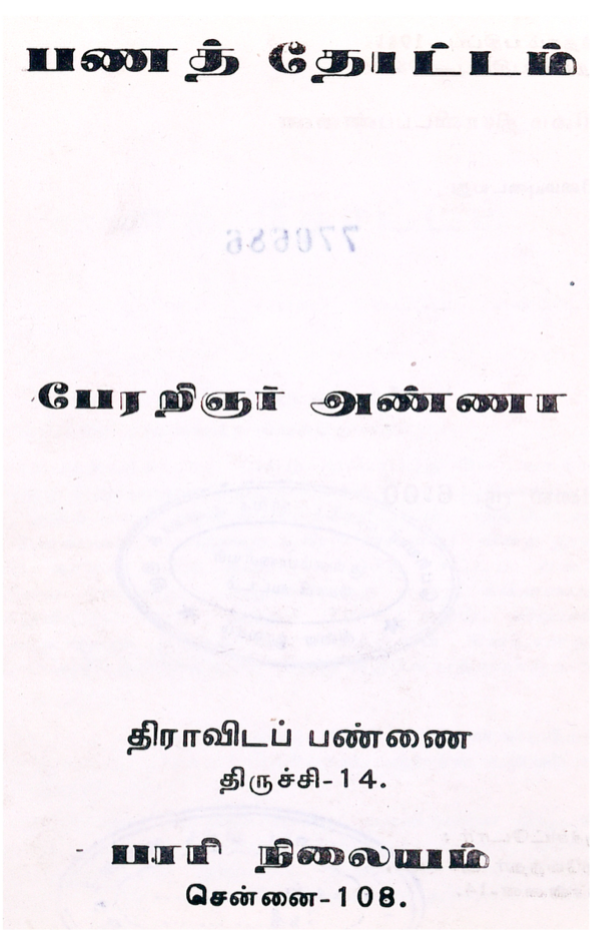
Cover of Panathottam (1985)
Panathottam (in English, ‘Garden of Money’) was written by Anna in 1946 (just a year before Indian independence), in the context of the economic situation of the then Madras Presidency. In the first chapter, he argues that the growth of banks is intertwined with the growth of the country. He points out that Northern India (particularly Banias) used banks as instruments to maintain the North–South divide. Indian Constitution defines India as ‘a Union of States’, whereas today states are deprived of fiscal autonomy in India. Against this backdrop, we should juxtapose this fine work. Anna argues that as India is a single country, a ‘Karamchand’ (metaphorically denotes a North Indian businessman) can start a business on the land of ‘Karuppannan Chettiyar’ (metaphorically denotes a South Indian businessman) because of this provision – India as a single country –, whereas he questioned the possibility of a person from the South to pursue trade and commerce in the North. Particularly, during the time of war, Anna points out how numerous banks appeared and how the money of Southern people was taken away.
Anna argued that the contradiction in the cloth production models followed by Bombay and Chennai (along with Travancore, Cochin, and Mysore), come primarily from the financial investments – which, in his opinion, became the source of Northern economic dominance (Annadurai, 1946/1985, pp. 17–22). He also pointed out the importance of state ownership by saying, ‘capitalism must be abolished but not the mills!’ (Annadurai, 1946/1985, p. 27).
‘Imperialism’ is a highly charged term in this context. Considering the role of institutions and upper hand of North in such institutions in India, what Anna wanted to point out is the unequal parasitic relations between entities within the same country. He clearly pointed out the contradiction between the business owners from North who settled in Dravidian homeland, growing at the expense of the Dravidian wealth, and creating nearly impossible conditions for Tamil counterparts who start business in the North to achieve similar progress.
Financial Autonomy in India Today
India, at present, still faces the same financial divide. The lack of financial autonomy results in underfunding states such as Tamil Nadu. Releasing funds for emergency situations (disasters like floods and landslides), education, and railways have been terribly affected by this North–South divide. The refusal of the Union Government of India to release education funds to the state of Tamil Nadu, largely on political grounds, reflects the problems that Anna had already identified in his time. State fiscal autonomy must be part of the core, driving future Indian economic growth.
Note: All translations are by the author.
Athmanathan Indrajith is a Swiss Government Excellence Scholarships PhD student at the University of Lausanne, and a member of the Walras Pareto Centre for the history of economic and political thought. He is working on the economics of J.M.Keynes and J.C.Kumarappa from a postcolonial perspective.
References
Ahmed, S., & Fathima, A. (2025). Tamil Nadu Budget 2025 Slams Fund Cuts by Union Government, Calls It Injustice. The News Minute, March 14.
Annadurai, C. N. (1985). Panathottam (6th ed.). Dravidap Pannai. (Original work published 1946).
Annadurai, C. N. (1999). Uzhaippaali, Thozhilaali, Paattaali. Manivasagar Pathippagam.
Jeyaraj, D. B. S. (2001). A Doyen Among Actors. Frontline, August 4.
Source of Photography
Arignar Anna Reading. (2008). Saraswati Mahal Library, Thanjavur.
Footnote
- Noted in K. Kulothungan’s article on 31-07-1974 in Uzhaippali magazine. This was provided in the edited volume of Annadurai’s selected writings on workers and Communists (Annadurai, 1999).↩
To cite this blog post : Athmanathan Indrajith, « The Economics Student Who Loved Theatre and Ended Up as the Leader of Tamil Nadu: C. N. Annadurai and his book Panathottam (1946) », Blog of the Centre Walras Pareto, October 5, 2025, https://wp.unil.ch/cwp-blog/2026/10/annadurai-and-his-book-panathottam/.