Original text published on https://wp.unil.ch/hecoutreach/fr/lia-comme-outil-de-developpement-des-competences-humaines/
The article shows how artificial intelligence is becoming an innovative tool for developing fundamental human skills such as empathy, communication, and leadership. Through virtual reality and behavioral analysis, AI makes it possible to assess and train these skills at scale, in realistic and high-pressure situations. Paradoxically, technology thereby helps strengthen what makes us most human.
Can artificial intelligence help us become better leaders, communicators, and collaborators? While AI is often seen as a threat to human jobs, Marianne Schmid Mast, Professor and Dean of HEC Lausanne, explores a different perspective: using AI to assess and improve our most essential interpersonal skills.
Discover how cutting-edge research is transforming AI into an unexpected tool for human development, in the article published in English in Edge magazine by the Institute of Leadership, winter 2024 edition, translated into French below.
Your new AI coach
Marianne Schmid Mast explains how artificial intelligence can be a powerful ally for assessing and developing key interpersonal skills.
In the era of artificial intelligence (AI), intrinsically human skills such as empathy, collaboration, leadership, and communication remain irreplaceable, and these interpersonal skills are only growing in importance in a volatile, uncertain, complex, and ambiguous world. Interpersonal skills refer to the ability to adopt behaviors that foster effective communication and to build positive relationships with others. The OECD Learning Framework 2030 emphasizes that interpersonal skills, or “soft skills,” are essential for meeting the future challenges of the world of work. In the age of AI, relational skills are becoming the new hard skills. If interpersonal skills make the difference in the workplace, companies will increasingly focus on these skills during the hiring process and will need to turn to validated assessment tools to measure them during recruitment. To remain competitive, companies will also have to invest more in developing these skills among their existing workforce.
How to assess interpersonal skills.
The best way to measure interpersonal skills is to place people in challenging social situations that require them to demonstrate and apply the skills in question. For example, a job candidate might be asked to dismiss a colleague, while a panel of observers watches and evaluates how effective the candidate was and whether they also showed empathy toward the colleague. Alternatively, a candidate might be asked to prepare a motivational speech to encourage underperforming team members, in order to assess their communication skills. These “work samples” are highly effective at predicting future candidate performance. Unfortunately, they are also costly to conduct, as they require actors to play the role of the colleague and trained panel members.
How can AI help?
Technology and AI can help do this, and at scale. Virtual reality can be used to simulate human colleagues, allowing candidates to be placed in various scenarios, for example, dismissing a virtual employee who reacts aggressively and must be managed, or giving a motivational speech or public presentation in front of an audience. This interaction can be recorded and then analyzed by a trained algorithm. The algorithm can then extract verbal and non-verbal behaviors from the video and correlate them with workplace performance data. If enough data is available, AI can learn to detect the relevant behavior in the video and predict the performance of new candidates. This makes it possible to quickly screen the interpersonal skills of large numbers of candidates. The challenge, however, is that the simulation scenario cannot be modified, and training the algorithm requires a large volume of data. In addition, the quality of the performance measure matters, and for leadership positions it is not always fully objective, since it is often based on the satisfaction of employees and colleagues.
Interpersonal skills training
Interpersonal skills can be learned and developed through training. Companies invest significant sums in training their staff, particularly in leadership and communication skills. Training in interpersonal skills generally involves showing trainees a model that perfectly demonstrates the desired outcome. For instance, trainees might watch a video of a Barack Obama speech during a public speaking training session. They can then practice and receive feedback to refine their skills. New technologies can help: trainees can be immersed in virtual reality and deliver speeches before a virtual audience, experiencing the same level of stress as if they were in a room filled with real people. Here again, the process is scalable (many people can train with the same virtual audience simply by putting on a VR headset. Training can be further enhanced by introducing additional stress factors. For example, imagine someone practicing a public speech while standing on a plank above a precipice. The fear of heights adds a layer of stress that must be mastered during training, making a subsequent speech in front of a real audience) without any fear of falling (feel like child’s play. It is also possible to collect feedback through automatic detection of verbal and non-verbal behaviors in a public-speaking scenario, and relay it to the trainee. For example, when an eye tracker detects that the speaker is not looking at the audience, the simulation can be programmed to let the virtual audience fall asleep) a clear signal to the presenter that something is wrong. While new technologies and AI can replace certain aspects of human work, they also offer the opportunity to enhance and refine intrinsically human skills such as interpersonal communication and leadership. By leveraging AI for training and development, we can strengthen the very capabilities that set humans apart from machines.
In this sense, technology can help us become more human! Marianne Schmid Mast is Full Professor of Organizational Behavior at the University of Lausanne and Dean of HEC Lausanne Business School. A former member of the Swiss National Research Council, she has also served as President of the Swiss Psychological Society. In 2018, 2019, and 2020, she was named one of the 50 most influential living psychologists.
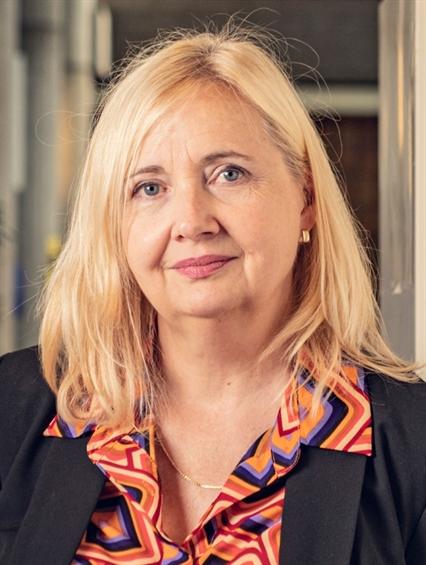
Marianne Schmid Mast is Professor of Organizational Behavior and Dean of HEC Lausanne. Her research, which notably uses virtual reality, focuses on interpersonal communication, leadership, and hierarchical dynamics.
Faculty of Business and Economics