
In a polarised world with geopolitical tensions, economic uncertainty and fast-paced technological change, the leaders we choose, and the decisions we make matter, whether we’re consumers, employees or citizens. Understanding human behaviour is central to this. This series looks at academic research leading the way, trying to unravel the issues.
The mechanisms and power of charisma
In times of instability and crisis, charismatic leaders emerge. Charisma involves signalling. It is symbolic, value-based and emotionally driven. To some extent, charisma can be taught allowing chief executives, civil society and political leaders to strengthen their ability to inspire their audiences. Leaders use verbal rhetorical tactics such as storytelling, metaphors, rhetorical questions and contrasts. They can express their moral conviction and the sentiment of the collective and set ambitious goals with confidence that they will be achieved. Non-verbal cues include eye contact, hand gestures or an animated voice.
Charisma is contagious, influencing people to rally around a vision and motivating others to act. Their personal aura can be a powerful motivator. Charismatic leaders can even boost the local economy, as shown by research among U.S. governors.1
“When you have a leader signalling charisma, it makes you identify with their cause. It also motivates you to work harder. You tend to trust that person more. If your leader puts effort into explain complex concepts to you using a compelling metaphor, then you also want to reciprocate and work harder,” explains PhD student Tiffany Kreutschy at HEC Lausanne. What Tiffany and other researchers have shown is that charisma can be experimentally manipulated, isolating its effects cleanly2.
The effect of extrinsic and intrinsic motivation
Traditional economic incentives typically rely on extrinsic motivation, such as money. For instance, employees may receive a fixed wage or pay-for-performance, where work is paid according to the amount produced. Then there is intrinsic motivation: it arises when people do a task because they enjoy it. A motivational speech by a charismatic leader can stimulate intrinsic motivation.
If people are given the option to do hard work or take shortcuts, the researchers found that a charismatic speech increases performance for the “hard” work but only when combined with a fixed wage. When paired with pay-for-performance, people still opted for the shortcut.
But why ?
What the experiment shows
In Tiffany’s experiment, participants were asked to count the number of 1s in tables composed of 1s and 0s. They could choose between easy tables (i.e., shortcut) or harder ones that were twice longer. Participants were offered a fixed wage, or a piece rate per correctly completed table. By completing the tables, they also generate money for charity.
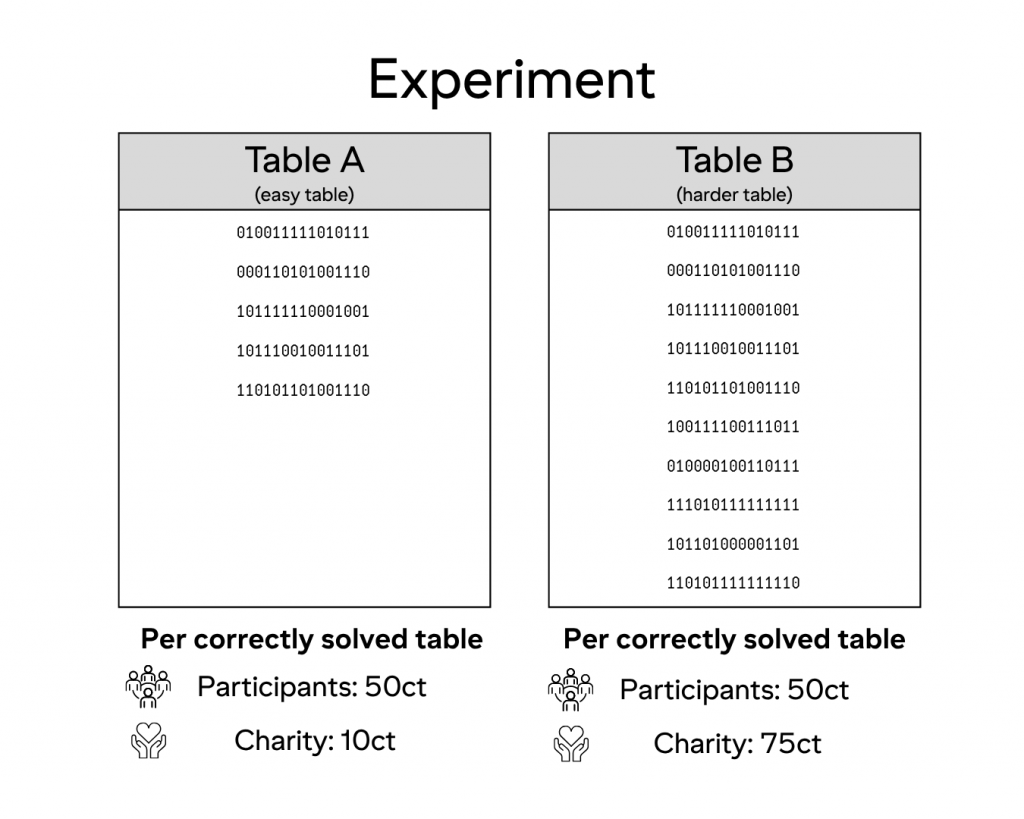
While their own pay for each correctly solved table stayed the same (50ct), the amount offered by the organizers for the charity was 7.5 times higher if they chose a hard table (75ct for a hard table versus 10ct for an easy one).
The researchers observed a trade-off between : 1. generating more for the charity by choosing the hard tables, or 2. more for oneself by choosing the easy tables, as they are shorter, less demanding but generates much less for the charity. Participants were also randomly assigned to either watch a charismatic or a standard speech.
“Employees want to do the right thing for their leaders, leading them to take on more demanding tasks. Intrinsic motivation makes the work more rewarding, benefiting both individuals and the charity, but this effect disappears under pay-for-performance. Such settings encourage individuals to think in terms of personal efficiency: seeking to maximise their gains for minimal effort, even when a charismatic leader tries to mobilise them. This highlights the strength of the well-known corrupting effects of incentives.” Kreutschy explains.
The role of charisma
“Basically there is often a misalignment between what bosses want and what workers want: for example, if employees want to maximise their remuneration for the least amount of effort, while bosses want them to work hard to contribute to the company’s goals. The challenge is therefore to align the interests of both, and charisma can help with that in specific settings.”
Reference:
1. The Impact of Governor Charisma on State-Level Outcomes, Academy of Management Proceedings, T. Kreutschy, C. Zehnder and J. Antonakis, 2024
2. Charismatic Leadership: An Antidote to the Pitfalls of Incentives?, Academy of Management Proceedings, 2025, T. Kreutschy, C. Zehnder and J. Antonakis, 17 Jun 2025.