
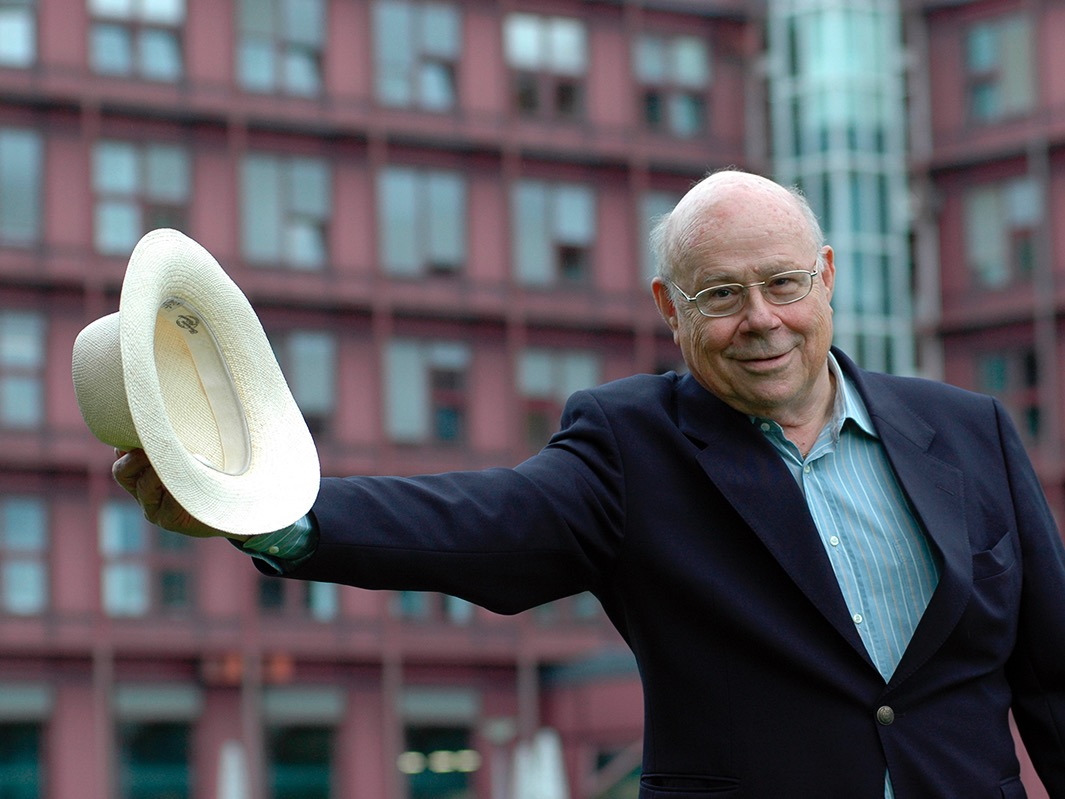
It is with deep sadness that our Faculty has learnt of the passing of our colleague and dear friend, Prof. Jean-Bernard Racine, on 23 March 2026. He will forever remain a leading figure at the Institute of Geography at the University of Lausanne.
Biography of Jean-Bernard Racine
You can pay your tribute below.
7 responses
-
J’ai rencontré J-B à la fin des années ’90, pour réaliser avec lui un court-métrage (collection Alice des TV publiques européennes) et ça a donné “Lausanne: géographie sentimentale” ( 26 min, SSR-RSI, 2000). Il m’avait intriguée en me disant que Lausanne est une ville méditerranéenne! Il a ouvert un monde/vision et depuis, à chaque film ou repérage, dans un coin de mon cerveau ou de mon oeil ou mon oreille, J-B Racine est là.
Buon vento e riposa in pace
Alessandra Gavin-Müller -
Cette triste nouvelle me touche profondément parce qu’une partie de ma vie est liée de Jean-Bernard et de Lausanne. Même si, peut-être que certains s’attendait à ça, on espérait dans notre cœur que ce moment va retarder. Nous ne sommes pas immortels. Tout est cyclique et toute tourne ronde. Jean-Bernard a été une figure importante de la Géographie mondiale. On a eu de la chance de le connaitre, de travailler avec lui et de construire ensemble. Les larmes ne sont pas autre chose que des petites rivières qui font des hommages à un homme spécial. Malheureusement, la nature, la divinité a pris ce qu’elle a donné : l’âme.
La beauté d’un homme se voit dans tous les rayons du soleil de la vie. Jean-Bernard avait une âme d’enfant et un enthousiasme contagieux.
J’ai pensé il y a quelques semaines de venir en Suisse et lui faire une visite. Comme d’habitude, il est trop tard. Mes regrettes planent sur mes pensées et je reste avec ces regrettes…
Oh mon Dieu ! Un homme, un géographe qui voyait dans la religion une échappe, a compris très bien que notre monde est gouverné par l’esprit religieux. Finalement, son esprit finit par se dissoudre dans ce monde pour la faire meilleur.
Président de la Société Roumaine de Géographie, Université Alexandru Ioan Cuza de Iasi (Roumanie) -
To Jean-Bernard’s family.
I was so very sorry to learn of Jean Bernard’s passing. I knew he had been ill for some time, but the news was still upsetting.
I have known J-B for over twenty- five years because of our membership of the IGU Urban Commission. His papers at the various meetings were always excellent. In addition, I was always impressed by the help he gave to people from outside Europe at the meetings who often struggled to communicate in English. Of course, he also received a Festschrift, a book of essays from many of his colleagues, itself a mark of how well he was respected. Very few these days receive such praise. So I hope you have received many messages praising his scholarly expertise. In addition, of course, J-B was also known for his sense of humour which often provided us all with light relief from days of listening to so many papers at commission meetings. I have so many memories of his light-hearted approach. It was such a pleasure to have known him. He will be solely missed by so many people around the world. Please accept my commiserations at his passing.
Some examples of his humour and issues he faced at meetings…
One example of his humour was when I was invited to lecture in Lausanne. I had found a cheap flight to Geneva but it arrived in late evening. J-B told me he would book a room in a hotel there and then I could to catch train to his city in next morning. I took him up on his offer but was rather bemused when I arrived in the area around the hotel to find it full of scantily dressed, mainly young women who seemed friendly. Then I realised what the area was. J-B’s humour again. Anyway, I got back to him in part when I gave a lecture to a large room full of his students. I thanked J-B for the invitation and said he was kind enough to book me in a hotel in the Paquis area of Geneva before coming to Lausanne. Place erupted with laughter. I went on to say that I assumed Professor Racine wanted me to see, but not experience, a type of urban area, a legal red light district, that we don’t have in Canada. More laughter.Another of my favourites occurred at our meeting In Finland. At the end of the last day of paper sessions we were asked to attend a reception. J.B and 3 others of us arrived first at the large community hall where the reception was to take place. But the door to the main room was closed and JB, after some discussion with the door man, came and told us it was a Finnish tradition to go into the large adjacent sauna first. Reluctantly we went in. After all, we all knew saunas are big in Finnish culture. Once inside we started to wonder and worry if all the other commission members, even the females, would join us. Then J-B said he had forgotten something, went outside and came back with a camera of all things and started taking photographs of us…to our annoyance as we were obviously all naked. Anyway, we convinced him to stop in the end and dressed again and went outside and found that most of the other conference members were now in the main community hall guzzling on the free beer and wine. Had J-B misunderstood the doorman, or did he deliberately mislead us for a laugh? Soon we started to worry about what he would do with the photographs. Would they be part of his presentation to our next Conference? The next day he came back from a photographers shop very upset. None of his pictures from the sauna had come out properly. It seemed there was so much moisture in the sauna that all the pictures showed was our heads and shoulder above the hot mists of steam. We were saved ! Did he misunderstand the gatekeeper to the reception hall or did he con us into the sauna? He would never admit what happened. But from the smile on his face I believe he set us up for a laugh.
Another example was when he sent me an Email telling me that one of our older commission members was looking for somebody to share a room for a forthcoming Conference. AS I had not booked anything I accepted the invitation to share expenses. To my horror at the conference I found that the member shed his clothes as soon as he entered our room and wandered around naked most of the time. Annoying! More of a problem was the fact that one day I was in the shower and thought I was alone in our room. Then I suddenly felt somebody touching my back in several place. Luckily I had my back to the closed shower curtain. I shouted out about what was the person doing. I got a reply that he was searching for the soap that he had left in the shower container. Of course, J.B had known about the commission members preference for being naked and had a good laugh at me for falling for the shared room idea. To be fair my room expenses were lower than if I had been on my own and I did get a couple of free beers from J.B for the joke in convincing innocent me to share with that member. Never again!.
Sometimes of course he could be too impulsive. At a meeting in South Africa the local organiser took us to an area of expensive houses and pointed out the many, many security features outside the houses as examples of the need to protect their properties against the high crime rates. We also toured the back of the houses in what amounted to a little forest. At one stage J-B said he wanted to climb up a little hill from the path we were on to get a view of the back of the houses. He started off the path and was about to climb over a knee-high barbed wire fence when one of our group shouted it was not safe. Just before JB started to go over the fence, one of the group threw a small branch across the wire fence. Boom. There was a big flash. Clearly the fence was electrified, and J. B. would have been badly burned. Saved again. But a vivid experience of the extent of security around rich houses in S Africa.
Another of my social memories came from our Calgary meeting, at the end of our day-long excursion to the various sights in Banff National Park. We ended up in Lake Louise, one of the splendid sights in the Park. I gave the bus party an hour to look around the lake. When we all got back to the bus one person was missing. It was J-B. I suggested that several of our group should go and look for him. But I was convinced I would find him in the upmarket Lake Louise hotel lounge, which had a splendid view of the lake, and where he, a Frenchman, would be sipping on a glass of some favourite French wine. To my concern he was not there. Soon a couple of our members came around the lakeside-path. They had found J.B slouched on a bench. They got him back to then bus and after a few drinks of water and I think some aspirins he had recovered. So there was no need to find a Dr. But it was a good illustration of the problem that some people have of dealing with altitude. I had explained to the bus load previously that Lake Louise was at around 5,500 ft and there was a need to be careful and not to over-exert oneself. J-B’s experience provided a vivid example of what could have happened to other conference participants. This was not one of his jokes.
I accept these are silly memories. But life is not only about academic excellence. J-B was an ex exceptional man, one who also gave us a lot of social memories which lit up our days. Such a unique man……
Wayne Davies. Emeritus Professor, University of Calgary, Canada
-
I probably recall the same Urban Commission meetings as Niamh. Like her, I found that discussing the problems and prospects of cities and urban development with him was always hugely insightful and enjoyable. Although we didn’t have that many personal encounters, we will always remember this gentle man in the best sense of the word. He will never be forgotten. R.I.P.
-
I only met Jean-Bernard twice at Urban Commission meetings but he was incredibly warm, jolly and welcoming. His humanity was so evident and he wore his incredible intellectual capacity very lightly. His contributions were so significant in bridging Anglo and Francophone geography communities and traditions. A generous spirit, I hope that generosity is returned now to his family and that you feel the warmth and support of an international, intellectual community that has lost a gentle guide. Ar Dheis Dé go raibh a anam dílis [An Irish blessing that he may rest in peace].
-
J-B. You embody the place of Geography in our world today and your contributions will define not only the regions you touched but to the ends of the earth.
My prayers are with your family as well as our as Geographers that we will find meaning in this defining moment. -
Jean-Bernard (who we knew as J-B) was an exceptional scholar, a lively personality, a valued colleague and a dear friend. In addition to his immense academic contributions, he was a warm and very generous person.
We were fortunate to enjoy his company over many decades, notably through the activities of the IGU Urban Commission. We also visited J-B and his family in Lausanne, and they in turn have stayed with us in Toronto.
We will miss him, and our frequent telephone exchanges, but he will never be forgotten.
Larry and Paula Bourne
University of Toronto





Leave a Reply