Athens in the Alps
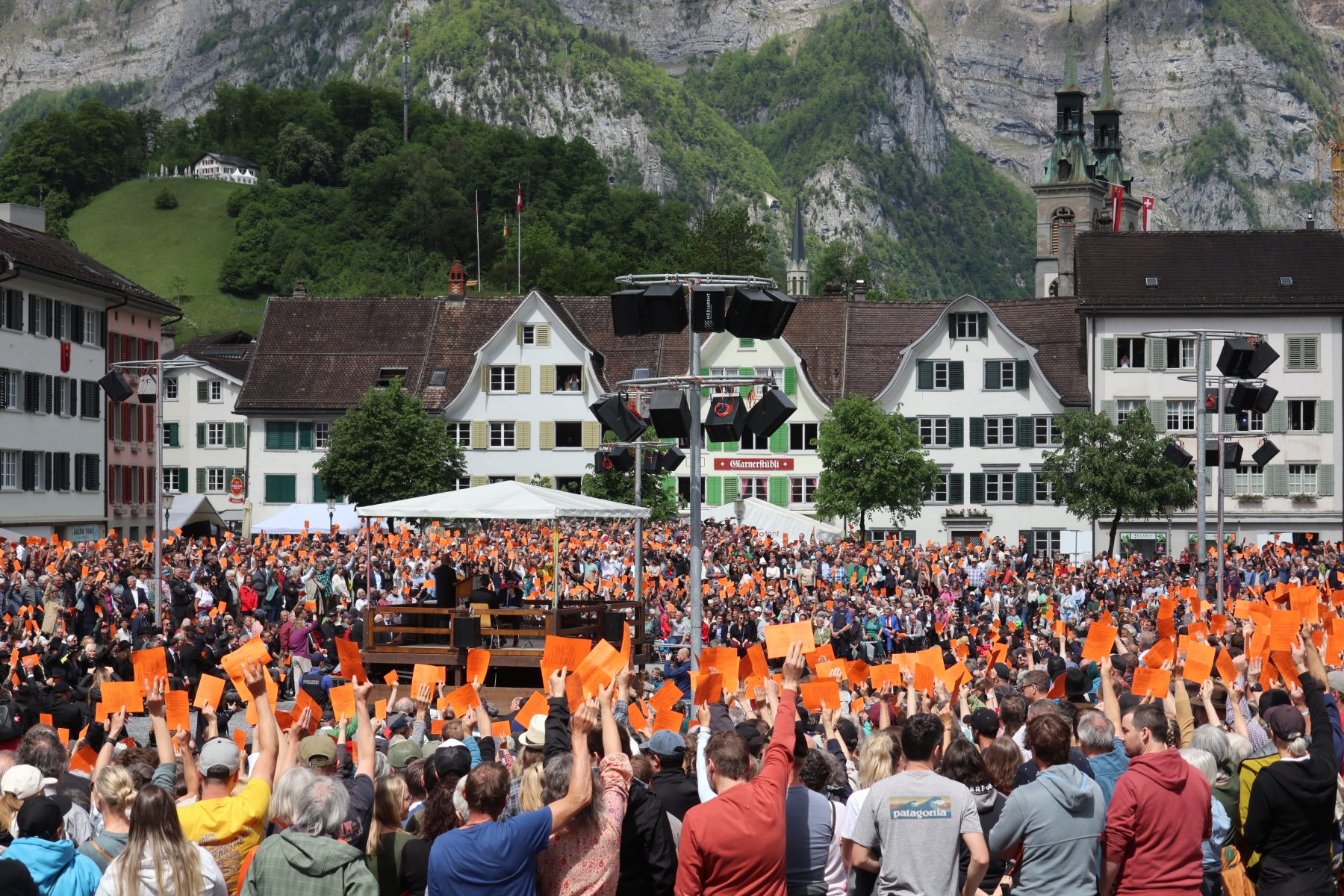
Meeting Direct Democracy at the Landsgemeinde of Glarus (4th May 2025/3rd May 2026)
As historians of political thought, we stretch our imagination to figure out from remote sources how direct democracy might have worked in, say, 508 b.c. Athens, or in the republics of early modern Europe. And yet, at a short train journey from Zürich, every first Sunday in May one can observe direct democracy in action at the Landsgemeinde – the popular assembly – of the Swiss canton of Glarus: the next one will take place on the 3rd of May 2026. On this occasion the citizens of the canton meet on the public square of its main town to elect the President and the other members of the local executive, and to debate on a series of issues concerning the laws and the administration of the canton. These may include changes to the constitution, the rate of imposition of the income tax paid to the canton, and any expense above 1 m. francs.
Today direct democracy as a distinctive feature of the Swiss political system is generally associated with popular consultations in the form of referenda or initiatives; it is these – local or national – votes that measure and orient the country’s main political choices. But until the adoption of the constitution of 1848, that after a sequence of upheavals finally gave Switzerland a central federal government, the secular practice of popular assemblies was still present in several small German speaking cantons at the heart of the country and remained in use afterwards in some places.
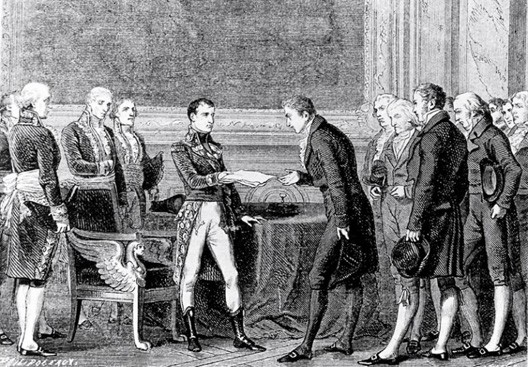
A vigorous attempt to suppress the practice had been made in 1803, during the negotiations over the treatise known as Acte de médiation. In 1798 the French revolutionary government of the Directory had included the Swiss Confederation in its policy of territorial conquest, occupying the country on the invitation of the local revolutionary “patriots”. However, the unified Helvetic Republic established under the French occupation had proved too conflictual and politically unstable. After four years of domestic unrest, the new ruler of France, the First Consul Napoleon Bonaparte, had finally resolved to leave the Swiss cantons free to revert to an independent confederation, on condition of their military neutrality. At the meetings of the Franco-Swiss Consulta at Saint-Cloud to discuss the treatise, both the First Consul’s French constitutional advisors, and the representatives of the powerful aristocratic cantons, had insisted on the suppression of the Landsgemeinden: too archaic, too time-consuming, too dangerously democratic.
But surprisingly Napoleon, invoking his own Corsican origins in a land of mountain dwellers, had rejected their arguments: such popular traditions – he argued – though old fashioned and cumbersome, represented the real identity of Switzerland: without it the country would be undistinguishable from any German or French province, and Europe would be deprived of the memory of its ancient democratic soul. Saved by the future emperor – like many in his generation a keen reader of the works of Jean-Jacques Rousseau – the Landsgemeinden were nevertheless abandoned by several cantons after 1848: in some cases (Schwytz and Zug) because the cantons were no longer deemed sovereign under the new federal constitution; in others (Appenzell AR, Obwald and Nidwald) more recently, in the late 1990s, for the same practical reasons of slowness and inefficiency that had been denounced in 1803.
In the 21st century only the two cantons of Appenzell Innerrhoden and Glarus maintain the institution of popular assemblies. At Glarus the number of participants range from an average 5.000, to 12.000 in the case of crucial or controversial issues; while women acquired the right to vote only in 1972, in 2007 the age for voting was lowered from eighteen to sixteen. In advance of the assembly citizens receive a document called Memorial (around 200 pages for the 4th May 2025), with the agenda of the meeting, and the details – implications and costs – of the different proposals. The assembly begins at 9.30 and should be over on time for the traditional lunch of grilled sausages, though discussions may take longer. The vote is by raise of hand: voters carry a bright-coloured card, making it easier to judge majorities at a glance. On this occasion exchanges were quite relaxed and good-natured – there were clearly no security concerns around the square – though in the past there have been more heated confrontations.
Some aspects of the procedure are obviously problematic. Citizens must be present in person, whatever the reasons that might prevent them from doing so; they must be prepared to stand for hours (not an easy exercise at all ages); the counting of votes remains approximate, and there is no legal procedure to contest it. Moreover, in the public assembly, all the advantages of secret voting, which protects voters from external pressures, are lost. Even the weather may affect deliberations: on the 4th of May 2025 the President invited speakers to make their interventions short, since a storm was expected by noon (luckily it arrived later, when the meeting was almost over); and yet holding the meeting indoors would deprive it of its symbolic significance.
There are undoubtedly some folkloric aspects in the Landsgemeinde, such as the parade before the assembly with a band, traditional costumes, and the members of government in tailcoats and top hats; or the oath to respect the constitution taken before the vote, with the three raised fingers to symbolize the three founding cantons of the Confederation. However, it would be a mistake to write off the occasion as some kind of popular festival. The Landsgemeinde has real power, at least locally; moreover, the people do not necessarily support, as one might expect, conservative views. In fact, the outcome of votes in the Landsgemeinde is more unpredictable than in any standard consultation, as voters can simply respond directly to the arguments of speakers, rather than following the indications of parties or of the media. To mention a few examples, over the last twenty years the assembly, beside lowering the age of voters, has decided a substantial administrative reform, reducing the number of communes from 25 to 3; it has rejected the interdiction of wearing burqas, later adopted at the federal level, and forbidden the use of oil and gas-fired boilers. The meeting of 2025 discussed the position of handicapped persons in the canton and introduced measures to improve their situation.
If the Landsgemeinde is a kind of historical monument, the monument appears very resilient, and talks back to those who come to observe it. In his 1970s book Why Switzerland? the late Jonathan Steinberg wrote that Switzerland was the only country were crisis were faced by expanding, rather than restricting, popular sovereignty. One can only hope that the future will confirm his prediction.
Biancamaria Fontana is Emeritus professor of History of political thought at the University of Lausanne, and a member of the Walras Pareto Centre for the history of economic and political thought.
Bibliographical references
Antoine Chollet, Défendre la démocratie directe, Lausanne, Presses Polytechniques, 2011.
Olivier Christin, Vox Populi, une histoire du vote avant le suffrage universel, Paris, Seuil, 2014.
John Dunn ed., Democracy, the Unfinished Journey, 508 b.c. to 1993 a.d., Cambridge, Cambridge University Press, 1992.
Biancamaria Fontana, La République helvétique, Lausanne, Presses Polytechniques, 2020.
Morgens Herman Hansen, « The Athenian Ecclesia and the Swiss Landsgemeinde », in The Athenian Ecclesia. A Collection of Articles, 1976-1983, Copenhagen, Museum Tusculanum Press, 1983.
Yannis Papadopoulos, Démocratie directe, Paris, Economica, 1998.
John R.Parkinson, Democracy and Public Space. The Physical Sites of Democratic Perfomance, Oxford, Oxford University Press, 2012.
Jonathan Steinberg, Why Switzerland?, Cambridge, Cambridge University Press, 1970.
To cite this blog post : Biancamaria Fontana, « Athens in the Alps », Blog of the Centre Walras Pareto, March 9, 2026, https://wp.unil.ch/cwp-blog/2026/03/athens-in-the-alps.