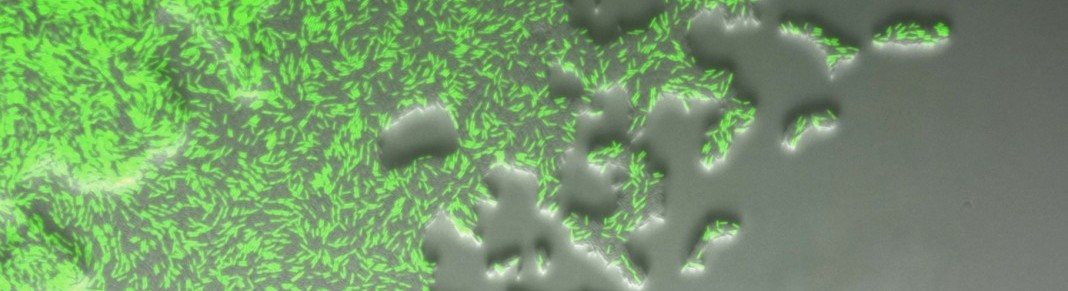
First up, Snorre Sulheim led a study probing the capacity of our 4-species synthetic community (species originally isolated from industrial fluids) to coexist on different minimal media in the lab. The answer: pretty much all of those we tested. We then explore all the different possible explanations we could think of and settle on metabolite cross-feeding as the main driver of this robust coexistence. A simple model shows that if species release enough different metabolites and others have different affinities for these metabolites and are somewhat specialized, it is not difficult to achieve such coexistence. It remains to be seen whether this will hold in other synthetic communities! Congratulations to all co-authors: Eric Ulrich, Alisson Gillon, Samuele Testa, Prajwal Padmanabha, and Miguel Teixeira and Daniel Machado our collaborators in Norway!
Second, Eric Ulrich published the main pre-print of his PhD! Our first venture into chemostat world. It turns out they are more complicated than I thought. We work through the theory and how to think about chemostats and then explore why two species from our 4-species SynCom (see above) again stubbornly coexist in a chemostat on a single carbon source. The answer is again cross-feeding, but this time, Eric shows how only micromolar concentrations of metabolites can be sufficient to support the coexistence of a species that would otherwise go extinct. Eric also shows that these metabolites don’t necessarily have to come from cross-feeding but can also be explained if the minimal medium contains trace contaminants, which we honestly expect to always be the case. Another important message from the paper: the effects that explain coexistence in chemostats are likely to be missed in batch culture competition experiments. So beware how you interpret those.