Tag: György Hetényi

  • A Journey to the center of the Earth with scientists from the University of Lausanne

    A Journey to the center of the Earth with scientists from the University of Lausanne

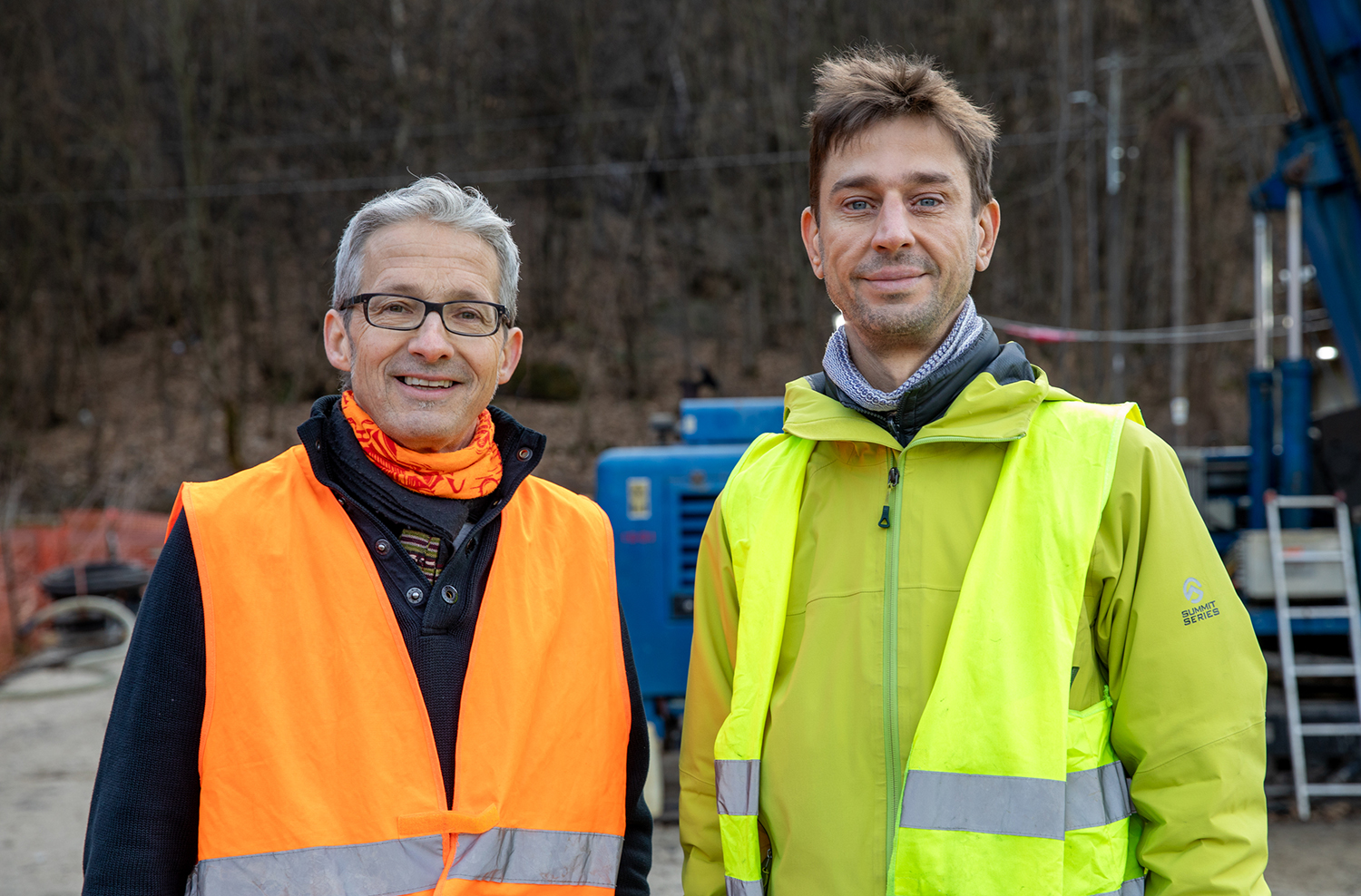
    Othmar Müntener and György Hetényi. (Fabrice Ducrest © UNIL)

    Experts from UNIL are co-directing a scientific drilling project almost a kilometer deep, aimed at reaching and documenting, for the first time, the base of the continental crust and the transition to the Earth’s mantle. This international project is taking place in Piedmont, Italy, in an area where usually deep-seated rocks are accessible thanks to a natural shortcut.

    What constitutes the interior of our planet? How was the Earth’s crust formed, and how deep can Life be found? For years, these fundamental questions have remained partly unanswered due to technical and financial obstacles. Despite several attempts, humans have never succeeded in continuously exploring the rocks beyond the Earth’s crust to reach the next layer: the mantle, usually some thirty kilometers below the surface.

    Scientists from the University of Lausanne’s Faculty of Geosciences and Environment are coordinating an international project that could change the game. Project DIVE (for Drilling the Ivrea-Verbano zonE) carries out scientific drilling in the geological area in the Alps known as Ivrea-Verbano (Piedmont, Italy), the uniqueness of which should make it possible, as a world first, to cross the crust and reach the Earth’s upper mantle.

    A region with virtually unique features in the world

    “Since around 35 million years ago, the African (Adria) and European continental plates have been moving towards each other. When they collided, in this segment Adria stayed above Europe, contributing to the formation of the Alps,” explains György Hetényi, professor at UNIL and co-leader of the project. “This phenomenon, accompanied by surface erosion, brought up rocks that were usually at depths of tens of kilometers. In this way, over some fifty kilometers on the surface, the Alps form a “shortcut” to the Earth’s mantle  which is then practically within reach.   Another particular feature of this region is that the continental crust is exceptionally well preserved and intact, with little fragmentation.

    In the village of Megolo di Mezzo, a borehole (the second in the DIVE project) was therefore initiated in November 2023 and will be completed in April 2024. From a current depth of 870 metres, the hole is expected to reach almost one kilometer, and will document the beginning of the transition between the continental crust and the mantle. In the field, specialists are already analyzing the cores extracted by the drillers, using two scientific containers, one dedicated to geological studies, the other to biology and gas analysis (such as hydrogen and other rare gases). A team of microbiologists is investigating whether there are organisms capable of surviving in extreme pressure conditions at depth.

    The precious cores will then be transferred to the various universities, depending on their area of expertise. “At the University of Lausanne, we are studying in particular the chemistry and isotopic composition of rocks, as well as their thermal and seismic properties,” explains Othmar Müntener, professor at the UNIL, initiator and co-leader of the project. “These analyses will give us unprecedented information about the formation and composition of the Earth’s crust.”

    The bulk of the work remains to be done, but the first results, notably from the first borehole – which reached a depth of 578 m – are starting to come out, and they are already bringing some surprises.  “There is more sulphur, carbon, fractures and above all a surprising spatial variability compared to what we expected in the lower crust”, observes György Hetényi. “We are also discovering the presence of minerals in unexpected amounts, such as graphite.”

    The next step is to complete this second borehole and continue the scientific analyses. A third borehole is planned, dedicated to analyzing and fully crossing the entire crust–mantle transition.

    DIVE Project

    DIVE project on the ICDP website

    DIVE is an international project funded by the International Continental Scientific Drilling Program (ICDP), which brings together multidisciplinary teams from seven countries and some twenty universities. Initiated by the University of Lausanne, this program aims to carry out scientific drilling to penetrate the lower continental crust, reach the upper mantle, and analyze the deep rocks of our planet. It is divided into two main phases. The first is currently underway with two boreholes, and the second is in preparation for a third borehole in a few years. The analyses carried out on these hitherto not studied rocks cover various fields such as geophysics, geochemistry, geodynamics, petrology, rheology (the way rocks deform) and microbiology.

  • Reaching the  Earth’s mantle: a dive into the depths of its continents

    Reaching the  Earth’s mantle: a dive into the depths of its continents

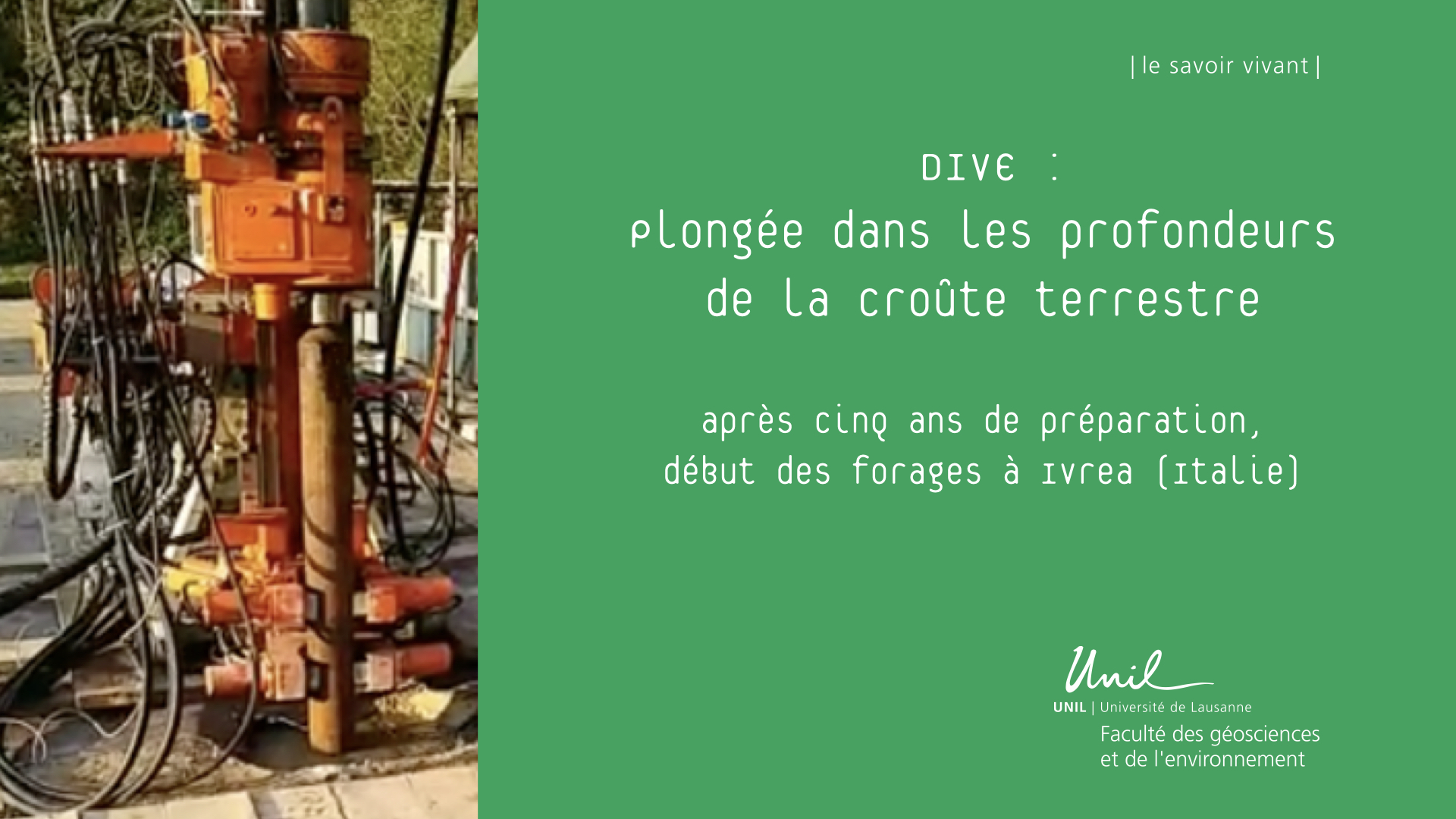
    The continental crust makes up 41% of the Earth’s surface. Because of its thickness, its deepest areas remain unknown, although they play a fundamental role in the global cycles occurring between the Earth’s surface and the mantle. The DIVE project ims to unveil the secrets of these transition processes. How?  Thanks to two boreholes of about 1 km deep in the region of thegeological zone known as Ivrea-Verbano (Piedmont, Italy).  After five years of preparation, UNIL scientists are finally on the ground.

    György Hetényi et Othmar Müntener (professeurs à l’Institut des sciences de la Terre) nous font partager leur enthousiasme pour ce projet.

    Reaching for the mantle: a project that is more than sixty years old

    The project to reach and cross the transition from the Earth’s crust to the upper mantle dates back more than 60 years. At the time, only indirect measurements gave a glimpse of  the physico-chemical properties of the rocks that compose it. But attempts  to gain access to the  deep  crust itself, by drilling  at  the bottom of the ocean or in  the USSR, proved unsuccessful. The technical constraints and costs generated in relation to the expected results then slowed down initiatives to renew such attempts.  

    What makes planet Earth unique? Together with water and life, it is plate tectonics.

    DIVE project

    In 2008, Luigi Burlini, a geologist at the ETHZ, discussed an original idea with Othmar Müntener. It is a question of using the Alps as a “shortcut” to the mantle. In the region of Ivrea-Verbano, the Earth’s mantle is at hand: it is about 3 km deep, following the alpine folding. It was the observation of high-density rocks and the rapid movement of seismic waves that revealed this singular situation covering an area about 70 km long (known as the Ivrea Geophysical Body).

    Cross-section through the Ivrea Geophysical Body, according to knowledge in 2017. This diagram shows the wavevelocities estimated in two ways: in black the velocities derived from seismic refraction and density anomalies of the Berckhemer model in 1968; in orange the iso-velocities of the P waves interpolated from the tomography of local earthquakes by Diehl et al. (2009) . This analysis reveals that the shaded area is indeed the mantle that the DIVE project aims to achieve.

    This original idea was taken up again to be concretized in 2017 during a workshop bringing together more than 45 researchers in Baveno on the shores of Lake Majeur in Italy, by setting up the DIVE project (Drilling the Ivrea-Verbano zonE). Supported by the International Continental Scientific Drilling Program (ICDP), DIVE is undertaking several scientific drillings in the Ivrea-Verbano area. His goal? Identify the physico-chemical properties of the crust-mantle transition, and better understand the processes that govern the formation and evolution of the lower continental crust. 

    What does the bottom of the continental crust look like? And how deep can we find life within the crust?

    DIVE project

    DIVE is conducted by an international and multidisciplinary research group, covering the fields of geophysics, geochemistry, geodynamics, and petrology and rheology. Microbiologists are also involved: they are trying to find out how deep life can be found in the Earth’s crust.

    Other members of the FGSE (ISTE) are also involved in this project: Klaus Holliger (professor), Alexia Secrétan, Kim Lemke, Zheng Luo (PhD students), Ludovic Baron (geophysical research engineer). Aurore Toussaint, Julien Reynes and Benjamin Klein, as well as researchers from the Universities of Bern, Mainz, Trieste, Pavia, Leoben, Grenoble, Georgia, and GFZ Berlin are also part of the scientific team taking turns on the site.

    This type of project cannot be done alone or in pairs, because to have all the necessary skills, as well as the associated technology, you really need this interdisciplinary collaboration.

    György Hetényi

    György Hetényi will focus on the transition gradient between the mantle and the lower crust: what is its thickness and what are its physical and chemical properties?

    Othmar Müntener will be involved in petrological research and more specifically in the identification of the nature of the rocks that form at the interface between the mantle and the Earth’s crust.

    From 2017 to 2022, numerous preliminary studies combining different geophysical methods were carried out, in particular to determine the location of boreholes. The proximity of the mantle to a depth of about 1 km below sea level at the surface was thus confirmed and modeled in 3 dimensions by Matteo Scarponi during his PhD at ISTE, The relief shape represents the mantle surface that “rises” towards the surface of the Earth’s crust according to the results of Matteo Scarponi, Printed at a scale of 1:1 million. Researchers from GFZ Potsdam and Montanuniversität Leoben are currently refining this image via higher resolution active seismic studies.

    The big day: the first drilling and extraction of the first rocks

    After more than five years of preparation, drilling finally began on October 6, 2022 in Ornavasso in the Osso l a. At first, the pace is slow. The team ensures the verticality of the drill and does not damage the first layers of soft soil. Subsequently, the speed should be increased to about 1 meter per hour – or 15 to 20 meters s per day ideally. So far, thefirst steps have been encouraging. The extracted carrots are exploitable at more than 95%, a very high yield!

    The cores are directly photographed and scanned to identify the rocks that compose them and evaluate the progress of the drilling. They will then be sawn in half in the long direction. One half will be used for chemical and physical analysis and the other half will be archived in Germany. Above is some of the first cores taken, photographed and listed (photo credit: Luca Ziberna, DIVE project).

    The borehole will have another advantage. Fine logging instruments can be placed there. They will measure the electrical, thermal and seismic properties of the terrain at a depth rarely reached, and will make a video recording along the hole. This device, associated with a continuum of several hundred meters of cores through the deep crust, constitute a unique dataset to date.

    The organization of this work is complex and interactions are continuous with the field. A team of 6 to 7 people remains permanently on site to monitor the drilling, analyze the extracted cores, list them on a digital interface or collect fragments for microbiologists. Questions or unforeseen events arise regularly, whether at technical level (purchase or adaptation of equipment) or scientific level (identification of minerals and structures). You have to be very responsive because drilling must be able to continue quickly.

    The drilling activities arouse the curiosity of the inhabitants and visitors of the site. Here is part of the leaflet that describes the project and its objectives, for the inhabitants and visitors of the region of Ivre a-Verbano. Public visits will also be carried out on site.

    Everyone at the drilling site was super happy…. When you see the rocks coming out, it is the direct result of these 5 years of investment. It’s really satisfying.

    Othmar Müntener

    A gratifying first step … who prepares the second

    The results of the research carried out in the coming years on the material obtained will determine the organization and timing of the second phase of the project, namely a 3-4 km borehole in search of the Moho (the transition between the crust and the mantle).

    From a scientific point of view, we are quite sure that we will have surprises either during the drilling or the analyses that will follow.

    György Hetényi & Othmar Müntener