Original text published on https://wp.unil.ch/geoblog/2024/03/combler-le-manque-de-donnees-pour-pouvoir-developper-des-modeles-fiables/
Understanding environmental change is a challenge when data are missing or incomplete. At UNIL, researcher Grégoire Mariéthoz develops hybrid approaches that combine stochastic models, physics, and artificial intelligence to reconstruct phenomena such as snow cover. By integrating satellite imagery, meteorological data, and algorithms, he is able to model complex realities with unprecedented accuracy—a crucial issue in the context of climate change.
Although there is currently a surge of digital data from multiple sensor systems, these are not always sufficient to study certain parameters or specific areas (due to limited sensor coverage, very localized measurements, rare events, etc.). Grégoire Mariéthoz and his team are developing statistical methods designed to fill these gaps and optimize the information that can be extracted from the available data.
Proceed step by step to fill in the gaps.
These methods are particularly valuable for studying processes at small temporal or geographical scales. Such approaches are crucial, given that the most severe climatic phenomena usually occur in very localized areas and can cause significant damage—such as tornadoes, severe storms, or flash floods. These events are currently difficult to predict and tend to become more frequent with climate change. The challenge faced by Grégoire Mariéthoz is to identify coherent patterns from highly fragmented data and processes that are sometimes random in nature.
To achieve this, he develops tools that can infer the value of a parameter located near a direct measurement, drawing on physical laws and various statistical methods. By proceeding step by step in this way, he can fill in the missing intervals between two measurements and obtain complete datasets. Using this approach, Grégoire Mariéthoz has been able to model rainfall histories, reconstruct truncated images, and recreate the historical record of snow cover in the Alps (see box).
The use of AI is growing, but it does not replace all models.
Although AI and its algorithms have existed for a long time, Grégoire Mariéthoz sees their development accelerating now, thanks in particular to the massive availability of exploitable data, the densification of various sensors (satellites, radars, webcams), and the open-source release of these datasets. The increasing performance of computers also plays a role. AI thus provides useful tools (such as ChatGPT or image generators), but it does not address every situation and cannot generate new knowledge. According to him, an AI-based model is not necessarily superior to another: ‘If the goal is to model a specific event or phenomenon, classical models can often be implemented by taking process knowledge into account. On the other hand, when a large amount of data is available, it may become worthwhile to integrate AI and dedicate time to collecting the necessary data and training the computer. This trade-off in time investment is one of the key criteria for deciding when to use AI.’
Determine the evolution of the snow cover over time using current satellite images.
Grégoire Mariéthoz and his colleagues aim to model the evolution of snow cover in Switzerland, particularly because it serves as a reliable indicator of temperature and climate variations and can strongly impact local hydrology during melting. The amount of snow covering a given area can be observed either directly, through ground measurements and weather stations, or indirectly via satellite imagery. These images can sometimes be difficult to interpret: shaded areas may be mistaken for snow-free regions due to their darker appearance (although some current satellites provide more reliable data, notably through infrared radiation measurements), or cloud cover can obstruct the view of the ground. In addition, the frequency of image acquisition is irregular (every 3 to 5 days), which provides an imperfect representation of a phenomenon that can change from day to day.
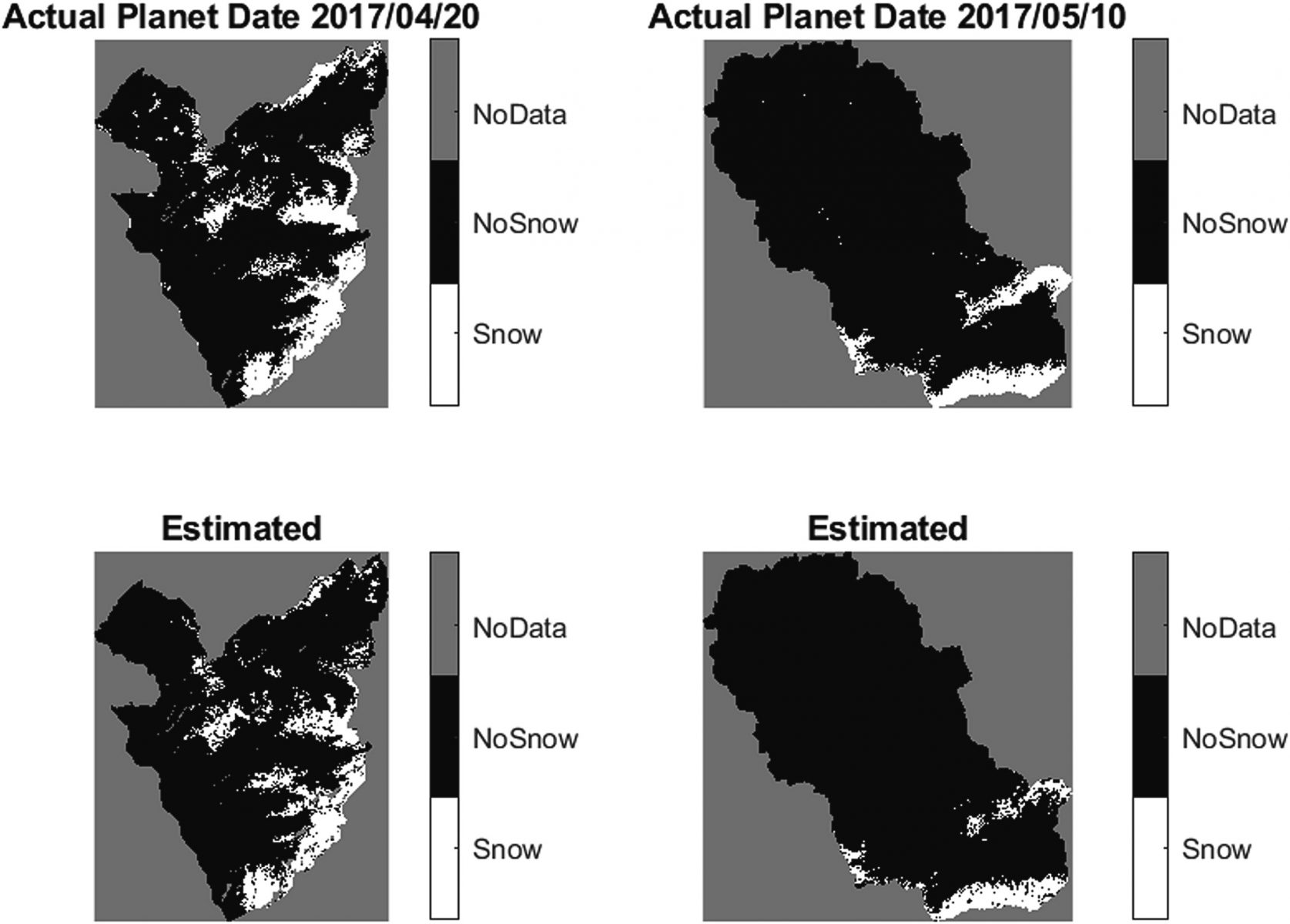
To address this issue, Grégoire Mariéthoz relied on the principle that snow cover evolution follows consistent patterns from year to year under similar weather conditions. He developed algorithms that train computers to link measured ground temperatures and precipitation to snow cover observed in satellite images that can be unambiguously interpreted (also incorporating other geomorphological parameters such as topography and aspect). By using climate data from different periods, he was able to create ‘synthetic’ satellite images of snow cover for the regions studied. The projections were validated both by comparison with on-site measurements and with images captured by another satellite. In all cases, the synthetic images predict snow cover distribution more accurately than traditional models, which rely solely on the physical processes of snow melt.
To go further
Stochastic model: A stochastic model is a mathematical model that accounts for the uncertainty or randomness of certain parameters under study. Unlike deterministic models, which produce identical results for given initial conditions, stochastic models incorporate elements of chance into their formulations. These models are often used to represent phenomena influenced by random variables or stochastic processes.
In a stochastic model, outcomes are not predetermined but are instead characterized by probability distributions. This allows for a more accurate representation of real-world phenomena that may be subject to unpredictable variations or random fluctuations. Stochastic models are commonly used in various fields, such as finance, meteorology, particle physics, and other areas where uncertainty and chance play a significant role.
Professor Grégoire Mariéthoz is interested in various environmental processes related to hydrology and climate.
Faculty of Geosciences and Environment
Algorithms in Computer Science, River Dynamics, Climatology