Original text plublished on: https://wp.unil.ch/geoblog/2024/03/modeliser-la-physique-atmospherique-prevoir-la-formation-de-cyclones-tropicaux-et-predire-le-climat-futur/
Climate models must handle vast amounts of data and complex atmospheric processes. Climate physicist at UNIL, Tom Beucler incorporates neural networks into his simulations to reduce computational cost while increasing their precision. Guided by the laws of physics, his hybrid models — at the intersection of AI and meteorology — enable better forecasting of extreme events such as tropical cyclones.By combining scientific rigor, computational power, and ethical reflection, this approach opens a new era for climate research.
To improve models thanks to neural networks while respecting laws of physic
The atmosphere obeys physical laws that can be formulated as equations. Atmospheric complexity stems from the vast array of interacting variables and scales. In seeking to model this complexity, Tom Beucler soon confronts the limitations of computational resources. By incorporating neural networks, he reduces the computational burden while enabling the integration of heterogeneous data sources — such as high-resolution simulations, meteorological radar, and satellite imagery. This approach enhances and streamlines the representation of intricate processes, making atmospheric models more efficient and accessible.
Tom Beucler notes that calculations based solely on data and algorithms can sometimes produce results that violate physical laws — for instance, he has obtained outputs that failed to satisfy the conservation of mass and energy. To prevent such inconsistencies, he incorporates physical knowledge into his AI models through physics-guided machine learning, where AI systems operate on data within a framework constrained by physical principles, thereby avoiding incoherent outcomes.
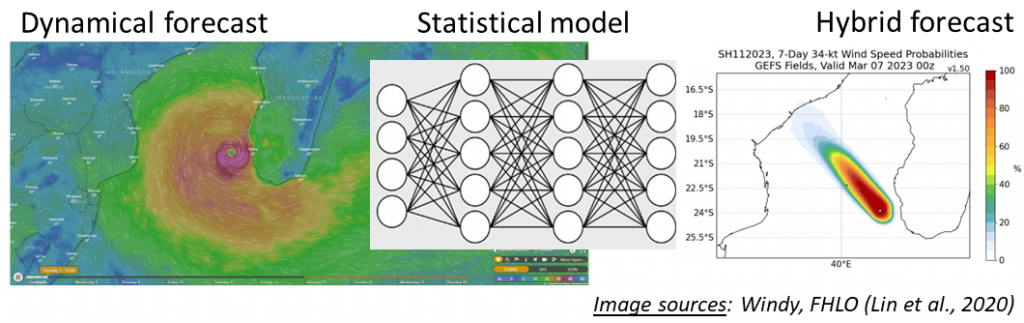
Using statistical modeling tools, Tom Beucler and his team have already achieved improvements in simulating the formation and evolution of tropical cyclones. Whereas conventional models tend to generate a high number of false positives — forecasting cyclones that do not materialize — data-consistent models retain correct predictions while substantially lowering the rate of false detections.
To respect ethical and scientific rules is essential in AI application
According to Tom Beucler : ” The use of AI can lead to a reversal of the scientific process ” (See the box). However, he warns against a potential biased use of machine learning when it isn’t governed by ethical and scientific laws. Even within meteorological research, biases can emerge: affluent regions typically benefit from a far greater concentration of data sensors compared to under-resourced areas. When it comes to forecasting cyclone formation, this disparity leads to significantly more accurate predictions near the U.S. coastline than in regions such as the northern Indian Ocean.
AI: a (r)evolution in research?
Tom Beucler describes a shift from a bottom-up to a top-down scientific approach. Traditionally, research begins with a theory, whose hypotheses are tested by collecting field data — the type of data gathered is determined by the research objective (a bottom-up approach, from hypotheses to data). With AI, all relevant data are processed and analyzed to reveal patterns or interactions between different parameters (a top-down approach, from data to hypotheses). Beucler notes: “This opens the door to discovering new interactions or equations, provided the data used are well-controlled — relevant and unbiased — and the results can be constrained within a coherent theoretical framework.”
Professor Tom Beucler is a climate physicist. He incorporates artificial intelligence into his research to improve atmospheric modelling, weather and climate forecasting, particularly in relation to extreme events.
Faculty of Geosciences and Environment