
The Expert Group on Artificial Intelligence at the University of Lausanne carried out, from November 29 to December 13, 2024, a survey among the university community to better understand AI uses, perceptions, and expectations.
The results of this study, based on responses from 1,827 members of UNIL, will help guide the future institutional strategy on artificial intelligence.
→ Download the full report (PDF)
Widespread adoption of AI
88% of respondents reported having already used a generative AI tool.
Among them, 53% use it very frequently.
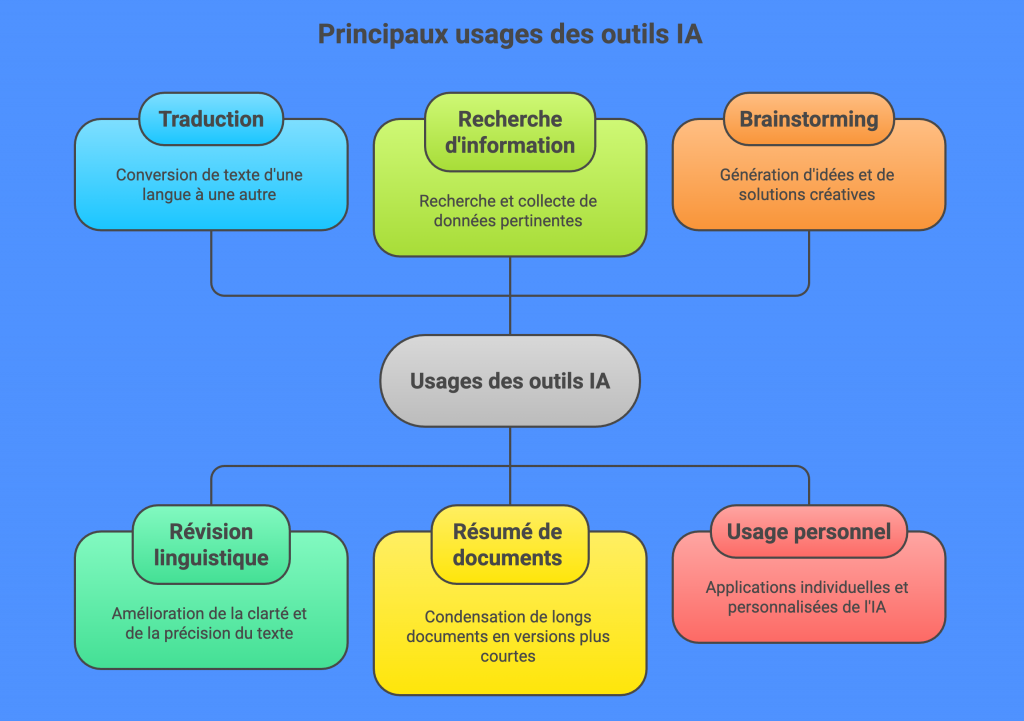
The most common uses include translation, language editing, information retrieval, document summarization, and brainstorming.
Conversational assistants (ChatGPT, Claude, etc.) and translation tools (DeepL, Google Translate) largely dominate current practices.
Differences and nuances across profiles
The survey highlights differences by gender and role.
34% of men report intensive or daily use, compared to 21% of women.
Students mainly use AI for idea generation and information search.
Teachers and researchers favor translation, language editing, and programming.
Administrative and technical staff mainly use AI for drafting and reviewing administrative documents.
Positive perceptions with cautious awareness
A large majority (87%) consider AI tools to be useful in academic and professional contexts.
However, this enthusiasm is tempered by several significant concerns:
- AI bias: 79% report being concerned
- Data privacy: 69%
- Ethical implications: 70%
- Environmental impact: 53%
These results reflect a critical and thoughtful approach to AI and its implications.
Expectations toward the institution
Respondents expressed a clear need for institutional support from UNIL:
- 61% call for clear guidelines
- 52% request ethical and legal support
- 50% wish for broader access to AI tools
- 41% expect more training opportunities
Teachers and researchers emphasize the importance of clear frameworks and ethical/legal guidance.
Administrative and technical staff highlight the need for training and technical support.
Students prioritize clear guidelines and tool access.
Toward an institutional strategy
Based on these findings, the AI Expert Group recommends a strategy structured around six key areas:
- Participatory and adaptive governance for AI use
- Clear regulatory framework for teaching, research, and assessment
- Critical and ethical approach shared across the community
- Integration of environmental considerations
- Secure institutional access to tools that respect data confidentiality
- Tailored training programs adapted to different profiles and levels of expertise
Full report (PDF): Download the report
Contact: iaunil@unil.ch