
The recent rise of artificial intelligence tools designed for scientific research has profoundly transformed the way we work. Many tools are emerging, offering a wide range of features, from automated article discovery to citation analysis and the visualization of scientific corpora. In this context of proliferating solutions, it is essential for researchers to understand the specificities, uses, and limitations of each tool in order to select those best suited to their methodological objectives and to ensure the rigor and quality of a scientific literature review.
This article aims to briefly present a non-exhaustive list of these tools and to encourage you to explore them for yourself so that you can integrate them into your own working practices.
Precautions for use. AI-generated syntheses may contain hallucinations, meaning entirely fabricated references, non-existent citations, or erroneous interpretations of sources. The coverage of these tools is predominantly English-language and more oriented toward the exact and medical sciences. French-language publications and work in the humanities and social sciences are generally less well represented. It is therefore essential to systematically verify every reference and every claim by consulting the original sources. The descriptions provided here reflect the state of the platforms as of March 2026 and may have changed since then.
Google Scholar
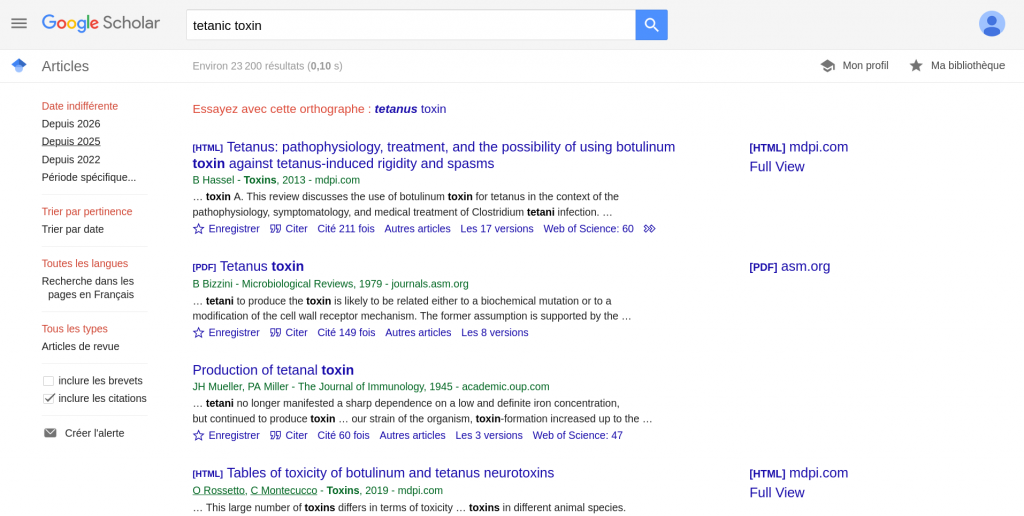
Google Scholar is a free academic search engine that is often the starting point for a literature review, as it provides quick access to a wide range of scientific documents: journal articles, theses, books, book chapters, conference proceedings, and preprints. It makes three major contributions to research work: first, the discovery of an initial corpus from keywords and authors; second, the expansion of the corpus through the “Cited by” and “Related articles” features, which allow users to trace foundational works and identify more recent publications; and third, scientific monitoring, through the creation of automatic alerts on a query or an author.
To use it effectively in a scientific review, it is recommended to adopt an iterative approach: start by combining keywords and synonyms, use quotation marks for exact phrases, refine by publication period, author, or journal using the advanced search, then systematically exploit citation chains to identify central contributions and recent debates. Google Scholar also facilitates the organization of work through saving references in a personal library and exporting citations to bibliographic management software, enabling a more efficient transition from documentary research to the structured writing of the literature review.
It is also worth noting that Google now offers, through the “Labs” tab accessible in Scholar’s navigation bar, experimental generative AI features. These make it possible to obtain automated syntheses of search results, thus bringing Scholar closer to tools such as Consensus or Elicit. As these features are still in the experimental phase, they are subject to change.
Open Knowledge Maps
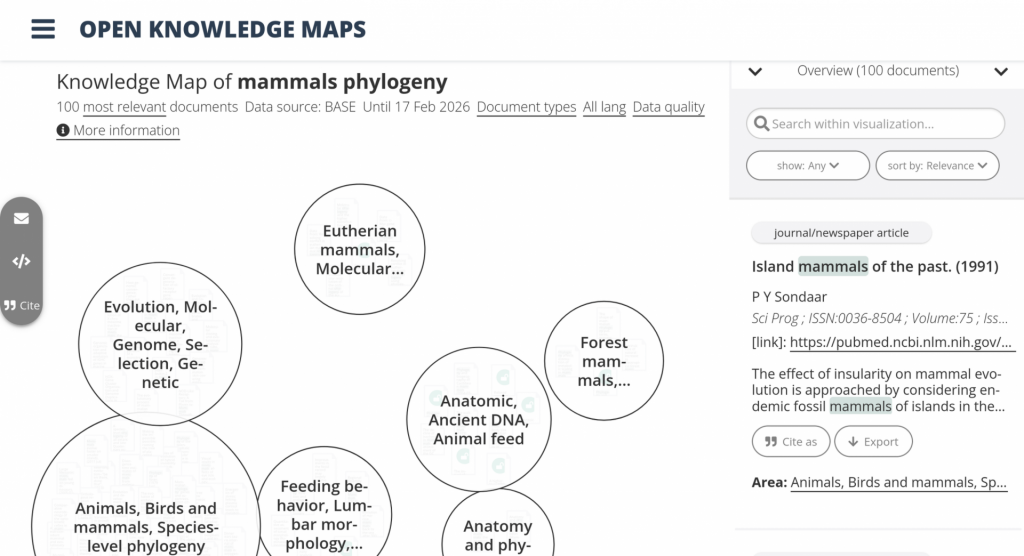
Open Knowledge Maps is a visual discovery tool for scientific literature that transforms a keyword query into a thematic “knowledge map“, allowing users to explore a research field in an intuitive and structured way rather than scrolling through a long linear list of results. The system queries one of two scientific databases: BASE, which covers all disciplines and indexes several hundred million documents, or PubMed, which specializes in the life sciences. It retrieves the most relevant articles for a given topic, then groups these results into clusters (thematic groupings) represented as bubbles. Each cluster contains related publications and key concepts that help understand the structure of the field.
This visualization helps to quickly identify the main themes, sub-topics, and conceptual links between works, providing a clear overview of a complex subject without registration or financial barriers. Open Knowledge Maps is designed on open science principles, is freely available, and allows users to navigate through clusters, click on articles, consult their metadata, and access open-access versions when available.
In a research process, the user simply enters keywords, generates a knowledge map, and then explores the bubbles to identify influential articles and the conceptual relationships linking different sets of results. This approach is particularly valuable during the exploratory phase for framing a question, identifying sub-topics to investigate further, and guiding a more systematic reading of the literature.
Connected Papers
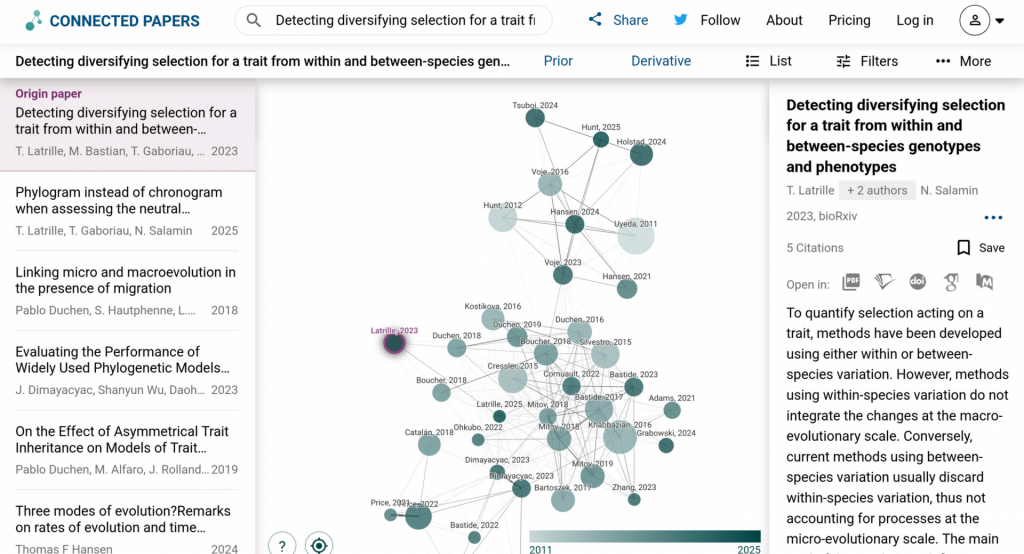
Connected Papers is a visual tool for exploring scientific literature that helps researchers, students, and professionals identify and understand the relationships between publications through an interactive graph rather than a linear list of results. The tool allows users to search by keywords, article title, or identifier (DOI), and relies on data from Semantic Scholar to build its graphs. From a starting article (seed paper), Connected Papers generates a graph of related documents where each node represents a relevant article and the links reflect thematic proximities based on citation and reference similarities. This means that conceptually close articles appear grouped together, even if they do not directly cite one another.
This representation makes it possible to quickly identify foundational prior works (“Prior Works” in the interface) as well as derivative works (“Derivative Works”), i.e., more recent publications that extend or develop an article, to identify major contributions, and to visualize the evolution of a research field.
In practice, Connected Papers is used as a dynamic mapping tool: the user searches for a central article, the tool automatically generates a network of related articles, and it is then possible to explore each node to consult metadata, abstracts, and links to publications. This approach facilitates the identification of thematic clusters, sub-domains, and distinct methodological axes within a single field. For a literature review, Connected Papers is valuable in the exploratory phase: it helps ensure that no important publications are overlooked, to identify the theoretical foundations of a domain, and to build a coherent bibliographic corpus. The tool operates on a freemium model (free basic access, paid advanced features). The free plan, limited to a few graphs per month, remains sufficient for occasional exploratory use.
ResearchRabbit
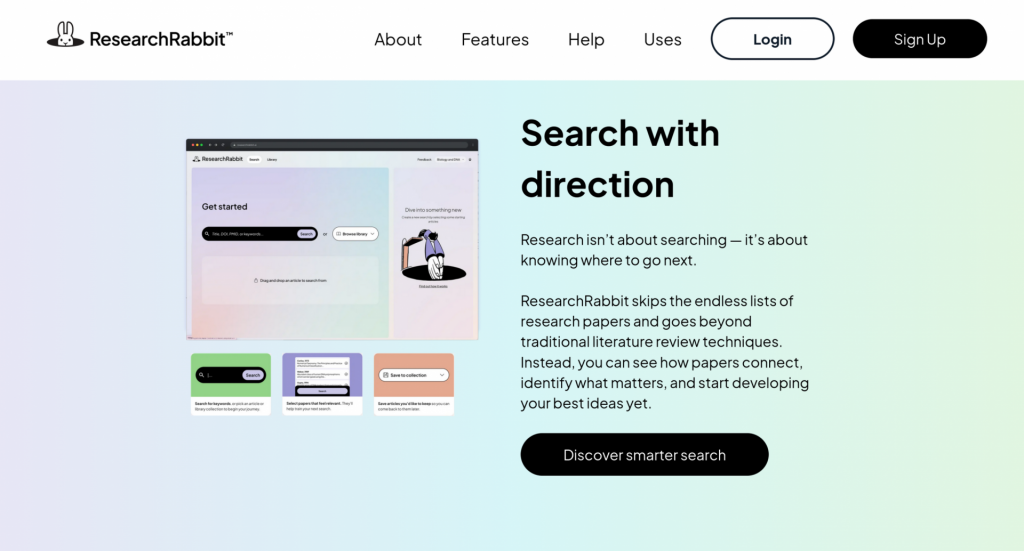
ResearchRabbit is a platform for discovering and visualizing scientific literature that helps researchers explore a research domain in an organized, interconnected, and dynamic way. Rather than presenting a simple list of results, ResearchRabbit allows users to create personalized collections of articles, then automatically explore the relationships between publications, authors, and themes through interactive graphs. The tool highlights connections such as co-cited articles, shared authors, emerging themes, and thematic clusters, helping to detect related research areas that would not be immediately visible through a traditional keyword search.
One of ResearchRabbit’s main strengths lies in its ability to expand a starting corpus in a strategic and reasoned manner. After beginning with a handful of foundational articles on a topic, the user can add these references to a collection and let the tool identify relevant related articles, often going beyond obvious synonyms or standard queries. This network-based exploration makes it possible to identify important work published in adjacent disciplines, key authors who appear across multiple sub-domains, and thematic trends that can structure a review. Searches can be conducted by title, DOI, or keywords, and the tool indexes more than 280 million articles.
In summary, ResearchRabbit functions as a contextual discovery engine, helping to map a research domain and visually organize a bibliographic corpus before moving on to critical reading and in-depth analysis of the texts. The free plan is very generous (unlimited searches, up to 50 articles as input per collection). A paid subscription is available for those who wish to manage multiple projects simultaneously or use extended search parameters.
Consensus
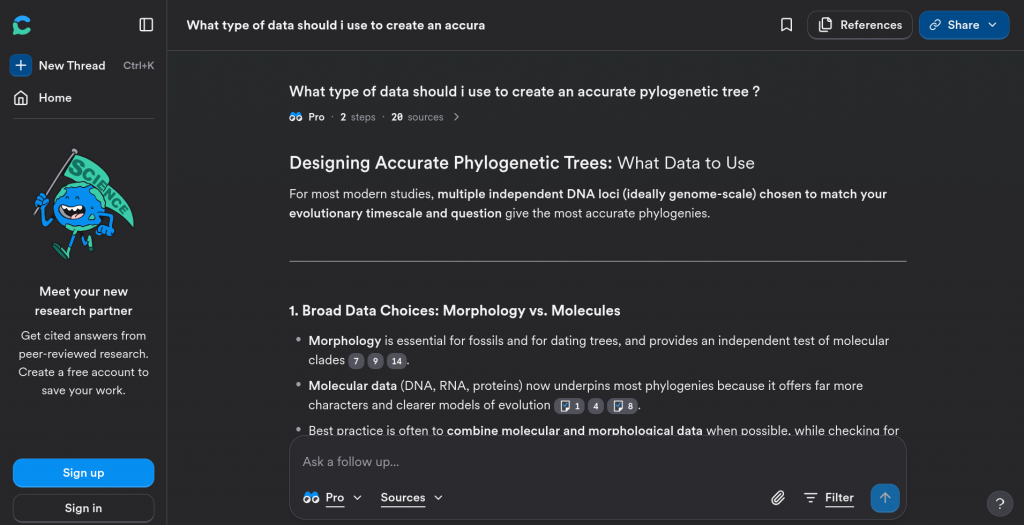
Consensus is a scientific research tool designed to answer specific research questions by synthesizing results from the scientific literature, rather than simply providing a list of links or titles. The tool queries a large corpus of publications indexed by Semantic Scholar, which includes both peer-reviewed articles and preprints (preprints). It analyzes the texts to extract significant passages, identify points of agreement or divergence between studies, and present results in an understandable form, even for users who are not domain experts. Among its notable features, the Consensus Meter offers a visualization of the degree of agreement between studies on a given question, while the Deep Search mode enables a more in-depth automated literature review, analyzing up to 50 articles.
For a literature review, Consensus provides significant support during the exploratory phase: it allows users to quickly obtain an initial synthesis of existing knowledge on a given question or concept. The user formulates a question in natural language (for example: “what is the effectiveness of method X for Y?”), the tool scans relevant publications, identifies those that provide answers, and generates an overview of the scientific results accompanied by cited references. It is also possible to create comparative tables between studies and to ask follow-up questions to refine the synthesis.
However, as with any automated assistant, the results should be used as a starting point to guide the research, and not as the sole basis for a systematic review, which requires rigorous methodological validation and direct consultation of original sources. Note that the free plan remains limited (syntheses based only on abstracts, limited number of in-depth searches). A subscription is required for intensive use.
Elicit
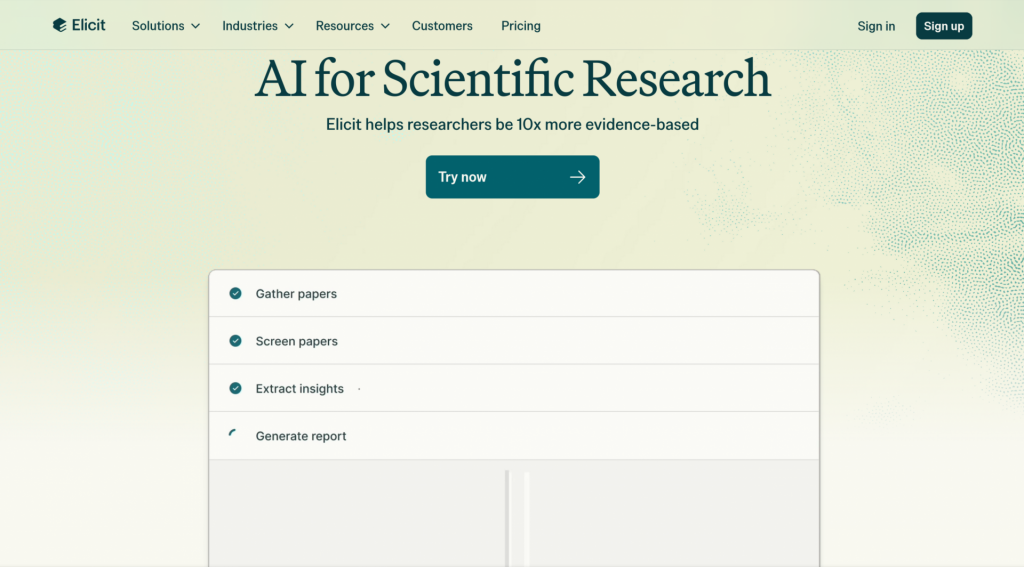
Elicit is an academic research assistant designed to help find, analyze, and synthesize scientific publications in a structured manner. Unlike a traditional search engine primarily based on keyword matching, Elicit relies on semantic search, meaning it understands a question formulated in natural language and identifies the most relevant articles even if the exact terms do not perfectly match. The tool indexes a vast corpus of more than 130 million scientific articles and offers advanced features such as automatic summary generation, structured extraction of key information (methodology, sample size, variables, results), as well as customizable comparative tables for quickly visualizing differences and similarities between studies. Elicit also offers a Paper Chat feature, which allows direct interaction with the full text of an article by asking targeted questions, and is developing AI Agents (in progressive deployment) capable of conducting research tasks semi-autonomously.
One of Elicit’s distinctive strengths is its structured processing pipeline in four stages, particularly visible when generating a research report: (1) collecting relevant sources from the corpus, (2) filtering these sources according to inclusion criteria, (3) extracting key data from the selected articles, and (4) generating a structured report with citations. This transparent process allows the user to follow and understand the methodology used by the tool at each stage.
Elicit proves to be a valuable ally for accelerating the time-consuming stages of a literature review: initial identification of relevant publications, screening of titles and abstracts, and systematic extraction of information. The tool is suited to approaches such as systematic reviews or scoping reviews (scoping review), as it helps standardize data extraction and reduce the risk of overlooking important information. The free plan is relatively generous for searching and summaries, but advanced features (structured extraction, systematic review, agents) require a paid subscription.
SciSpace
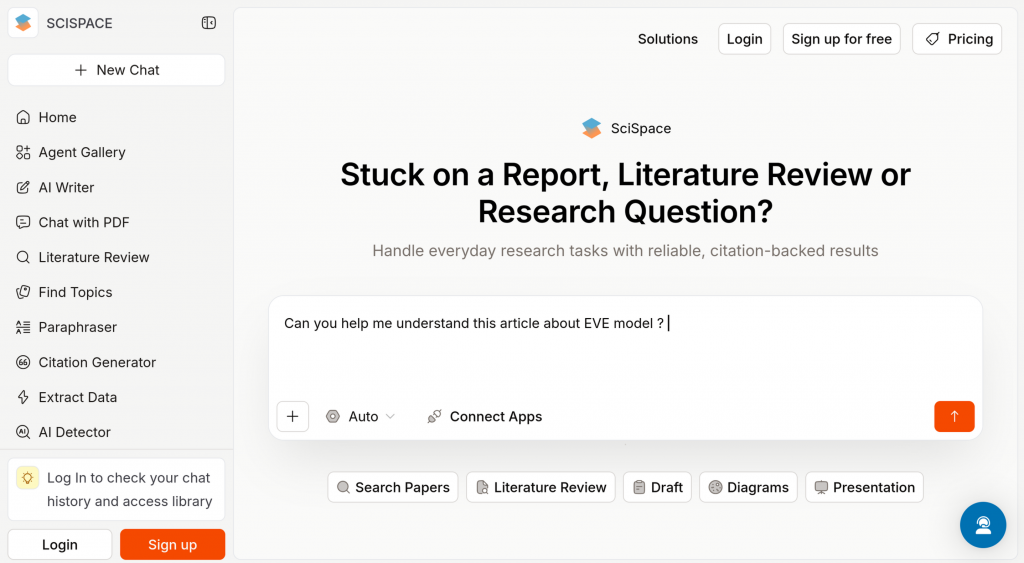
Originally designed as a reading assistant for scientific PDFs, SciSpace has evolved considerably and now presents itself as an integrated research platform. The tool provides access to more than 280 million articles and offers a set of tools covering several stages of the literature review process. From its home page, the user defines a task: review the literature, draft a rough version, generate a diagram, search for articles, extract data, or proofread a text. Then, the integrated research agent executes this task by simultaneously querying multiple sources (its own database, full texts, Google Scholar, arXiv, and, where applicable, the user’s personal library). Results are presented as structured reports including a summary synthesis, comparative tables between studies, and suggestions for further research, all of which can be saved in a notebook or exported.
Beyond documentary research, SciSpace offers complementary features such as assisted writing (AI Writer), paraphrasing, citation generation, or conversation with an imported PDF. These ancillary features are of variable maturity and do not replace rigorous writing work.
For the literature review, the main value of SciSpace lies in its ability to automate the collection, synthesis, and structuring of information in a single workflow. The user formulates their question, and the tool takes care of locating relevant articles, extracting key data, and producing an actionable report. This approach saves time during the exploratory phase, while retaining the ability to verify each cited source. The generated reports remain starting points that should be compared against original sources, as automated synthesis may simplify or omit important nuances. Registration is required and the free plan, limited in credits, is quickly consumed.
scite.ai
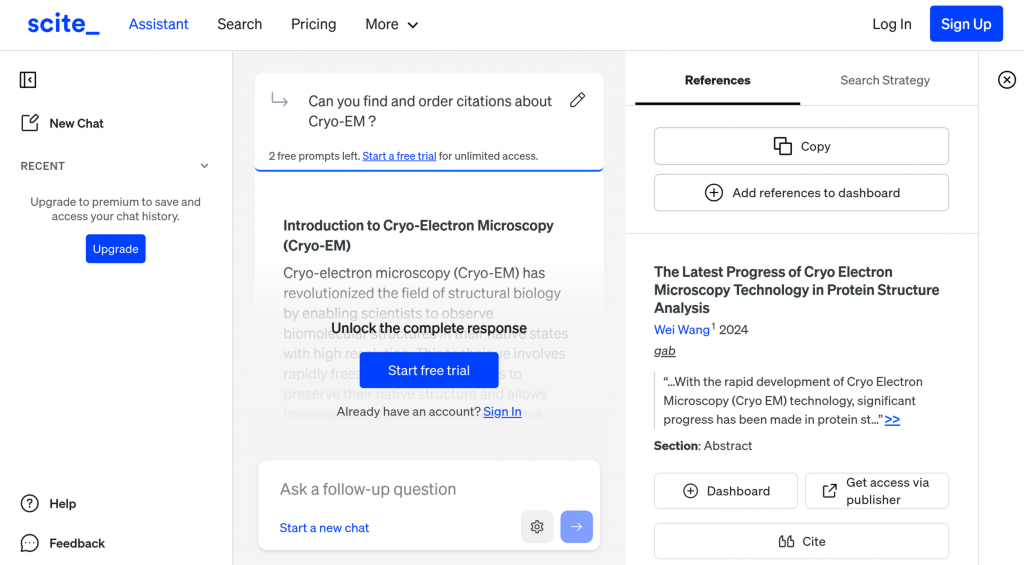
scite.ai is a platform for analyzing scientific citations that does not merely indicate how many times an article has been cited, but qualifies the context of those citations. Specifically, rather than simply seeing a citation count, scite.ai classifies the mentions of an article into three main categories: supporting citations (“Supporting” in the interface, which confirm or support the results), mentioning citations (“Mentioning”, which refer to the work without taking a position), and contrasting citations (“Contrasting”, which question or contradict the conclusions). Each classification is accompanied by a confidence score and the exact passage in which the citation appears, with an indication of the section of the source article. This level of analysis provides a highly useful qualitative dimension for assessing the robustness of a result or the scientific debate around an article, going well beyond traditional metrics such as citation count or impact factor.
In addition to these contextualized citations (“Smart Citations“), the tool offers advanced search and filtering interfaces, the ability to create personalized dashboards to monitor a set of publications, as well as alerts and contextual summaries of relationships between works, which help to assess how a contribution is perceived and integrated within its field.
In the context of a literature review, scite.ai is mainly used to refine the critical reading of key articles: by looking not only at who cites a paper but above all at how it is cited, one can identify results that are strongly supported by the community, those that are contested or debated, as well as methodological or conceptual points of friction. It should be noted that free access is very restrictive: only a limited preview of citation contexts is available without a subscription, making it quickly necessary for full use of the tool.
Summary table
The table below provides an overview of the tools discussed, organized according to a logical progression in the literature review process: from initial search to critical evaluation of citations.
Note: “Free with limits” refers to a freemium model (free basic access, paid advanced features).
| Tool | Access | What it’s for | What to know before using it |
| Google Scholar | Free | Academic search engine used to build an initial corpus through keywords, expand it via citation chains, and set up monitoring through alerts. Very broad coverage. | Few restrictions. No structured analysis of results. The Labs feature (AI-generated syntheses) is still experimental. |
| Open Knowledge Maps | Free | From keywords, generates a visual map organized into thematic clusters. Helps identify the main lines of a research field via BASE or PubMed. | Few restrictions. Limited to the metadata and abstracts of indexed articles. |
| Connected Papers | Free with limitations | From a specific article, generates an interactive graph of related publications. Helps identify foundational works and recent developments on a topic. | Moderate restrictions. A few graphs per month available in the free version. Based on a database of more than 200 million articles. |
| ResearchRabbit | Free with limitations | From a collection of articles, discovers related publications through citation and author networks. Unlimited searches across more than 280 million articles. | Moderate restrictions. Limited to 50 input articles and a single project in the free version. |
| Consensus | Free with limitations | Answers research questions by synthesizing the scientific consensus. A consensus indicator visualizes the level of agreement between studies; the deep search mode analyzes up to 50 articles. | Strong restrictions. Free search limited to abstracts, with a restricted number of in-depth searches. Includes preprints. |
| Elicit | Free with limitations | Semantic research assistant that automates data collection, screening, and structured extraction. Transparent four-step processing pipeline, from collection to final report. | Strong restrictions. Structured extraction and systematic review features are reserved for the paid plan. The number of reports is limited in the free version. |
| SciSpace | Free with limitations | Integrated platform: multi-source search, synthesis, structured reports, and assisted writing. Research agent querying multiple databases simultaneously. | Strong restrictions. Free credits are quickly used up. Generated reports require critical verification. |
| scite.ai | Free with limitations | Qualitative citation analysis: each mention is classified as supporting, mentioning, or contrasting, with the exact passage and a confidence score. | Strong restrictions. Free access is very limited. A subscription is almost essential for effective use. |