Tag: Jack Gillespie

  • First traces of water on Mars date back 4.45 billion years

    First traces of water on Mars date back 4.45 billion years

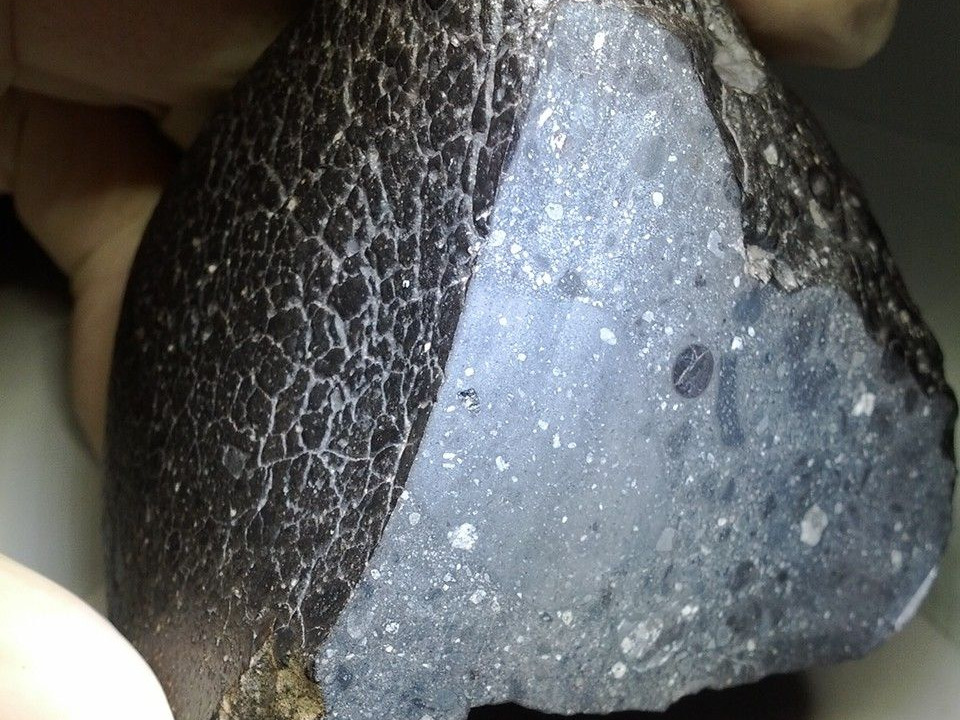
    Designated Northwest Africa (NWA) 7034, and nicknamed Black Beauty, this Martian meteorite weighs approximately 320 g – © NASA
    Jack Gillespie, Institute of Earth Sciences

    By analyzing a Martian meteorite, scientists from the University of Lausanne and Curtin University have discovered traces of water in the crust of Mars dating back 4.45 billion years, i.e. to near the very beginning of the planet’s formation.

    This new information strengthens the hypothesis that the planet may have been habitable at some point in its history.

    Thanks to observations from Mars rovers and spacecraft, we’ve known for decades that the planet Mars was once home to water, and probably had rivers and lakes. However, many questions remain. When did this precious liquid first appear in the history of Mars, and did the Red Planet, in the course of its evolution, create the conditions necessary for the emergence of life?

    By analyzing the composition of a mineral (zircon) found in a Martian meteorite, scientists from the University of Lausanne, Curtin University and the University of Adelaide have succeeded in dating traces of water in the crust of Mars. According to the study, published in Science Advances, hydrothermal activity dates back 4.45 billion years, just 100 million years after the planet’s formation.  

    “Our data suggests the presence of water in the crust of Mars at a comparable time to the earliest evidence for water on Earth’s surface, around 4.4 billion years ago,” comments Jack Gillespie, first author of the study and researcher at the University of Lausanne’s Faculty of Geosciences and Environment. “This discovery provides new evidence for understanding the planetary evolution of Mars, the processes that took place on it and its potential to have harboured life”.

    A Martian meteorite found in the desert

    The scientists worked on a small piece of the meteorite NWA 7034 “Black Beauty”, which was discovered in the Sahara Desert in 2011. “Black Beauty” originates from the Martian surface and was thrown to Earth following an impact on Mars around 5-10 million years ago. Analysis focused on zircon; a mineral contained in the meteorite. Highly resistant, zircon crystals are key tools for dating geological processes: they contain chemical elements that make it possible to reconstruct the date and conditions under which they crystallized (temperature, interaction with fluids, etc.). “Zircon contains traces of uranium, an element that acts as a natural clock,” explains Jack Gillespie. “This element decays to lead over time at a precisely known rate. By comparing the ratio of uranium to lead, we can calculate the age of crystal formation.”

    Through nano-scale spectroscopy, the team identified element patterns in this unique zircon, including unusual amounts of iron, aluminium, and sodium. These elements were incorporated as the zircon formed 4.45 billion years ago, suggesting water was present during early Martian magmatic activity.

    These new findings further support the hypothesis that the Red Planet may have once offered conditions favorable to life at some point in its history.

    “Hydrothermal systems were essential for the development of life on Earth, and our findings suggest Mars also had water, a key ingredient for habitable environment, during the earliest history of crust formation”

    Aaron Cavosie from Curtin’s School of Earth and Planetary Sciences, co-author

    Lead author Dr Jack Gillespie from the University of Lausanne was a Postdoctoral Research Associate at Curtin’s School of Earth and Planetary Sciences when work began on the study, which was co-authored by researchers from Curtin’s Space Science and Technology Centre , the John de Laeter Centre  and the University of Adelaide, with funding from the Australian Research Council, Curtin University, and the Swiss National Science Foundation.

    Source

    J. Gillespie, A. J. Cavosie, D. Fougerouse, C. L. Ciobanu, W. D. A. Rickard, D. W. Saxey, G. K. Benedix, and P. A. Bland, Zircon trace element evidence for early hydrothermal activity on Mars, Science Advances, 2024 (DOI 10.1126/sciadv.adq3694)

  • A dive into the dawn of Earth’s history

    A dive into the dawn of Earth’s history

    Jack Gillespie, Institute of Earth Sciences

    How did the Earth’s continental crust form and transform over geological time?

    This question about the beginnings of our planet’s fundamental dynamics remains hotly debated. Jack Gillespie, who has just taken up his post as Ambizione fellow1 at the Faculty of Geosciences and Environment (FGSE), is keen to unravel this mystery.

    How do you infer a history of over 4.5 billion years?

    Jack Gillespie: I am an isotope geochemist. Using the isotopic composition of rocks, I try to understand what they have experienced – the geological processes they have gone through over the course of their long history. Thanks to these “tracers”, I’m working to resolve a question that keeps nagging at me: was the early Earth similar to the one we live on? Or was the early tectonic environment profoundly different from today’s Earth?

    “We know so little about the origin of the planet we live on.”

    Jack Gillespie

    Why are you interested in early Earth history?

    J. G.: The scale of our ignorance is immense. We know so little about such a vast period! That’s what I find so compelling. And the further we go back in time, the greater the challenge, as our archives are increasingly small and fragmented. The most ancient rocks we have are 4 billion years old. For the first 500 million years, we simply don’t have any intact rock.

    Now, how can you meet the challenge of jumping into the distant past?

    J. G.: Today, we can “do more with less”. We’ve improved both our conceptual understanding and our technical abilities. So we can examine a very small volume of material and extract more information out of it. Just a few decades ago, geologists had to reduce and dissolve down large chunks of rock to derive geochemical insights. 

    My project synthesizes and brings together a bunch of powerful advances to develop new tools that can meet this challenge.

    “The conditions that prevailed during the formation of a rock leave different signatures in the minerals. We’re deciphering them to try and reconstruct these conditions.”

    Jack Gillespie
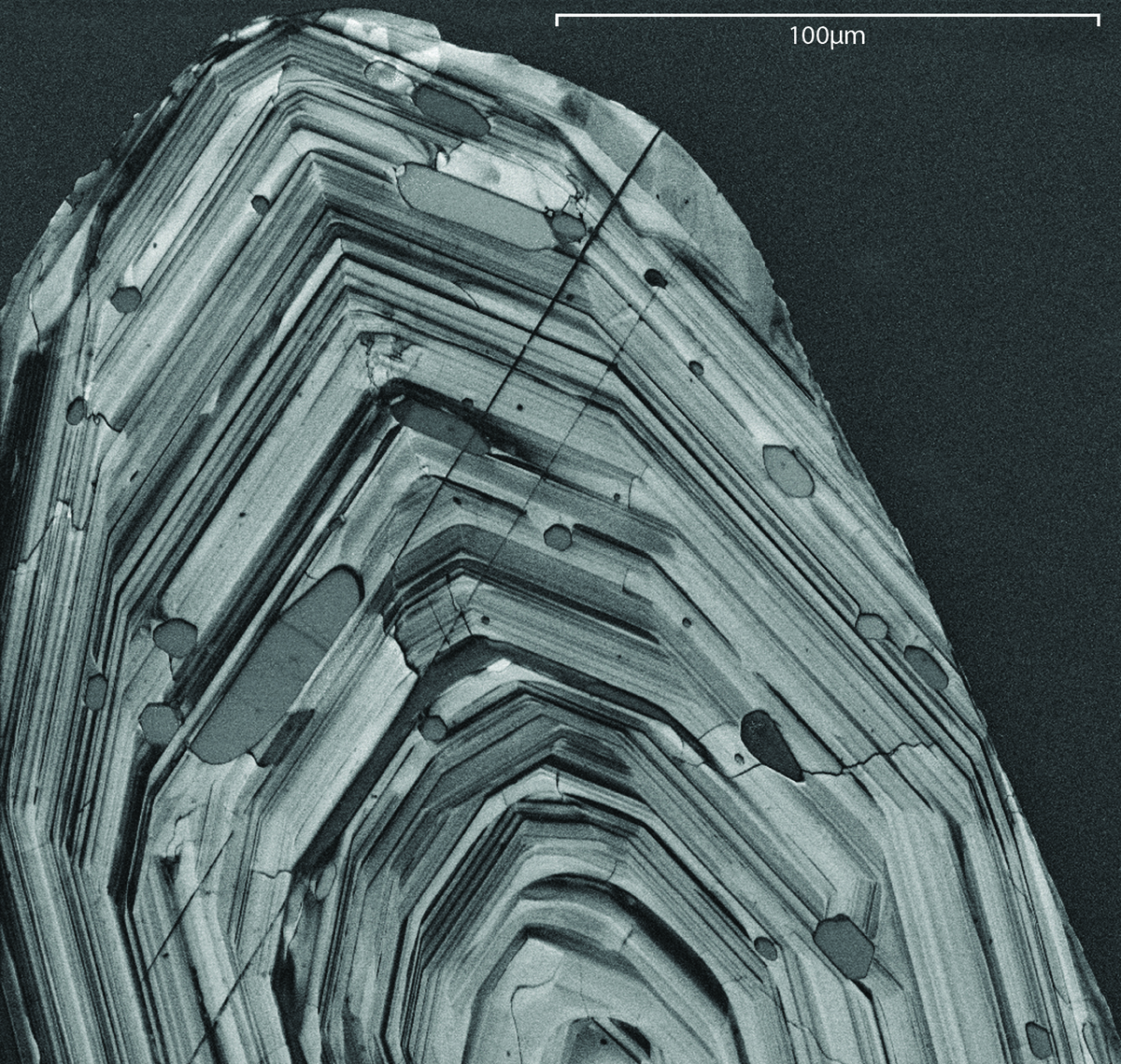
    The mineral zircon is one of the major tools used by geochemists: it’s robust, hard to break, and found as tiny grains in many rocks. In this electron micrograph, we can also see inclusions of another mineral inside: Apatite. More easily destroyed, it nevertheless contains a wealth of complementary information to zircon about our past. Jack Gillespie aims to access and make sense of this information in a way we couldn’t before. In particular, he is trying to understand when and how these minerals formed, in order to deduce far-reaching earth processes. (© Jack Gillespie)

    What did early Earth look like?

    Was it a hellish period, as the name “Hadean” suggests, in reference to the god of the underworld, Hades? This is a somewhat outdated idea, and we’ve known for some time that this wasn’t precisely the case. But the nature of the primary landscapes and the forces that governed them during the Hadean and the Archean remain uncertain. Some emphasise a violent and eventful history for the early Earth, such as is illustrated on the left, with burning skies and meteorites crashing everywhere.

    Others would argue the more peaceful vision on the right, with its placid volcanoes and bodies of water is more faithful to reality. This scenario is compelling, with the hot pools at the edge of the land identified as a good place for the first hatching of life.

    Why did you choose the FGSE for your Ambizione?

    J. G.: Several groups at the Institute of Earth Sciences (ISTE) are raising questions about early Earth, and our approaches will enrich each other. Johanna Marin Carbonne is working on the link between the atmosphere, the oceans and primitive continents, and the processes that led to life and oxygenation of the atmosphere. Othmar Müntener is interested in the creation of the earth’s crust.

    The SwissSIMS ion probe is ideal for what I want to do: measuring tiny features and extracting information from it.


    1. Ambizione est une bourse carrière du Fonds National Suisse, à destination des jeunes chercheuses et chercheurs (dans les quatre ans suivant l’obtention du doctorat) qui ambitionnent réaliser et diriger un projet de manière autonome. Les subsides sont octroyés pour une période de quatre ans. ↩︎