Tag: Georgina King

  • Toward inclusive fieldwork: A handbook in the making

    Toward inclusive fieldwork: A handbook in the making

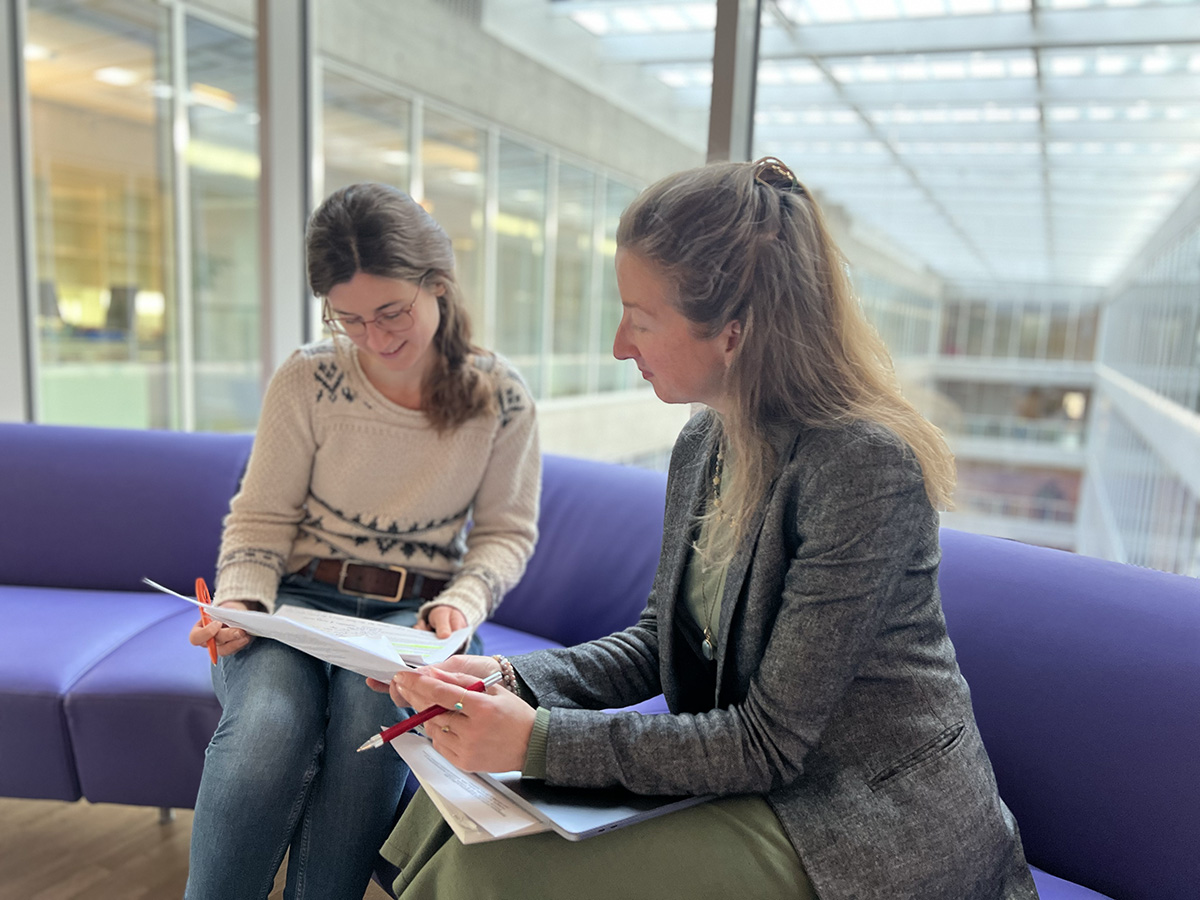
    Floreana Miesen is a field technician, involved in a variety of field projects at the Institute of Earth Surface Dynamics (IDYST). Natalie Emch is Equity, Diversity and Inclusion (EDI) officer at the Faculty of Geoscience and the Environment. Through their involvement in this working group, both would like to ensure fieldwork would be a positive learning and professional experience for all. Three other people are actively working in the group: Prof. Georgina King, Dr Ian Delaney and Léa Rodari.

    Fieldwork constitutes a crucial element in teaching and research within Geography and the Earth and Environmental Sciences. It has a pivotal role in shaping a student’s career trajectory and for accomplishing research objectives. Recognizing its significance has raised the following concern: how can we make fieldwork as inclusive and accessible as possible? In a collaborative effort to address this issue, Floreana Miesen and Natalie Emch are actively engaged in a working group tasked with crafting a toolkit to help make fieldwork more accessible. The aim is to come up with solutions that respond to the various needs, by involving the entire student and research community in the reflection process.

    Can you say more about this working group “A good practice guide for fieldwork”?

    N.E : The working group endeavors to collect input and advice from members of the FGSE across different perspectives and institutes. Our aim is to produce a Handbook of Good practice – a useful resource for both teaching staff and students. It will be a support document for preparing and organising any type of field camp, whether for teaching or research purposes. Unlike a set of rigid rules or directives, the Handbook aims to inspire and guide. It will cover aspects such as communication, sanitary installations, accessibility to material to give some examples. We would like the community to know there is a support structure at the faculty to address these challenges related to fieldwork.

    What will be the content of this handbook?

    F.M. :  The document is structured around simple questions for teaching staff and participants. They encompass safety and well-being issues. For examples: “Have the participants been informed about the daily schedule, the mobile phone network coverage, local customs…?” – “Have participants been informed of the equipment to bring and how to obtain it?” – “As a participant, am I uneasy about an issue I wish to raise with the organisers? Is there any constraints I could to share with the organisers, such as family care responsibilities?”

    The important point is to foster timely communication and open dialog between organisers and participants. This initiative seeks to raise awareness about the fact that students may not dare to express significant concerns, such as safety and personal needs. It’s central to avoid assuming that everyone has a sleeping bag, has been to the mountain tops or is free of family duty.

    “The aim of the document is to remove barriers that can hinder or prevent participation and learning, and to create safe and pleasant conditions for everyone.”


    Floreana Miesen

    Work in progress – your input is welcome!

    You are a student, a teacher, a researcher at the FGSE and wish to share your experience on the field? Or do you simply want to know more? Feel free to contact the working group ce-fgse@unil.ch.

    We are still collecting input from different perspectives and across the three FSGE institutes. For instance, we welcome suggestions about:

    • What type of support is needed to organise a successful field camp? (Training in conflict management, in how to deal with anxiety…?)
    • As a participant, what information do you need to prepare a field camp with confidence?

    Why this project for a good practice guide?

    N.E. : UNIL is committed to improve the well-being of its members and the inclusion of people, regardless of their gender, ethnic or migratory background, disability… This work is hence a contribution to UNIL’s ambition to fight inequality. Issues of safety and personal integrity in the field are part of UNIL’s action plan for equality, diversity and inclusion, and our working group is part of this commitment.

    “When people feel safe, respected, valued, supported, they are able to actively contribute.”

    Natalie Emch

    Natalie Emch, why is this project important to you?

    N. E. : When I arrived in 2022, a workshop had just taken place at FGSE with Ann Rowan (University of Bergen, Norway) (March 2022), which addressed the question of inclusivity in fieldwork.  Feedback from the students highlighted that fieldwork was highly valued, as it enabled them to acquire scientific and practical know-how that was distinct from that of the classroom.

    However, some students highlighted their anxieties, their specific needs and lack of clarity around responsibility and field conditions which can interfere with their learning. We observe that due to hierarchical structures and the fact that students are evaluated they can feel shy to speak up.

    This led to the decision to create a working group to address this issue and develop a handbook for good practices. As the EDI officer of FGSE, I have embraced this project and I hope this work will attract more diversity in the field.

    For Floreana, field work is an opportunity to see and feel the study landscape. (Photo: Nikola Schulte-Kellinghaus)

    Floreana Miesen, why is this project important to you?

    F. M.: I enjoy everything related to fieldwork. During my studies in Geography in Germany, I had the opportunity to participate in a lot of field courses and field research. I felt it really was one of the best ways to learn. Fieldwork was my motivation to apply for this position at IDYST. I still appreciate the variety of projects and approaches in the field.  However, I have noticed that students sometimes face challenges. For example, they can feel overwhelmed by the gap between their experience of hiking with friends and the demands of working in mountainous terrain.

    I am convinced that to focus on the learning objectives, students should not be preoccupied with managing challenges related to personal needs exacerbated by a field course. By addressing issues – like physical fitness requirements, personal constraints or financial limitations – this handbook proposes strategies to lower entry barriers. 

    “I would like to convey my enthusiasm for field work, and ensure that more people can enjoy fully this experience.”

    Floreana Miesen

    Links

    A multi-pronged FGSE approach of welfare and security

    The FGSE is committed to protecting its students and employees and to improving study and research conditions from all points of view, through various bodies (Health and Safety Committee, Equality Commission, Ethics Commission, internal support for employees), and through more informal steps such as the production of this Handbook.

    This Handbook of Good Practices for Fieldwork in the making is primarily designed as a list of recommendations, and does not have a binding scope like the two Décanat Directives for fieldwork (Directive à l’intention des membres de la FGSE sur la sécurité et les mesures de protection pour le travail de terrain) and off-campus activities (Directive FGSE pour les travaux de recherche impliquant des déplacements à l’étranger).

    The Fieldwork Directive requires each person involved in fieldwork to carry out an adequate risk assessment beforehand, in an autonomous and personal way. It is more focused – although not only – on physical safety in field camps, while the Handbook of Good Practice focuses on the emotional safety and personal integrity of people participating in camps or excursions, so as to make them more accessible. 

    The future Handbook also develops, deepens and thus very usefully complements the concepts that appear briefly in the second directive, devoted to the elements to be taken into account in general when planning off-campus activities.

  • Using rock surface luminescence dating to understand the dynamics of a glacier: a new approach initiated this summer at the Mer de Glace

    Using rock surface luminescence dating to understand the dynamics of a glacier: a new approach initiated this summer at the Mer de Glace

    This summer, three young scientists including Léa Rodari (student of the master in Environmental Science) went to the Mer de Glace (Chamonix, France) to extract icebound rocks.

    Their aim is to measure the time during which these rocks have passed through the glacier, using rock surface luminescence dating. This fieldwork marks the first step in a novel approach to directly quantifying the movement of ice and the objects it contains.

    Glaciers are not inert objects. Their mass is constantly moving from top to bottom, under the effect of gravity. With melting due to global warming, we are currently finding all kinds of debris, material – even human remains – at the end of the glacier tongue. Most often these objects were buried well upstream and were transported down with their surrounding ice. But how long did it take for these particles to make their journey and remain buried in the ice? Currently the evaluation of glacial dynamics (= speed of movement of the glacier) is mainly based on theoretical data and numerical models. Prof. Georgina King and her team are seeking direct observations of the glacier’s movement. To do this, she intends to determine the duration of burial of rocks that have been buried within the glacier, until their re-appearance in the open air. This new approach to the study of glacial dynamics is based on applying the luminescence dating technique to minerals contained in rocks. 

    The idea for the project comes from the fact that, although we know a lot about glaciers, we don’t know how long it takes to transport fragments within them, and that is because there were no methods available that you could use to really measure that.

    Glacier movements can have consequences for the downstream water regime (e.g. flash floods) or for the stability of glacier margins, for example. It is therefore important to understand glacier dynamics in order to better anticipate these risks.

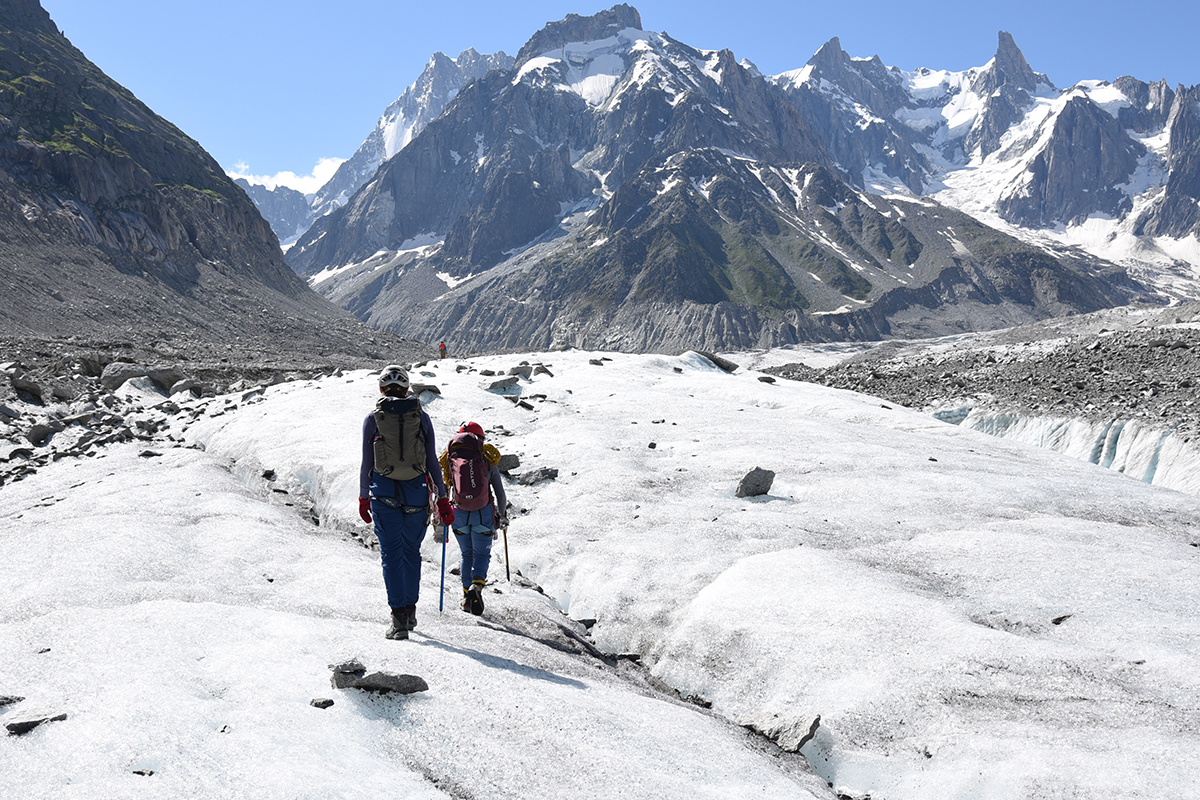
    The first stage of this research took place this summer at the Mer de Glace above Chamonix (France). Léa Rodari student of the Master in Environmental Sciences and Audrey Margirier (post-doctoral fellow at the Institute of Earth Surface Dynamics – IDYST) shared their field experiences in this landscape that is both magnificent and physically and technically demanding.

    The first challenge of this expedition was to find interesting sites in the middle of the immensity of the glacier tongue, covered with rocky debris. The young scientists walked for two days to spot potential samples. One of the main difficulties was to distinguish the recently fallen rock debris from the summits from those that had stayed within the ice. In order to circumvent this pitfall, they took the option of concentrating their research on steep slopes (bordering crevasses or the supraglacial river,) which are free of debris that had fallen from the summits (i.e. where it was certain that the debris were englacial). The second challenge was to access these samples trapped in the ice cliffs.

    Sometimes we spotted an interesting rock on an ice slope in front of us, but we didn’t see it at all once we got to the top of the cliff, the wall being too vertical. Several times we had to rappel “blind”.

    Audrey Margirier

    The rocks extracted from their surrounding ice were directly packed in opaque black bags to protect them from daylight, which interferes with the luminescence analysis. These samples were then prepared in the laboratory: cores were cut from the surface of the rocks, then sliced into thin 1mm discs. These operations were carried out in red light so as not to disturb the luminescence signals of the minerals in the rock.

    Prof. Georgina King explains what luminescence in rocks is

    Luminescence is the emission of light by minerals contained in rocks. The reason for this light emission is that these minerals, over time, have been exposed to radiation emitted by surrounding minerals, causing electrons to shift and become trapped in defects within the mineral. Exposing these samples to light of a certain frequency or color in the laboratory (in this case, blue or infra-red light), causes these electrons to return to their original orbit. This movement is accompanied by the emission of light of a different color, which can be measured. The amount of light emitted corresponds to the time during which the samples remained buried in the glacier, and therefore to the time it took the glacier to transport these rocks into the ice.

    It now remains to perform the luminescence analyses. This work will determine the duration of burial of the rock (time during which it was plunged into darkness within the glacier). The team is excited to get the first results to compare them with the values used so far. Georgina King concludes :

    We hope that the values we obtain will agree with the values predicted from numerical models. Otherwise, we will have some interesting discussions with the glaciologists to identify where the differences lie.

    Georgina King
    View of the Mer de Glace glacier with the Mont-Blanc massif in the background

    Going into the field involves risks

    They are quite high in this particular case, and required appropriate measures that were effectively put in place to ensure smooth operation. The FGSE has drawn up a guideline and a process to enable scientists going into the field to prepare their outing and assess the risks involved (preliminary risk assesment). External resources for information on the nature of the terrain are also mentioned (e.g. WSL-natural hazards for excursions in Switzerland).

    In the case of this research involving work on a glacier, people going out on site must undergo an appropriate prior training especially if they have no or weak previous practical experience on this field and its constraints (snow cover, crevasses locating, wheather analysis and monitoring etc.) use of equipment (proper use of crampons, ropes etc.) In this particular case, lone working is outlawed: as a precaution, activity on the glacier must involve the simultaneous presence of at several people, as this team of three scientists. 

    So even though the images may reflect an idyllic landscape, and “fun” activities, this fieldwork, like all others, required a very meticulous preparation and prior training to ensure that risks are minimized in terrain conditions which, as the images show, are very demanding for participants. Risk is always present, even for experienced and well-equipped people, and must be a constant concern, both for others and for ourselves.

    Directive FGSE sur la sécurité du travail de terrain

  • How cold was it, 20,000 years ago?

    How cold was it, 20,000 years ago?

    During the Last Glacial Maximum, about 20,000 years ago, it was cold. But how cold? Estimates of surface air temperature vary between 1.8 and 8°C colder than today. This remains imprecise.  Christoph Schmidt and Georgina King are working on a new SNSF project to develop a method for estimating past temperatures that can be applied globally – at any latitude and any altitude.

    A “global” method – from the moon to the foot of Mont Blanc

    This method is based on almost ubiquitous material: quartz and feldspar. The idea was first introduced in the 1960s for terrestrial applications, and then in the 1970s for lunar samples from the Apollo 12 mission. It has only recently been revived and developed, in particular by a un groupe de la FGSE : Frédéric Herman and Rabiul Biswas (now a professor in India) put a lot of effort and time into it. “They have developed it to a point where we can now build on it and try to apply it on a larger scale” points out Ch. Schmidt. “There are still a range of open questions and problem we have to face, but we have ideas on how to overcome them.”  This method could be applied in all regions of the world where these minerals are present, and why not, on other planets!

    The trace of paleo-temperatures trapped in minerals

    How can we reconstruct past temperatures? Quartz and feldspar trap electrons generated by environmental radiation. The team is exploiting the fact that the charge trapped in these minerals – generated by irradiation – depends on the ambient temperature. In the luminescence machine (visible on the video), the sample is exposed to heat or light, which triggers the release of the luminescence signal. A highly sensitive device, called a photomultiplier, is then able to record individual photons released from the mineral – a level of light well beyond the detection limit of the human eye.

    We try to measure the relative level of signals in response to two competing processes: radiation and temperature. By doing so, we try to find the thermal history that most likely can explain the signal pattern that we observe experimentally from our sample.

    Christoph Schmidt
    One of the main challenges is to accurately characterise the behaviour of the quartz and feldspar samples. In order to extrapolate laboratory observations to a larger time scale, it is important to be as accurate as possible: small inaccuracies will seriously affect an extrapolation into the distant past.

    We aim to reconstruct absolute temperature in different ranges of time, from 30 to 40,000 years to shorter time scale. But this method will have other possible applications: for example to estimate the temperature of a rock during a volcanic eruption or any type of thermal hazards.

    Christoph Schmidt

    20,000 years ago, from the equator to the far north

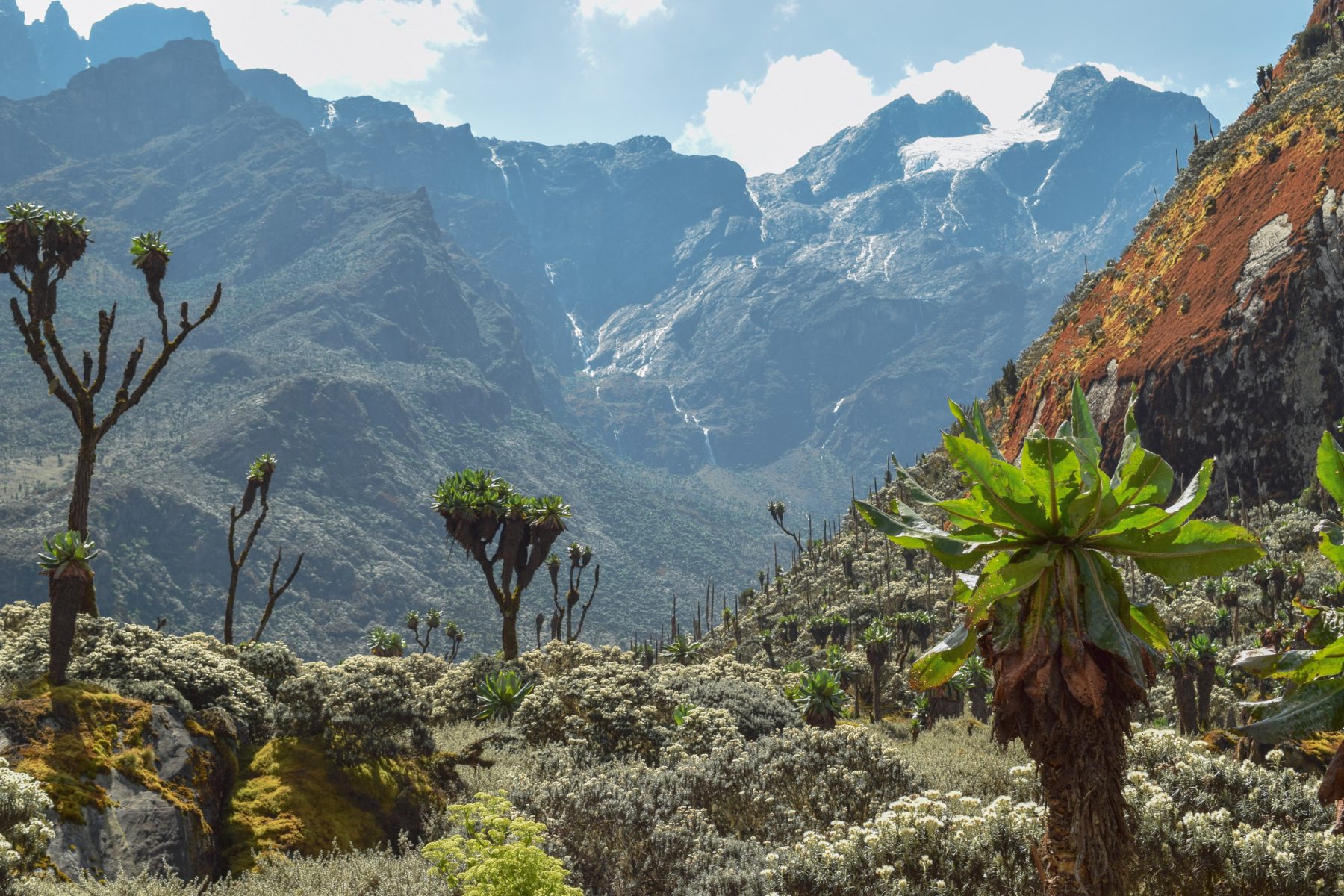
    Reconstructing the absolute temperature time series from the Last Glacial Maximum to the present day is one thing. The team also aims to cover as wide a latitudinal gradient as possible. “We start in the North in Norway, it is the northern most piece of bedrock that was not covered by a glacier during the last ice age (as we want to reconstruct air temperature). At the southernmost point, very close to the equator, the Ruwenzori Mountains in Uganda are the only non-volcanic mountain massive in central Africa. So there is not much of a choice! Non-volcanic origin is important, because volcanic samples show very special luminescence properties that we try to avoid.”

    Ruwenzori Mountains, Uganda (© Martin Mwaura | Dreamstime.com)
    Mont-Blanc, France (© Christoph Schmidt)

    Two massifs, one in the tropics and the other in a temperate region will allow estimating how temperatures dropped from 1000 to 4000 m during the Last Glacial Maximum (26,500 to 19,000 years ago). This adiabatic lapse rate is crucial to model the atmospheric climate. The adiabatic lapse rate is the variation of air temperature with altitude, related to atmospheric pressure alone.

    Reconstructing past temperatures to better understand the future?

    Knowledge of past surface air temperatures as a function of latitude and altitude is important for understanding the Earth’s climate oscillations and atmospheric circulation. In the context of global warming, it is a key element in predicting future scenarios. In particular, these temperature data serve as crucial input parameters for evaluating climate models and determining climate sensitivity. “This information can be fed into climate models that will tell us about our future on this planet, that is what the temperature will be in the next 50 or 100 years.”

    There weren’t people with thermometers 20,000 years ago, so we try to extract this information from the rocks, to give that to the climate scientists.

    Georgina King

    Article

    • Biswas, R.H., Herman, F., King, G.E., Lehmann, B., Singhvi, A.K., 2020. Surface paleothermometry using low-temperature thermoluminescence of feldspar. Climate of the Past 16, 2075-2093.
      doi.org/10.5194/cp-16-2075-2020