Category: Insights

  • How much is Climate Change responsible for the release of bodies and wreckage in Alpine Glaciers?

    How much is Climate Change responsible for the release of bodies and wreckage in Alpine Glaciers?

    Guillaume Jouvet, Institute of Earth Surface Dynamics

    This summer has again broken temperature and glacier melt records. Along this, the release of the remains of unfortunate mountaineers, wreckage of airplanes, and other objects trapped in the ice for several decades has been reported multiple times in newspapers. Together with severe drought and wildfire, these re-emergences were essentially attributed to climate change by media without any further explanations on the underlying glacial drivers.

    Prof. Guillaume Jouvet, analyses herehow much climate change explains the release of all these bodies and wreckage on Alpine Glaciers. 

    While enhanced melt over summer naturally facilitates the re-emergence of any englacial objects, can we really attribute it entirely to global warming?To answer this question, one needs to understand how glacier form, move, and melt.

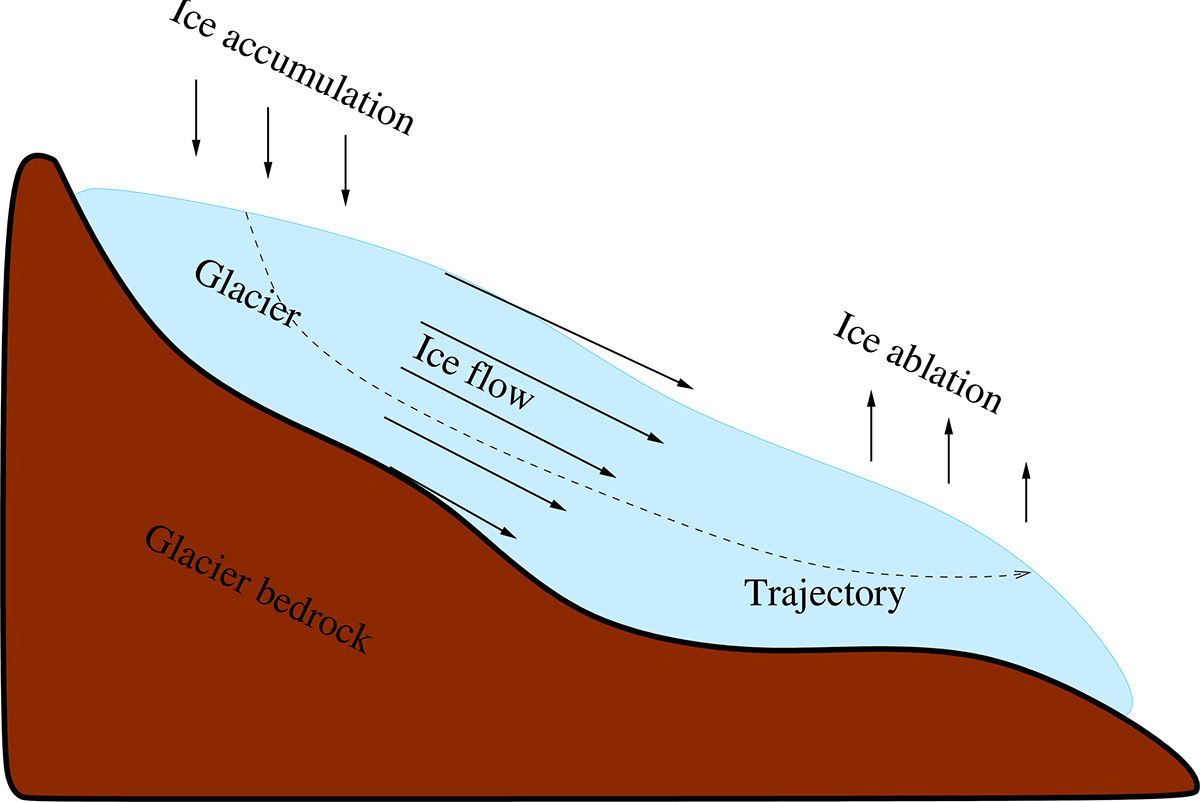
    Glaciers are formed because ice accumulates in high elevation mountains due to the compression of snow precipitation, and are sustained by low temperatures. Under the effect of gravity, the ice moves as a viscous fluid, slowly downstream in a zone where melt exceeds the snowfall: there, the glacier loses mass. Therefore, any objects left on a glacier at high elevation will be naturally “swallowed” by the glacier, and moved downstream by the ice flow until being released on the surface due to predominant melt in low elevation. Therefore, the release of bodies, planes, and any other objects at the glacier surface as seen this summer is the result of a natural phenomenon, which occurs in any case irrespective of climate variability. This phenomenon has caused the gigantic glacier flowing along the Rhone Valley after the last glacial maximum (about 24’000 years ago) to move and release numerous erratic boulders. They scattered the landscape while the climate was much colder than today.

    Any objects left on a glacier at high elevation will be naturally “swallowed” by the glacier, and moved downstream by the ice flow until being released on the surface.

    Guillaume Jouvet
    The trajectory of objects transported within glacier ice is the result of accumulation, motion, and ablation processes.

    Of course, climate conditions influence the burial and the re-emergence speeds, and therefore the trajectory of any particles moving within the ice. The undergoing atmospheric warming, which is particularly pronounced since the late 1980s (see the real temperature series in red below), enhances surface melt, contributing to thin glaciers, and then probably to accelerate their re-emergence. But on the other hand, the thinning of glaciers reduces the glacier motion, and therefore contributing to making the journey in ice longer. Therefore, the impact of the warming of the last decades on the recent release of glacial relics is far from obvious. To measure the impact of the post 1990s warming, I have carried a modelling experience based on the story of the Piper aircraft, which crashed in summer 1968 over the great Aletsch Glacier. The wreckage of the Piper was found at the glacier surface this summer by glacier hikers. Following the crash in 1968 on the “Jungfraufirn”, the plane has been buried and transported by the ice, before re-emerging about 5 km downstream the crash location close to “Konkordiaplatz”’. The trajectory of the airplane within the ice can be reconstructed with the aid of numerical modelling of ice flow, accumulation and melt. Using this technique, I previously reconstructed the path taken by unfortunate mountaineers in Aletsch Glacier (Jouvet et col., 2020).

    I have therefore reconstructed the trajectory of the Piper airplane starting from the known crash location in 1968 to the site where the wreckage was found in July 2022. The great advantage of numerical modelling is that it permits to explore other climate scenarios (see images of simulation results on the Aletsch glacier). Thus, I performed a second simulation by removing the climate warming anomalies seen from the 1990s (Figure below, bottom panel). This is done assuming the climate observed between 1960 and 1990 (which is fairly stable) is repeated after 1990. As a result, if the climate had not warmed from the 1990s, the Piper would have re-emerged about 250 m downstream and 7 years later compared to the position and time the wreckage was found (Figure below, top panel). While this sounds significative, it is actually only 5% and 13% of the total length and time duration of the trajectory. Therefore, I conclude that the warming observed since the late 1980s only caused a minor alteration of the trajectory.

    The Piper airplane would have emerged about 250 m further without post 1990s warming (blue dots), than the actual trajectory with post 1990s warming (red dots). The trajectory resulting from modelling based on the temperature series (in °C) of the bottom panel (red line: real temperatures; blue line: series for which I removed the climate warming anomalies seen from the 1990s).

    The democratization of mountaineering and aviation in the 20th century has contributed to augment the number of accidents, and therefore to increase the number of remains within glaciers. It is therefore expected to see more frequent release events. On the other hand, enhanced glacier melt in the last decades has contributed to accelerating a release that would have anyway occurred at some point. However, this had a rather minor impact in the case of the Piper, and probably for a number of other cases. This factor is however expected to have more and more impact in the future with the likely major shrinkage of Alpine Glacier in the 21st century predicted by the latest models (Zekollari et col., 2019).

    Enhanced glacier melt in the last three decades has contributed to accelerating a release that would have anyway occurred at some point.

    Guillaume Jouvet

    Global warming is causing considerable shrinkage of glaciers worldwide, and there are many direct indicators that clearly witness its major impact on the ongoing and future transformation of our landscape. However, its general influence on the release of glacial relics this summer is more complex. Quantifying the impact of global warming accurately is a crucial work that scientists must accomplish to provide the most precise picture of the situation to the public.

    Read more

    • Glacial Mystery: a mini video report on the unfortunate climbers who fell in 1926 and found the Aletsch Glacier  (G. Jouvet, January 2015).

    Scientific articles cited in the text

    • G. Jouvet and M. Funk. Modelling the trajectory of the corpses of mountaineers who disappeared in 1926 on Aletschgletscher, Switzerland. Journal of Glaciology, 60(220):255–261, 2014. doi: 10.3189/2014JoG13J156
    • G. Jouvet, S. Röllin, H. Sahli, J. Corcho, L. Gnägi, L. Compagno, D. Sidler, M. Schwikowski, A. Bauder, and M. Funk. Mapping the age of ice of Gauligletscher combining surface radionuclide contamination and ice flow modeling. The Cryosphere, 14(11):4233–4251, 2020. doi:
      10.5194/tc-14-4233-2020
    • H. Zekollari, M. Huss, and D. Farinotti. Modelling the future evolution of glaciers in the European Alps under the euro-cordex rcm ensemble. The Cryosphere, 13(4):1125–1146, 2019. 

    Guillaume Jouvet acknowledges Pascal Stoebener, Igor Canepa and Adrienne Bellwald for providing the information on the airplane necessary to lead the modelling work.

  • Interview with Gerta Keller

    Interview with Gerta Keller

    Gerta Keller, Princeton University

    Interview with Gerta Keller about her conference in Lausanne: Dinosaur wars: how Deccan volcanism trumped the meteorite.

    Prof. Gerta Keller gives us her thoughts on some current issues, on the scientific controversies that continue to agitate her field and on her own scientific approach.

    Are observations you made on climate and ecosystem changes at K-Pg transition time similar to those that are observed today? To which extend do you think there is a parallel between Cretaceous extinctions and today’s situation?

    Gerta Keller : Yes, the situation seems very similar, except that nowadays the climate change is really faster. During the Cretaceous, volcanoes released a large amount of CO2 into the atmosphere. This induced global climate warming and ocean acidification. That is exactly what is observed today around the world. During the KPB mass extinction, an increase of 2° Celsius in less than 1’000 years lead to the climate tipping point causing the mass extinction. Today, we are on the way to achieve 1.5-2° warming in 30-50 years. We have already lost an estimated 50% of the biodiversity. We don’t see it because it concerns mostly species that are not visible, such as bacteria, fungi, and other microorganisms plus much of the marine life in oceans and seas. We are on the way to the next major mass extinction, caused by mankind; it will mark the 6th mass extinction in Earth’s history and we may be the dinosaurs of this mass extinction.

    What do you think about the COP26 conference? 

    GK : I think that there was no progress made at this conference. That was disappointing because all the elements were there to show that something has to be done and quickly. People ae not ready to understand that we are at a critical point and the real consequences of global warming on the environment and society are very grave. I am very pessimistic about the future with risks of the rising sea level, submerging coastal cities, big loss of land for cultivation leading to starvation and consequently migrations fueled also by climate warming. As long as the few super-rich can influence the debate according to their own interest and well-being, it will be difficult to move things along and safe our planet.

    In the title of your seminar you used the term Dinosaur “wars”: why? and why is this controversy still debated so intensively today ? 

    GK : LeThe four decades long investigation of the end-Cretaceous mass extinction was indeed, and still is, long-term science warfare. Virtually all sciences have encountered such acrimonious warfare over the centuries. So, though rare, this is not unusual and each such long-term ‘warfare’ seems to follow the same blueprint (described by Thomas Kuhn, 1962, Structure of Scientific Revolutions; Lee Smolin, 2006, The Trouble with Physics). The war always concerns a popular topic and the dominant group fights for fame, glory and power corrupting evidence that doesn’t fit. Today, this war involves fossil fuel industry, big business, the billionaires that made their money in the fuel industry, politics and government. In the science it comes down to fighting truth with lies. The Dinosaur Wars follow the same patterns described by Kuhn and also Smolin. The reason the debate is still continuing today is the escalation of climate warming due to humans’ fossil fuel burning, our impending mass extinction caused by mankind, and the climate warming deniers. This climate warming catastrophe has been recognized since officially since 1980 and nothing has been done to rain in the greenhouse gas escalation (CO2) – not even the 2021 United Nations Glasgow Climate Conference could reach a solution that has teeth in to slow down, and better yet eliminate the rapid rise of climate warming that leads us into the next mass extinction well before the end of this century.

    Why did you doubt the impact theory so early and so firmly?

    GK : In the 1980’s, I was already conducting research on the dinosaur mass extinction. I was looking for evidences of climate and environmental changes that could explain extinctions. When I heard about the Alvarez’s impact theory, I wanted to find evidence that supported the proposed meteoritic impact. But found none. On the contrary, I found elements that were inconsistent with it. For example, I observed impact glass spherules, which originated from an impact, well before the mass extinction and also well above it separated by 100,000 to 300,000 years. The oldest and primary impact layer in the Cretaceous predated the mass extinction by 200-300 thousand years. Subsequent spherule layers were eroded from the primary deposit over time by currents and re-deposited still below the mass extinction and in other areas well after the mass extinction by the Gulf Stream current. It was clear that the impact was not the cause of the KPB mass extinction. There had to be another catastrophe. This impact spherule evidence didn’t fit the impact theory and was therefore dismissed.

    In the 1980s, another scientist, Dewey McLean, had already proposed that the massive extinction could be attributed to very high volcanic activity in the Deccan Volcanic province of India. This was more in agreement my research results. Over the past 15 years, my research focused on volcanism in India and its effects on climate, environmental changes and the mass extinction. 

    Do the evolution of methods and technics help bring about strong supporting evidence for your theory?

    GK : Yes, absolutely. For example, the Deccan traps major lava flows are linked to high volcanic activity but no age dating has been possible. To understand the environmental influence of volcanism and its relationship to the mass extinction, we needed to date the lava layers. One of my colleagues at Princeton, Blair Schoene, is expert in using Uranium-Lead dating based on zircon crystals commonly found in volcanic ash, but such ash layers were rare in Deccan volcanism. We searched for zircons in redbole clay layers between lava flows with success and were able to age dating the time line of volcanic eruptions and the position of the mass extinction in the 3400m high lava mountains. The next step was to link the catastrophic lava eruptions to the mass extinction worldwide using mercury fallout from the volcanic plumes that distributed Hg worldwide.  By measuring the mercury fallout in Tunisia, Israel, Mexico and many other localities we could link it back to the volcanic lava flows in the Deccan Traps based on the zircon dating and the biostratigraphy and orbital cyclicity age control of the sediments. The results yielded excellent age control worldwide linking the mass extinction catastrophe directly to the most massive pulse of Deccan volcanic eruptions in India. This left no doubt that the mass extinction was closely related to the massive Deccan volcanism, its high toxicity, rapid climate warming and ocean acidification.

    You say that the phenomenon of extinction took place gradually (over thousands of years). Why did so few species manage to adapt to this “slow” climate change? 

    GK : Thousands of years is not a long time when it comes to mass extinctions – indeed it’s rather fast on a geological time scale. When paleontologists talk about “gradual extinctions”, they mean it lasted over tens to hundreds of thousands or more years. The “gradual” change refers to long-term climate and environmental changes that left their imprint on species populations that decreased often terminally because they couldn’t adapt to the changes. Species can do small quick adaptations which correspond to “stress adaptation”, which allow species to survive short term. During the K-P mass extinction, frequent massive volcanic activity with its toxicity and extreme climate warming quickly led to the extinction of all specialized large species that had already successively decreased and weakened during the preceding 200,000 years. Only a small group of small environmentally adapted species survived the mass extinction for a short time interval, leaving just one survivor species, known as a disaster opportunist (Guembelitria cretacea) that thrived when other species couldn’t.

    Is there a further (or last) element that you wish to find to strengthen the evidence for your theory?

    GK : Yes, absolutely: 

    1. Prove the age of the Chicxulub impact predates the mass extinction by about 200,000 years.
    2. Determine the origin of the iridium anomaly at the KP boundary mass extinction: was it impact or volcanism?
    References
    • Kuhn, Thomas S. (1962). The Structure of Scientific Revolutions (1st ed.). University of Chicago Press.
    • Smolin, Lee. (2006). The Trouble With Physics: The Rise of String Theory, the Fall of a Science, and What Comes Next. Houghton Mifflin.