Category: In the field

  • Where rocks transform: a geological immersion in eastern Canada

    Where rocks transform: a geological immersion in eastern Canada

    design sans titre 6
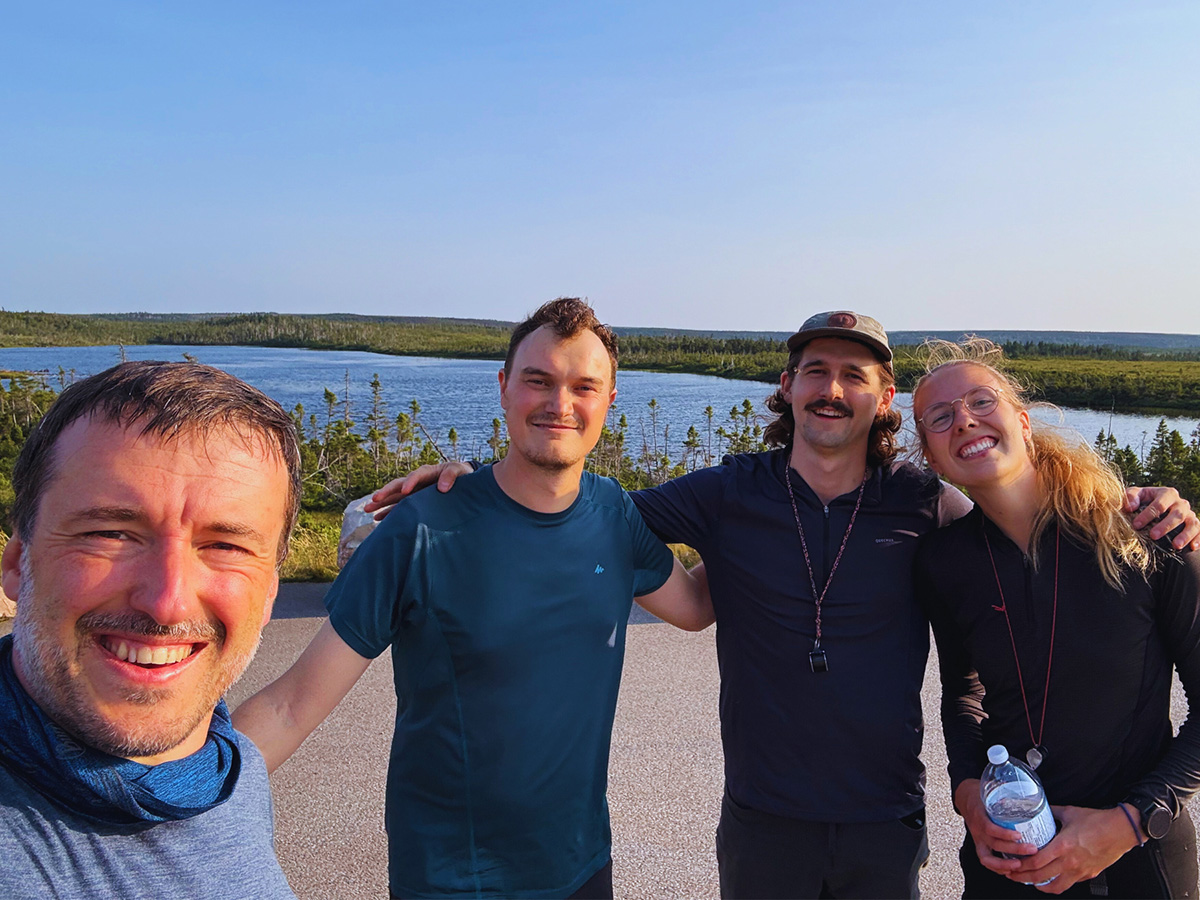
     (from left to right) Pierre Lanari, supervisor and professor, Jonas, postdoctoral researcher, Philip and Noralinde, doctoral students

    Nora and Philip, two doctoral students from the Faculty of Geosciences and Environment at UNIL, take us on a field trip to Canada, where they went to study metamorphic rocks.

    Goedendag ! Salut ! We are Nora and Philip, two PhD students in Metamorphic Petrology at the University of Lausanne (UNIL). As part of the research group for metamorphic processes we work on a multi-year research project trying to deepen our understanding about the extent and mechanisms of rock metamorphosis, i.e. the transformation of rocks by burial and heating in the Earth’s crust.

    This transformation occurs when rocks are buried deep underground—for example, during mountain formation—and subjected to high temperatures and pressures, which alter their composition and structure.

    In the summer of 2025, we travelled across eastern Canada for a three-week field campaign to collect rocks that were once mud and clay sediments. These sediments were buried deep in the Earth and transformed by heat and pressure, and we studied how that transformation happened. Our fieldwork took us first to the Cape Breton Highlands National Park in the Canadian Appalachians, and then north to Labrador City, within the Grenville Province — both regions offering unique windows into the deep roots of the ancient Appalachian and Grenvillian mountain belts.

    Our project aims to improve thermodynamic models of metamorphism by characterizing the mineralogy and chemical composition of metapelites across a wide pressure–temperature range, from low-grade metamorphism (~300 °C) to the onset of partial melting (~900 °C). Understanding this evolution is critical for reconstructing the tectonic history of continental crust and deciphering how fluids and volatiles, such as water, behave and move during mountain-building processes.

    Cape Breton — Exploring a Metamorphic Gradient in Steep Forested Valleys

    Our first stop was Cape Breton Highlands National Park in Nova Scotia, a region of steep forested valleys, streams, and waterfalls. Here, outcrops of metamorphic rocks are beautifully exposed by the on-going erosion in the steep brooks. This erosion exposes rocks from deeper levels within a former mountain range the further inland we walk from the coast, as previous studies have shown. This systematic increase of the metamorphic conditions is called a metamorphic field gradient. During our fieldwork we follow these gradients in metamorphic conditions to sample rocks with minerals that formed at ever increasing temperatures and depths, i.e. metamorphic grades.

    terrain canada 1
    Cap Breton, outcrops of metapelitic rocks next to the road.

    Each day, we ventured into the forest in pairs, mapping rock layers and structures, noting the minerals visible in the field, and collecting samples spanning a range of metamorphic grades. The rocks along the coast are still fine-grained and made almost entirely of micas, which are flaky minerals that develop when clay particles are heated and compressed, turning soft mud into harder, layered rock. When we hiked further up the brooks we found a typical sequence of garnet, staurolite and kyanite appearing on after another in the rocks changing their appearance from a slate into a beautiful micaschist.

    Working in such dense forest required careful planning and an awareness of local wildlife. Bear spray and bells – allowing us to warn the bear of our presence – accompanied us on every hike, though the only bear we saw remained safely in the distance, visible from our car.

    Labrador City — High-Pressure Rocks in the Grenville Province

    After a week in Cape Breton, we headed north to Labrador City, in the heart of the Grenville Province, in the heart of the Grenville Province—a classic metamorphic terrane, meaning a large area made of rocks that share the same ancient history. Here, the landscape conceals ancient roots of the Grenvillian orogen, a massive mountain belt formed more than a billion years ago during the assembly of the supercontinent Rodinia.

    terrain canada 7
    View of the Canadian forests and lakes.

    Using the same systematic sampling strategy, we collected metapelites across a metamorphic gradient. In the Grenville province the metamorphic rocks preserve evidence of unusually deep burial and, in places, conditions approaching partial melting. Despite long days and the challenge of navigating remote terrain, the reward was a diverse and scientifically valuable sample set.

    Fieldwork in Labrador required more logistical planning. Outcrops were scattered and often hidden beneath dense boreal forest, so we relied on geological maps, satellite imagery, and forestry tracks to locate suitable sites. Our sampling focused on the metamorphic sediments, that preserve evidence of deep burial and the earliest stages of partial melting. In the beautiful forest floor of Labrador, mosquitoes and midges presented a constant challenge, prompting the use of protective head nets while we worked.

    Beyond collecting rocks, we also visited a nearby iron mine, where ancient, banded iron formations are still being extracted, a striking reminder of the long history recorded in these landscapes.

    terrain canada 10
    Iron mine next to Labrador City

    From Field to Laboratory — What Comes Next

    Back at the University of Lausanne, the fieldwork transitions into the next phase of research. The samples we collected will be prepared as thin sections for microscopic study, analyzed for mineral composition and zoning patterns, and measured for their whole-rock chemistry. These data allow us to reconstruct the pressure and temperature conditions the rocks experienced, refining thermodynamic models of metamorphism. In particular, this work sheds light on how fluids and volatiles are released or sequestered during mountain building, an important aspect of the deep Earth’s volatile cycles.

    terrain canada 11
    Large garnet minerals (red) in a metamorphic rock.

    Lessons from the Field

    This field campaign reminded us that geological research is as much about people and planning as it is about rocks. It demanded careful organization, adaptability, teamwork, and attention to safety, all while navigating remote and beautiful landscapes. More importantly, it provided an exceptional set of samples and observations that will fuel our research for years to come. After three weeks immersed in Canada’s wilderness, we returned inspired by the landscapes, the geology, and the stories these ancient rocks are ready to tell.

    Partial melting and granite formation

    Partial melting during metamorphism occurs when temperature and pressure conditions exceed the melting point, causing small amounts of magma to form within solid rock. In metapelites, partial melting generally occurs at high temperatures (> 650–700 °C), often in the presence of fluids. Typical reactions involve the dehydration of micas and the formation of magma accompanied by residues rich in quartz, feldspar and garnet. The process of partial melting plays a major role in element mobility and crustal differentiation, as it produces magmas that can migrate and form granitic plutons.

  • A transdisciplinary field school for understanding how past human activities are still shaping the biodiversity of Gabon’s ecosystems

    A transdisciplinary field school for understanding how past human activities are still shaping the biodiversity of Gabon’s ecosystems

    Gretchen Walters, Institute of Geography and Durability

    Prof. Gretchen Walters recently joined Gabonese colleagues and international partners in Doumé to study and teach with them how past human activities are still influencing biodiversity in Gabon’s areas that may appear “natural”. This research aims to better manage and protect biodiversity, taking cultural and historical practices into account.

    By Gretchen Walters

    Viewing the forest and savannas from a plane or drone, the expansive ecosystems look almost uniform, and natural. But if one knows how to read the landscape, it’s a completely different story: the ecosystem bears the marks of its history in its flora, fauna, soil, and its people. 

    Studying biodiversity is at its best when it brings together different disciplines and stakeholders to understand the issues. In June and July 2025, Professor Gretchen Walters taught in the Ecole de Terrain “ECOTROP” in Gabon to students and professionals from the national parks agency, in collaboration with teachers from Gabon, France, the UK, the US, Swaziland, and Greece. The goal was to conduct research with students and teach tools and methodologies that would allow to understand the biodiversity of Gabon’s ancient villages which are scattered throughout the forest.

    27 participants1  and several professors from the Université Omar Bongo (UOB, with which UNIL has an agreement), Université des sciences et techniques de Masuku (USTM), the Gabon national parks agency, and five American universities, set out together to find out.

    plan village gabon
    Drone image of the village of Doumé. Photo : D. Mouketou-Tarazewicz.

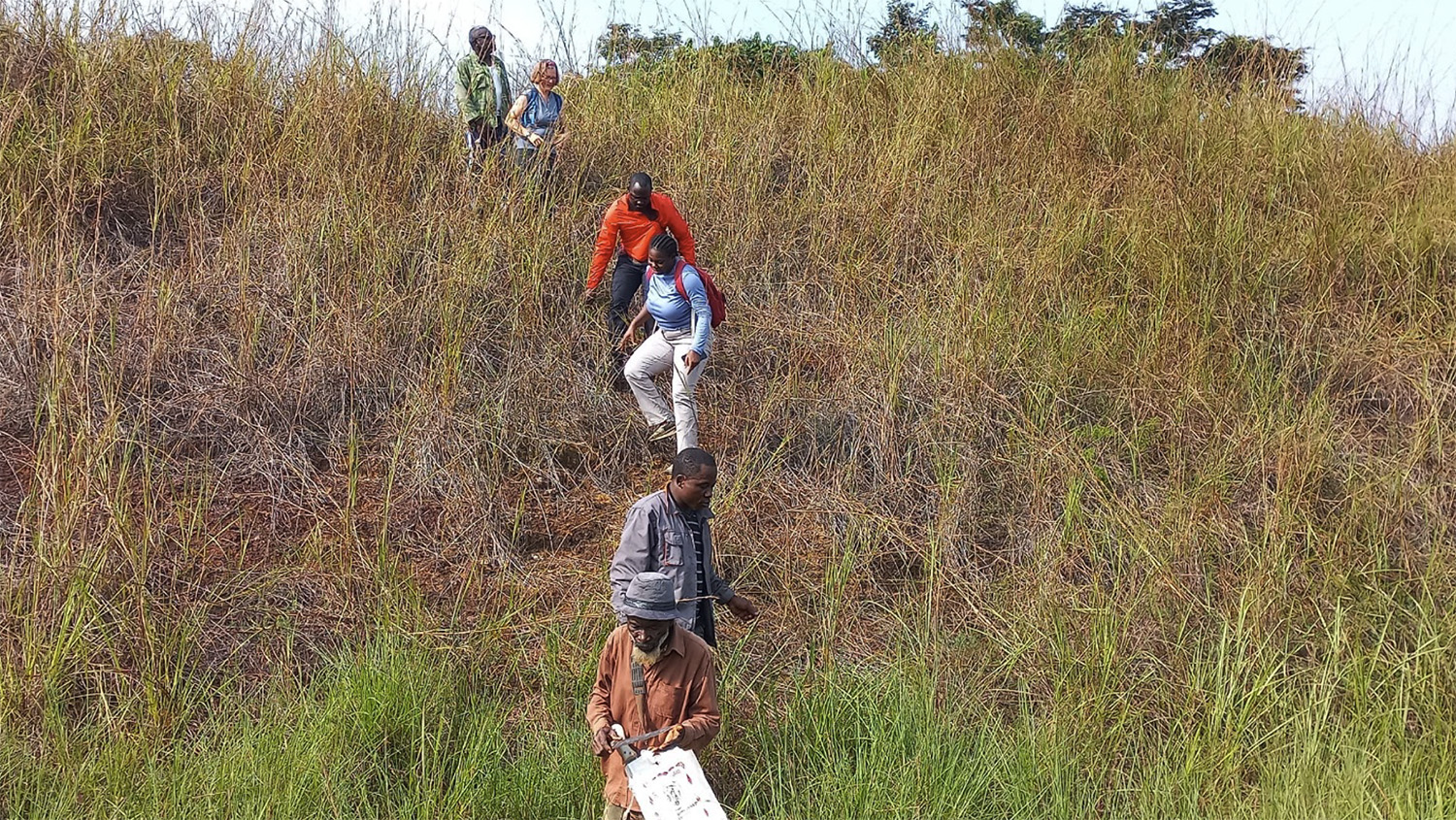
    Over the course of three weeks, we studied the biodiversity of former village sites in Gabon around the village of Doumé in collaboration with members of the Kota, Adouma, Bongo, and Awandji ethnic groups, who have lived in this forest-savanna mosaic at the edge of the Ogooué River for several hundred years.

    Prof. Gretchen Walters
    image
    Doumé village, Gabon

    Gabon’s forests were previously extensively settled with villages and their associated territories occupying vast areas. However, during the colonization by France, villages were forced to move to the roadsides, in what is called the “Regroupement”, a process that occurred from 1919 to the 1970s. This far-reaching colonial policy displaced villages, but did not displace land use. People regularly return to these former villages and they still are part of village hunting territories and remain important for cultural reasons. However, most research does not account for these parts of the ecosystem, tending to focus on places which appear to have less human influence. Thus, this field school and the related FNS forest history project aims to fill these important gaps, and to account for how people have shaped the ecosystem over time.

    In ECOTROP, participants become members of a one of the following thematic “ateliers”: archaeology, pedology, botany, zoology (birds and mammals), and participatory cartography. Each atelier is led by a researcher, and the results of each atelier contribute to answer our research questions about understanding the role of people in modifying soil and biodiversity. Using a variety of methods, each atelier documents the biodiversity, social history, and soils of a former village and a neighboring comparative site which has never had a village or an agricultural field.  UNIL’s contribution to the field school is to bring an environmental anthropology approach using transdisciplinary methods, which collaborate with experts from the four ethnic groups of Doumé. While the field school is funded in part by an National Science Foundation grant from the US, UNIL’s participation is from a sister project, funded by the FNS, which also focuses on understanding the legacies of the past forest land use.

    This year, we focused on the former villages of Mabouli and Manenga while the archaeology team worked in the nearby Youmbidi cave. Each team works with community members, but in the participatory historic cartography one, these community members become experts that we work with, since we are documenting their village histories.

    During our fieldwork, our work was documented by  Victor Amman, a graduate of UNIL who creates science documentaries. We look forward to seeing his film early next year!

    When we are finished with our research, we present our findings back to the community members in Doumé and in the nearby cite of Lastoursville. This is an important step for participants to learn how to communicate their findings to the general public and most importantly, for the host communities to understand what we did. We look forward to working with them again next year.

    ECOTROP is a field-based research class that has been held in Gabon and Cameroon since 2011.

    The Consortium is led by the Gabon National Parks Agency in partnership with the USTM and UOB, along with numerous other universities outside of Gabon, but notably the University of New Orleans and the Institute of research and development of France. The field school is largely financed by a grant the United States National Science Foundation to the University of New Orleans and TOTAL. UNIL became a partner of the ECOTROP Consortium in 2025,  and participates in ECOTROP as part of a wider FNS project on a related subject in Gabon. 

    entretien doume
    Interview in Doumé village, participatory historical mapping workshop. Photo: B. Ngonda Makita.

    1. Participants are called “apprenants” because they may be university students or professionals from the national parks agency. ↩︎
  • Using rock surface luminescence dating to understand the dynamics of a glacier: a new approach initiated this summer at the Mer de Glace

    Using rock surface luminescence dating to understand the dynamics of a glacier: a new approach initiated this summer at the Mer de Glace

    This summer, three young scientists including Léa Rodari (student of the master in Environmental Science) went to the Mer de Glace (Chamonix, France) to extract icebound rocks.

    Their aim is to measure the time during which these rocks have passed through the glacier, using rock surface luminescence dating. This fieldwork marks the first step in a novel approach to directly quantifying the movement of ice and the objects it contains.

    Glaciers are not inert objects. Their mass is constantly moving from top to bottom, under the effect of gravity. With melting due to global warming, we are currently finding all kinds of debris, material – even human remains – at the end of the glacier tongue. Most often these objects were buried well upstream and were transported down with their surrounding ice. But how long did it take for these particles to make their journey and remain buried in the ice? Currently the evaluation of glacial dynamics (= speed of movement of the glacier) is mainly based on theoretical data and numerical models. Prof. Georgina King and her team are seeking direct observations of the glacier’s movement. To do this, she intends to determine the duration of burial of rocks that have been buried within the glacier, until their re-appearance in the open air. This new approach to the study of glacial dynamics is based on applying the luminescence dating technique to minerals contained in rocks. 

    The idea for the project comes from the fact that, although we know a lot about glaciers, we don’t know how long it takes to transport fragments within them, and that is because there were no methods available that you could use to really measure that.

    Glacier movements can have consequences for the downstream water regime (e.g. flash floods) or for the stability of glacier margins, for example. It is therefore important to understand glacier dynamics in order to better anticipate these risks.

    The first stage of this research took place this summer at the Mer de Glace above Chamonix (France). Léa Rodari student of the Master in Environmental Sciences and Audrey Margirier (post-doctoral fellow at the Institute of Earth Surface Dynamics – IDYST) shared their field experiences in this landscape that is both magnificent and physically and technically demanding.

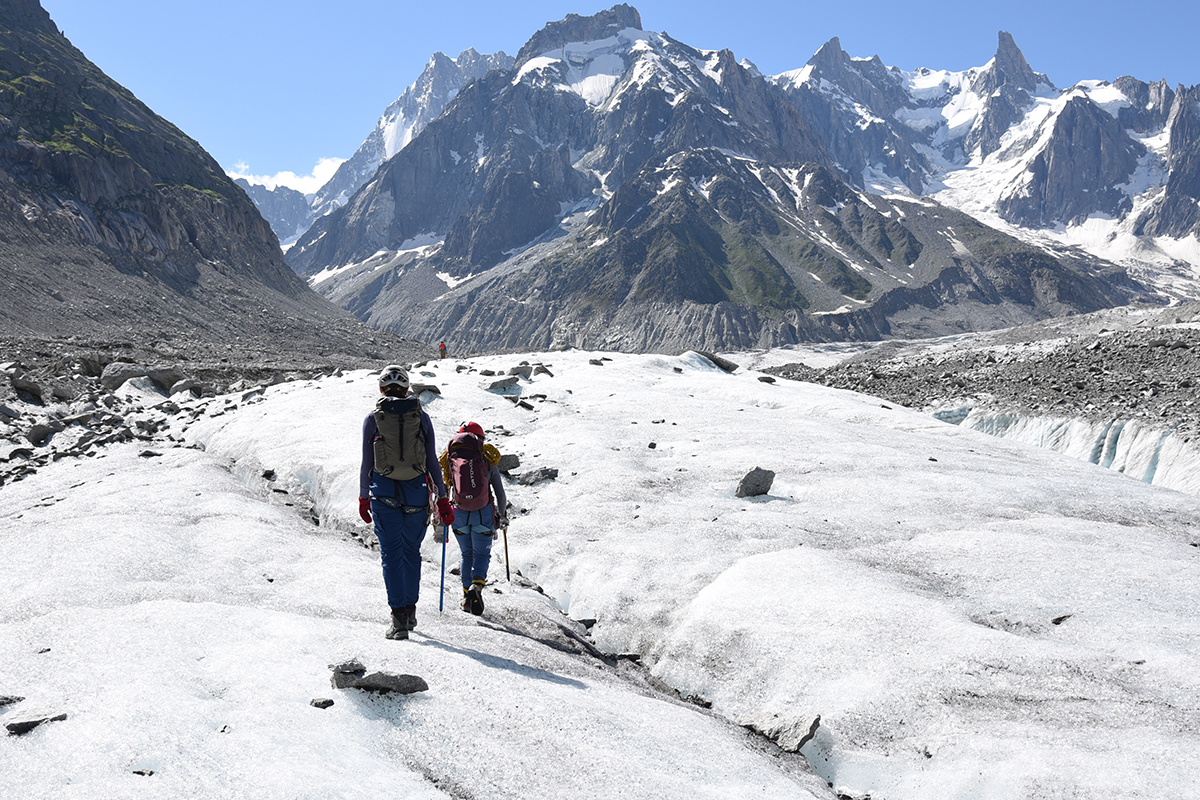
    The first challenge of this expedition was to find interesting sites in the middle of the immensity of the glacier tongue, covered with rocky debris. The young scientists walked for two days to spot potential samples. One of the main difficulties was to distinguish the recently fallen rock debris from the summits from those that had stayed within the ice. In order to circumvent this pitfall, they took the option of concentrating their research on steep slopes (bordering crevasses or the supraglacial river,) which are free of debris that had fallen from the summits (i.e. where it was certain that the debris were englacial). The second challenge was to access these samples trapped in the ice cliffs.

    Sometimes we spotted an interesting rock on an ice slope in front of us, but we didn’t see it at all once we got to the top of the cliff, the wall being too vertical. Several times we had to rappel “blind”.

    Audrey Margirier

    The rocks extracted from their surrounding ice were directly packed in opaque black bags to protect them from daylight, which interferes with the luminescence analysis. These samples were then prepared in the laboratory: cores were cut from the surface of the rocks, then sliced into thin 1mm discs. These operations were carried out in red light so as not to disturb the luminescence signals of the minerals in the rock.

    Prof. Georgina King explains what luminescence in rocks is

    Luminescence is the emission of light by minerals contained in rocks. The reason for this light emission is that these minerals, over time, have been exposed to radiation emitted by surrounding minerals, causing electrons to shift and become trapped in defects within the mineral. Exposing these samples to light of a certain frequency or color in the laboratory (in this case, blue or infra-red light), causes these electrons to return to their original orbit. This movement is accompanied by the emission of light of a different color, which can be measured. The amount of light emitted corresponds to the time during which the samples remained buried in the glacier, and therefore to the time it took the glacier to transport these rocks into the ice.

    It now remains to perform the luminescence analyses. This work will determine the duration of burial of the rock (time during which it was plunged into darkness within the glacier). The team is excited to get the first results to compare them with the values used so far. Georgina King concludes :

    We hope that the values we obtain will agree with the values predicted from numerical models. Otherwise, we will have some interesting discussions with the glaciologists to identify where the differences lie.

    Georgina King
    View of the Mer de Glace glacier with the Mont-Blanc massif in the background

    Going into the field involves risks

    They are quite high in this particular case, and required appropriate measures that were effectively put in place to ensure smooth operation. The FGSE has drawn up a guideline and a process to enable scientists going into the field to prepare their outing and assess the risks involved (preliminary risk assesment). External resources for information on the nature of the terrain are also mentioned (e.g. WSL-natural hazards for excursions in Switzerland).

    In the case of this research involving work on a glacier, people going out on site must undergo an appropriate prior training especially if they have no or weak previous practical experience on this field and its constraints (snow cover, crevasses locating, wheather analysis and monitoring etc.) use of equipment (proper use of crampons, ropes etc.) In this particular case, lone working is outlawed: as a precaution, activity on the glacier must involve the simultaneous presence of at several people, as this team of three scientists. 

    So even though the images may reflect an idyllic landscape, and “fun” activities, this fieldwork, like all others, required a very meticulous preparation and prior training to ensure that risks are minimized in terrain conditions which, as the images show, are very demanding for participants. Risk is always present, even for experienced and well-equipped people, and must be a constant concern, both for others and for ourselves.

    Directive FGSE sur la sécurité du travail de terrain

  • Studying the impact of glacier retreat on biodiversity

    Studying the impact of glacier retreat on biodiversity

    Gianalberto Losapio, Institute of Earth Surface Dynamics (IDYST)


    Glaciers are the guardians of an entire ecosystem, and their disappearance caused by global warming will lead to a dramatic decline in biodiversity.

    In the field, the members of the Biodiversity Change Group are studying and documenting the impact of glacier retreat on biodiversity and ecosystem. Meet the group.


    “It may seem counter-intuitive, but glaciers and their surroundings provide very favourable conditions for biodiversity,” explains Gianalberto Losapio, PI at the Institute of Earth Surface Dynamics from the Faculty of Geosciences and the Environment (FGSE). “With the disappearance of glaciers, we are losing plant species, some of which may have strong medicinal potential, but also the fauna such as pollinators and predators associated with them”.

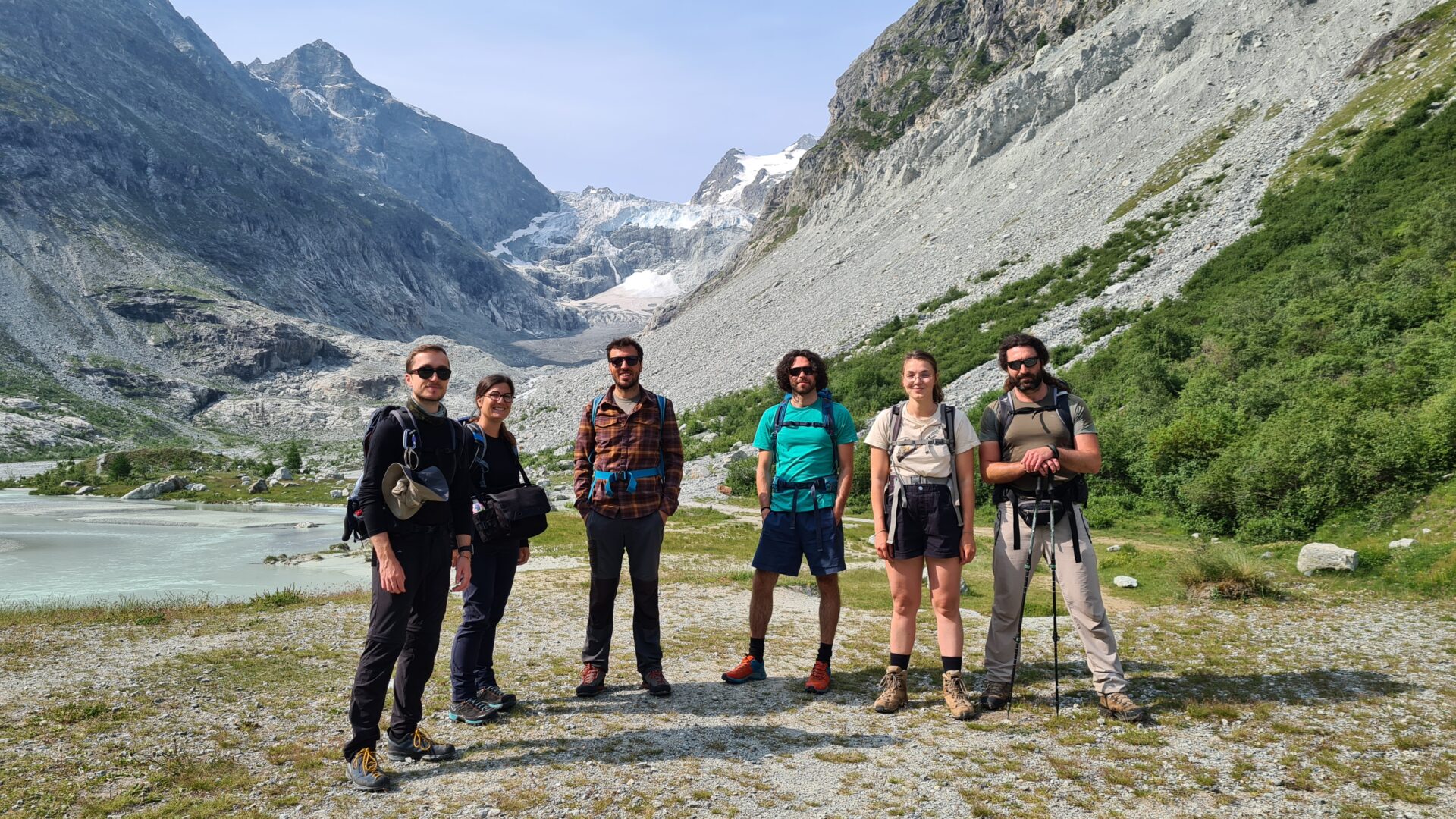
    With his Biodiversity Change research group, Gianalberto Losapio is spending part of the summer in the field at Ferpècle in Valais, documenting and studying the impact of glacier retreat on biodiversity and ecosystem functions. For several weeks, Bachelor and Master students, doctoral candidates and scientists from various countries are carrying out insect and plant surveys, analyzing soil and gas emissions, and parametrizing models to predict the distribution of species and conserve biodiversity.

    “Overall, we know that melting glaciers initially lead to an increase in biodiversity, with the arrival of pioneer plants and the colonization of insects. But over time, only few competitive species gain the upper hand such as larches and rhododendrons which ultimately dominate the scene”, explains Losapio. “This mechanism is already clearly visible to the nake eye. One of the missions of our group is to study ways of preserving this biodiversity”.


    This is the case of Luca Eiholzer, who is doing a master’s degree in environmental sciences at the FGSE. Equipped with a square meter and a GPS, he lists the presence/absence of targeted species – i.e. bioindicator species such as trees, moss, etc.– in around a hundred randomly distributed points in the proglacial margin. This data is then used to draw up an assessment of the current situation and projections for the distribution of species, with the help of machine-learning algorithms. “We hope that this information will be useful for the authorities, helping them, for example, to define areas to be protected. At the same time, being out in the field allows me to come face to face with the difficulties of collecting data. It’s very instructive.

    ”Eléa Pierre, a Master student specializing in geosciences, ecology and the environment, is interested in the influence that the presence of livestock can have on glacier margins. “I’m carrying out plant surveys around the Zinal, Arolla and Ferpècle glaciers,” she explains. “The idea is to compare changes in biodiversity depending on whether or not there is grazing around the glacier.
    There is a lot of uncertainty around the effects of livestock in these novel ecosystems.

    But according to our knowledge, large herbivores shape their environment, and not the other way round, through their diet, their dropping, trampling and their general behavior. These data could therefore be used to develop different conservation scenarios for sustainable management as these pastures are currently used by local population”.”


    Preparing for professional life

    Data collection generally lasts all day and is carried out by around fifteen people. The members of the group then meet up in a refuge, where they have their meals and spend the night. “Fieldwork is a great experience because, even though everyone is working on a specific project, we can talk to other researchers, help each other and work together,” says Eléa Pierre. Gianalberto Losapio adds: “We want the projects to be carried out independently, from start to finish. The idea is to prepare students for professional life.”

    Art meets science

    The work and research carried out at Ferpècle also include an artistic component. Gianalberto Losapio is collaborating with visual artist and artistic researcher Maëlle Cornut, who is following the group in the field. Funded by Pro Helvetia and the Swiss Polar Institute, the art-science project, which will run for almost two years, focuses on the consequences of the extinction of glaciers on ecosystems, but also addresses broader concepts such as ecofeminism, ecology decolonization and climate justice. It will include videos superimposing micro images of plants and insects and landscape images to show the interconnections between the various scales. “So far, we’ve done a lot of research and shared our practices and ideas. I’ve now started the production phase, installed several cameras traps, and the concrete part of the project is about to begin”, she explains.

  • Jorat Natural Park : first steps towards long-term monitoring

    Jorat Natural Park : first steps towards long-term monitoring

    A new peri-urban park was born in the Jorat woods in 2021, becoming the second of its kind in Switzerland.

    Pascal Vittoz (IDYST) is involved in the initial monitoring of this forest, which is entering a new phase following the complete cessation of logging. How will this forest landscape, a favorite walking spot for Lausanne residents, evolve over the next 50 years? The first milestones have been set, and now we’ll have to let the forest give us the answers, at its own pace.

    Armed with a map and a compass, Pascal Vittoz ventured through the thicket in search of the plot he was to survey today. A traverse through the brush reveals an area dominated by spruces. These conifers, planted in the 19th or early 20th century because of their rapid growth, are still predominant today. Without human intervention for economic reasons, this area would be covered with fir and beech today.

    How will the forest, its wildlife and its inhabitants evolve in the future? That’s what this study is all about. Pascal Vittoz is in charge of monitoring the flora, in particular the undergrowth, in order to study the consequences of the creation of the forest reserve on floristic diversity. These surveys will be carried out every 10 years, in collaboration with a commissioned botanist, Loïc Liberati, former student at FGSE (Faculty of Geosciences and Environment) and Patrice Descombes, former student at FBM (Faculty of Biology and Medicine), and current curator at the Lausanne Botanical Garden. They share the 132 monitoring points randomly distributed throughout the forest plots, according to a plan drawn up by the Swiss Federal Institute for Forest, Snow and Landscape Research (WSL), with the aim of observing the future of the forest.

    The Jorat Natural Park is divided into parcels to facilitate and organize flora monitoring. In the north, the park’s “core zone” is no longer managed by foresters. (Photo: A. Dreiss).

    The new Jorat Natural Park aims to encourage the presence of dead wood. With it, certain birds that burrow into old trunks, beetles whose larvae feed on wood and fungi that decompose dead trees will flourish. One part of the forest – the central zone of the park – will remain untouched for the next 50 years: no cutting, no logging, no off-trail passage. It will simply be left to its natural evolution, with the exception of a few necessary cuts to ensure trail safety. In the transition zone further south, towards the Chalet à Gobet, logging will continue as before, but certain measures will be put in place to promote biodiversity and welcome the public.

    In each plot, the botanists examine two concentric surfaces around the point selected at random by WSL. They describe the structure of the forest and list the flora in the herbaceous, shrub (less than 3 meters high) and arborescent (more than 3 meters high) strata. This gives us an idea of regeneration: if a tree type is present in all strata, it has a good chance of remaining in the future forest.

    The botanists draw up a complete inventory of the flora in two concentric zones, starting from a central point marked on the photo by a blue stake. The first disc, measuring 10 m², corresponds to the standard used for biodiversity monitoring in Switzerland. The second, measuring 200 m², gives a more complete picture of the undergrowth flora, providing a better description of forest structure, such as tree size and proportion of dead wood.

    Pascal Vittoz measures the tree stratum using a convex grid mirror.

    A beetle trap suspended in the middle of the plot bears witness to the various monitoring activities carried out by other groups of scientists. To explore the future of the forest, regular surveys are carried out to study its uses (pedestrians, bicycles, horses) and fauna (beetles, batrachians, deer…).

    After logging ceases, we can expect the trees to age, leading to a denser, darker forest, with less light reaching the ground and therefore fewer plant species in the undergrowth. However, the vagaries of storms and climate change make predictions difficult. Spruces, for example, could suffer from the heat and be partly decimated by attacks from the bark beetle. In a conventional forest, foresters cut down affected trees to contain their proliferation. But what will happen when there are no longer any health checks on the trees? Will the bark beetle spread further? Will their presence favor species other than spruce?

    « This reserve is set up for 50 years, which is more than half a human lifetime, or about ten times a standard research project. » Pascal Vittoz

    So we’ll have to wait to see the benefits of this park materialize. Typical research projects are planned to last 3 to 4 years. In this case, that’s not long enough to study forest flora, which evolves very slowly. This study, which spans the entire lifespan of a tree, will not deliver its results for several decades.

    What do botanists find in the Jorat woods?
    Wood horsetail
    (photo : P. Vittoz)

    The forest is dominated by spruce and beech, with undergrowth often lacking in plant diversity. However, some wetter areas, such as ash groves, offer surprises and less common species. Horsetail, a common species in the Alps but much more widespread on the Plateau. Horsetails are among the oldest plant species, having appeared nearly 400 million years ago. Some species were important trees in the Carboniferous period, while today’s largest representatives grow to around 1 m.

    More informations