

This publication is also available in :
 English
Thèse en sciences de l’environnement, soutenue le 25 juin 2026 par Wenyue Zou, rattachée à l’Institut des dynamiques de la surface terrestre (IDYST) de la FGSE.
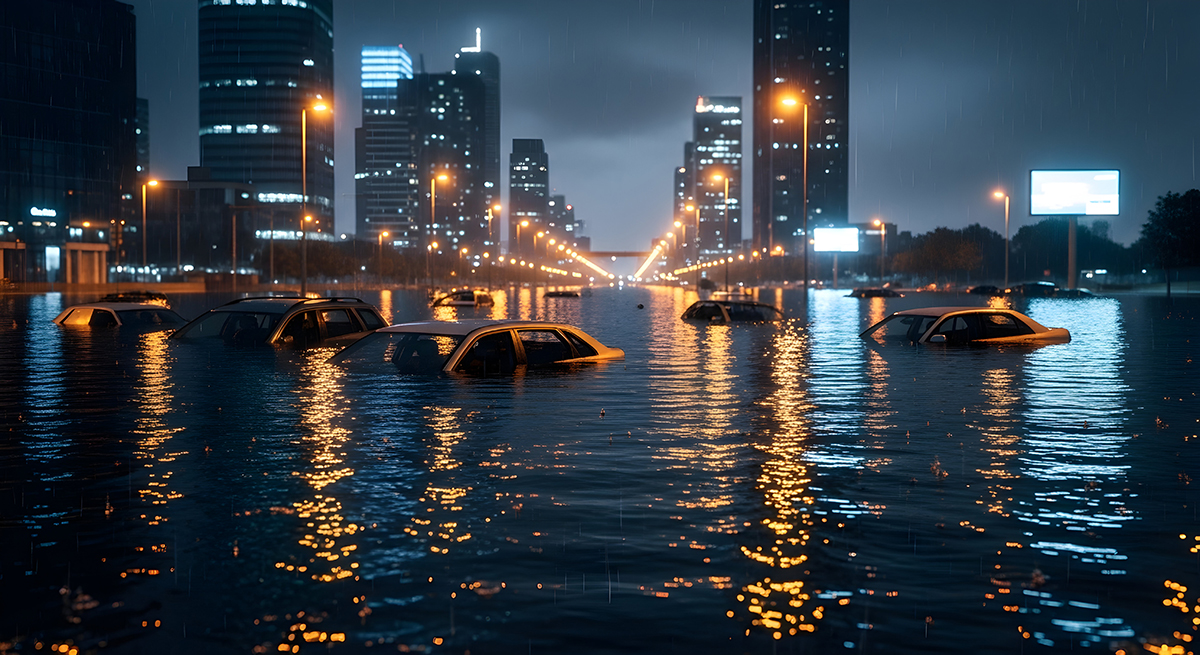
Cities around the world are becoming increasingly vulnerable to sudden, intense rainstorms. These short bursts of heavy rainfall can overwhelm drainage systems within minutes, leading to dangerous urban floods. With climate warming, such events are expected to become more frequent and more intense. Understanding future changes in storm intensity, spatial structure and corresponding urban floods is therefore essential for climate-resilient urban planning.
However, today’s rainfall and flood projections remain limited by the lack of long-term, high-resolution rainfall data, the inadequate estimation of nonstationary rainfall extremes, and the absence of flood assessments that integrate future changes in both storm intensity and spatial structure.
This thesis develops an observation-based and physically grounded approach to fill these gaps. It provides an efficient and scalable way to project how extreme rainfall and urban flooding may evolve under climate warming. The framework is built on three main elements:
1. Downscaling high-resolution rainfall datasets
A new spatial downscaling method was developed to convert coarse satellite rainfall data into long-term, high-resolution rainfall at the 1-km scale. Applied in Beijing, it successfully downscales 22 years of realistic storm series using only a limited amount of radar training data. Such high-resolution rainfall data are essential for regional storm and flood risk assessments.
2. Projecting future extreme rainfall
A lightweight projection method combines a novel spatial mapping with a stochastic storm model. This approach generates realistic future storm fields and updated intensity–duration–frequency (IDF) curves without the heavy computational cost of advanced climate models. For Beijing, the results show storms becoming not only stronger but also more concentrated in space, with extreme rainfall increasing by about 4% for every 1 °C of warming.
3. Simulating future urban floods
The projected storms were then simulated into a high-resolution flood model to estimate how water would move through streets under different warming levels (+1 °C, +3 °C, +5 °C). The findings reveal a nonlinear flood response: while rainfall intensifies with warming, the way storms shrink or shift spatially can amplify or dampen local flooding. This highlights that spatial rainfall patterns—not intensity alone—play a critical role in future urban flood risk.
Overall contribution
The thesis delivers a practical and transferable framework for assessing climate-driven changes in extreme rainfall and urban flooding, using widely available observations rather than expensive climate simulations. It opens the door to scalable city- or national-level climate-adaptive IDF maps—that many engineering and planning agencies urgently need.
Broader impact
This new methodology can support climate-resilient planning in rapidly growing cities as well as infrastructure-intensive countries such as China and Switzerland. Its applications range from urban drainage design and flood-risk assessment to long-term resilient city planning, helping to build climate-resilient and sustainable communities in a warming world.
Laisser un commentaire