Categories
Books Cities Communication Economy Graph analysis History MAPS Misc Networks Resilience SCIENCE Social network Social science Society Vizualization World

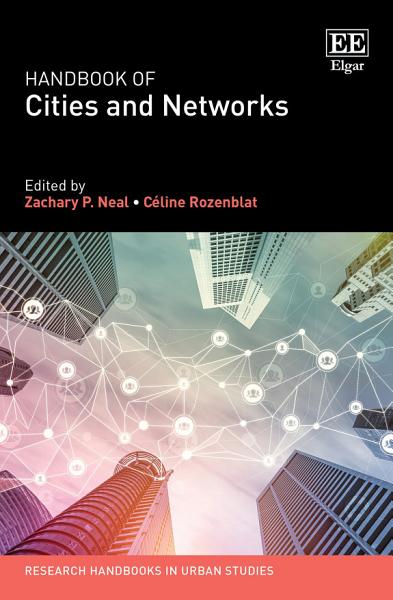
Handbook on cities and networks

Edited by Zachary P. Neal, Associate Professor, Department of Psychology, Michigan State University, US and Céline Rozenblat, Professor of Urban Geography, Faculty of Geosciences and Environment,Université de Lausanne, Switzerland

Publication Date: 2021 ISBN: 978 1 78811 470 7 Extent: 672 pp

If you want to understand cities – the innovation and dynamism they generate and the way they sort and segregate people by class, race and other dimensions – you have to start by understanding that cities are networks. Zachary Neal and Céline Rozenblat have done all of us who care about cities a great service by pulling together the very best and brightest thinkers on cities and networks in this terrific volume.
– Richard Florida, University of Toronto, US and author of The Rise of the Creative Class and The New Urban Crisis

This Handbook of Cities and Networks provides a cutting-edge overview of research on how economic, social and transportation networks affect processes both in and between cities. Exploring the ways in which cities connect and intertwine, it offers a varied set of collaborations, highlighting different theoretical, historical and methodological perspectives.

International contributions assess the state of the field of network analysis, presenting interdisciplinary insights that draw on theory from geography, economics, sociology, history, archaeology and psychology, and outlining methodological tools that include ethnographic, qualitative and quantitative approaches. Illustrating a framework for integrating the diversity of urban networks, the Handbook demonstrates that by exploring urban networks with different combinations of levels and scales, new insights and opportunities can emerge.

Featuring focused studies on specific regions and cities, this state-of-the-art Handbook is essential reading for scholars and researchers of urban studies and regional science, particularly those focusing on the transformation of cities as connected spaces through intracity and intercity networks. Its core theoretical insights will also benefit graduate students in urban studies and network analysis.
Categories
Graph analysis Networks SCIENCE Social network Society

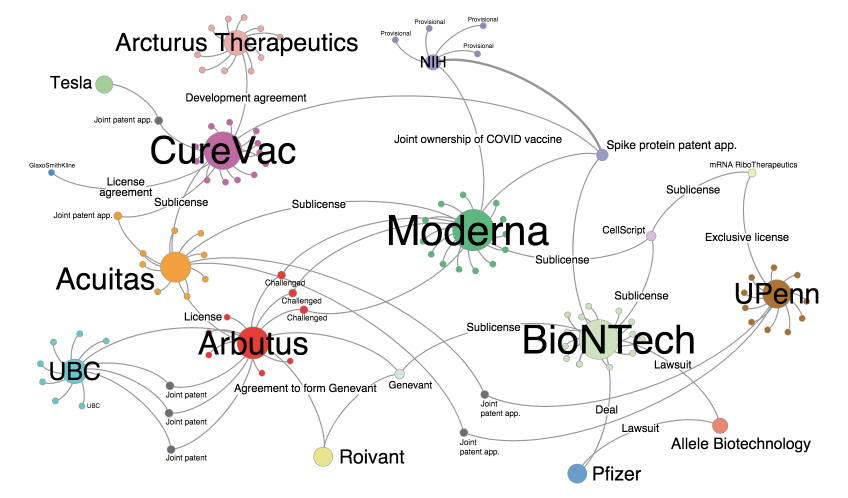
A network analysis of Covid-19 vaccines

The rapid development of Covid-19 vaccines has been underpinned by an intricate web of co-patents, intellectual property agreements and lawsuits. Showing them as a network can be useful to highlight the most relevant nodes and the relations they’re embedded into. A preliminary work on this has been recently featured in Nature Biotechnology. Besides reconstructing the main actors in the production of mRNA vaccines, the authors have also analyzed the landscape of scientific terms used in mRNA patents, using a network methodology and the software VOS viewer . A heated debate is underway around the possibility to limit intellectual property rights to facilitate the access to vaccines for developing countries, and network visualization tools can greatly help in understanding the complexity of the relations at stake.

Source: Gaviria and Kilic, 2021: A network analysis of COVID-19 mRNA vaccine patents. Nature Biotechnology, VOL 39, pp. 546–549.

Categories
Europe Geography Graph analysis Networks Social network Vizualization World

Navigating the supply chain network of strategic resources

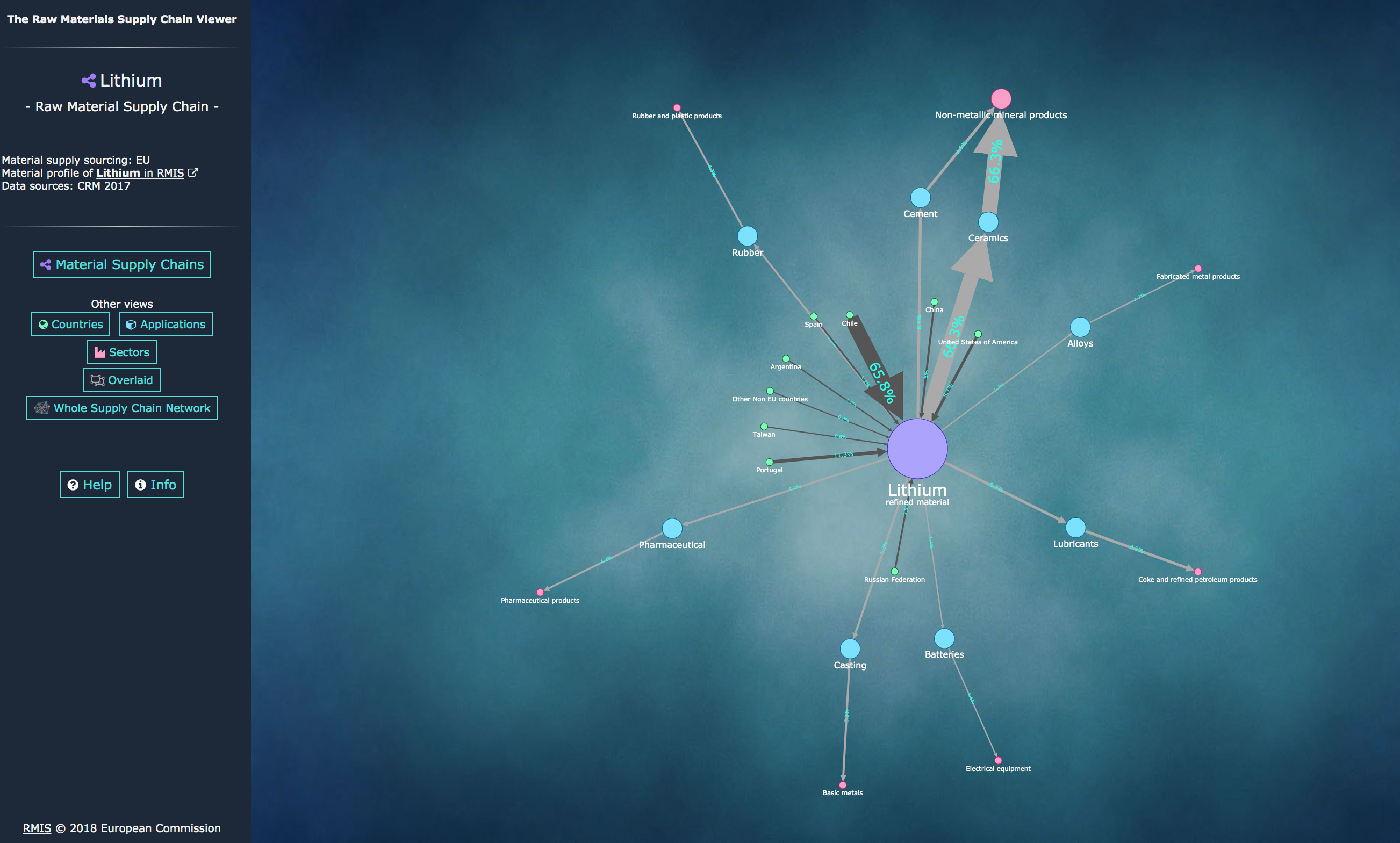
The European Union has recently acknowledged the strategic role of a number of critical raw materials that are used in the ICT, energy and defense industry. As a result, the Joint Research Center of the European Commission has set up a Raw Materials Information Center that collects legal, economic, trade and policy data on strategic raw materials. A particularly interesting tool is the Supply Chain Viewer, that allows to visualize the global production network of a number of raw materials along with the countries of production and the sectors in which they are employed.

“The raw materials Supply Chain Viewer (SCV) provides an overview of networks of selected raw materials supply chains, consisting of supplying countries, material products, product applications, and economic sectors using such products and materials.

Conceptually, this type of data representation is forming a directed graph, i.e. a network consisting of nodes or vertices (four different types, namely countries, materials, applications and sectors) connected together. These connections (named either links or edges) are representing the flows associated to a specific material. More precisely, in technical terms, this is referred to as an acyclicconnected and oriented graph, i.e. a directed graph without multiple/symmetric edges or loops.[5]

Data for the linkages among countries, materials, product applications and sectors were selected mainly from the EC criticality assessment (CRM 2017)[1]. Such underlying data refer to the period 2010-2014. For several cases, where data were not reported in the CRM 2017, missing data were collected from BGS[3] or Eurostat[4]. On each link, a detailing popup displays the data source. In the SCV graph, data is comprised in the connecting links and not in the nodes, these being simply connecting points in the network[2].”

For more information, you can visit the project page.

Categories
Graph analysis Social network Vizualization World event

Research on Covid-19: mapping scientific communities and their connections

What scientific literature is being produced and by which different scientific communities on the Covid-19 pandemic? Never before has scientific information been so quickly and widely produced, having a strategic impact in the public response to the Coronavirus crisis.

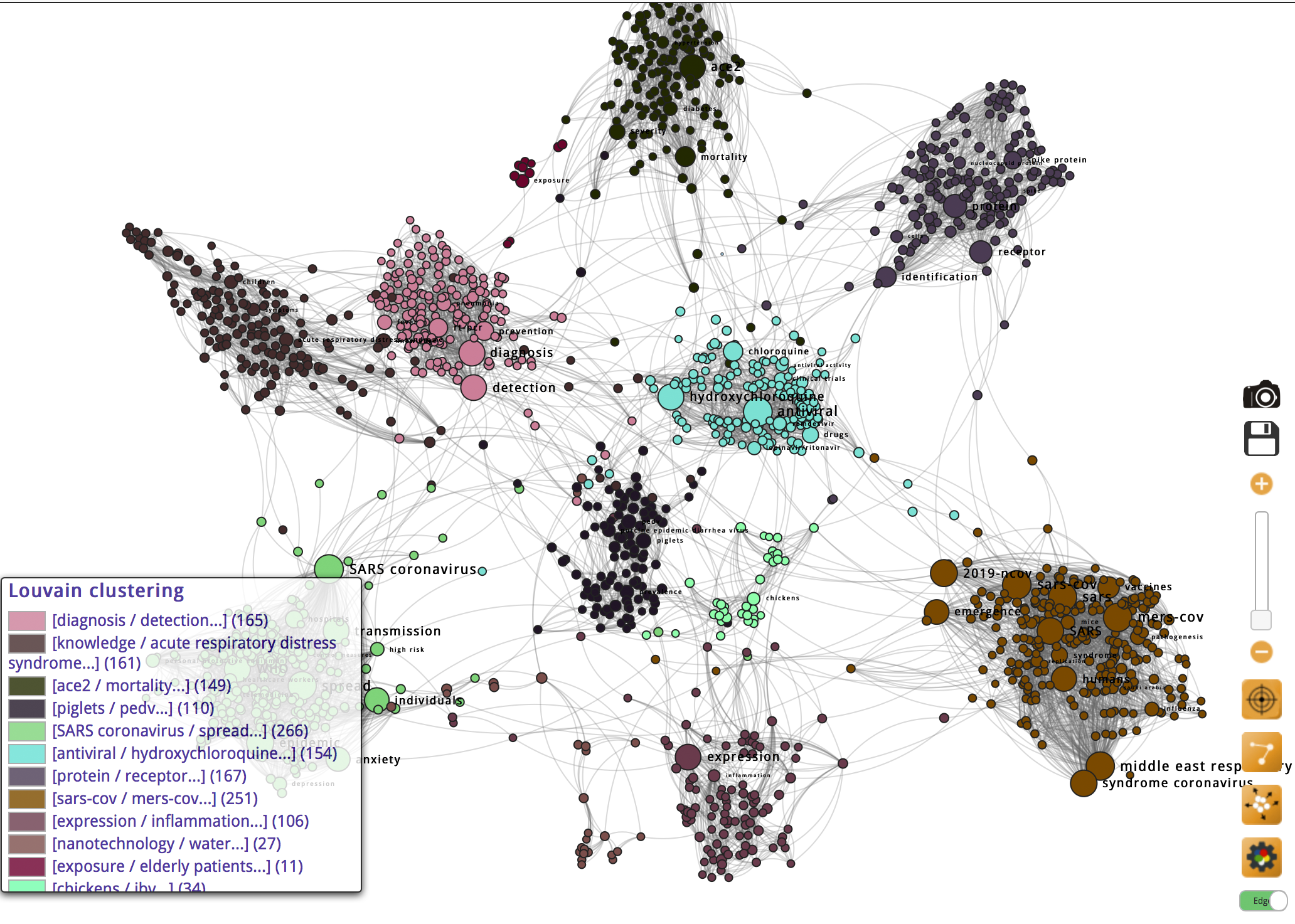
A group of researchers at the Institute of Complex Systems in Paris have produced an interactive visualization platform in order to map the scientific connections that are emerging around Covid-19. Using the online text mining platform Gargantext, developed within the same institute, they could feed the program a large number of scientific articles that have been analyzed in search of recurring patterns of word co-presence. You can check their work here.

“These maps has been realized using Gargantext from a PubMed Corpora with query “covid-19 OR coronavirus” on April 29 2020 (7.2k documents from Jan 2020 to April 28 2020). The methodology is described here

When you click on a term, the most related terms are displayed in a tag cloud on the right along with the Publications from PubMed that mention the most the selected terms.

In the Conditional map (the first map to be loaded), links between terms represent the conditionnal probability of having one terms knowing the other in a paper (its the confidence measure). It capture the interaction of terms within the document. This map depicts well the different communities working on covid-19 with their own research angle : biological mechanisms, diagnostic, treatments, social consequences, exposure of the elderly, etc. Node size in this maps reflect the degree of the node.

In the Distributional maps links between terms capture a proximity measure that takes into account the profiles of interaction of each term with the others. It can infer relevant relations between terms even if their haven’t co-occur in a paper (second order proximity measure). Node size in this graph is a fonction of the pagerank of the term in the graph.

The mathematical formula of these proximity measure can be found in the Gargantext documentation. “

Categories
Graph analysis Networks SCIENCE Simulation

The cosmic web and a slime mold: network patterns across scales

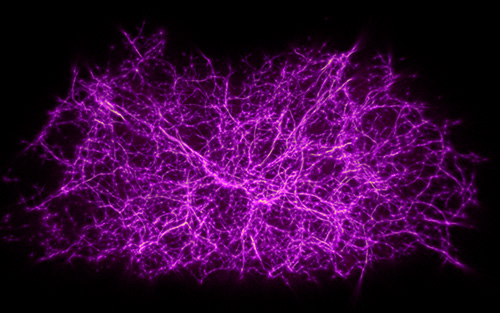
Is there a relation between a yellow slime organism called Physarum polycephalum, that  can be easily found on decaying trees and leaves in the forest’s shade, and the complex organization of galaxies?

Researchers Joe Burchett and Oskar Elek at the University of California at Santa Cruz created a 3D algorithm that represents how the slime builds its networked structures in space. Then, they applied the algorithm to a dataset of 37.000 galaxies, finding a rather precise representation of the cosmic web. In the words of one of the authors:

“That was kind of a Eureka moment, and I became convinced that the slime mold model was the way forward for us,” Burchett said. “It’s somewhat coincidental that it works, but not entirely. A slime mold creates an optimized transport network, finding the most efficient pathways to connect food sources. In the cosmic web, the growth of structure produces networks that are also, in a sense, optimal. The underlying processes are different, but they produce mathematical structures that are analogous.”

This is an interesting step towards understanding the laws of complexity and how they create similar structures across scales. Read the full contribution here.

Categories
Art Graph analysis Networks Vizualization

“L’art trouble, la science rassure” – Bringing art and network analysis together

Kirell Benzi is a data artist, speaker and data visualization lecturer. He holds a Ph.D. in Data Science since 2016, which he obtained at EFPL (Ecole Polytechnique Fédérale de Lausanne).

Building on very heterogeneous datasets (collaborations between musicians, patents, corporate links and much more) Kirell created a number of artistic network visualizations in which the insights from data are powerfully supported by the strength of the representation.

Please visit his outstanding network art gallery at: https://www.kirellbenzi.com

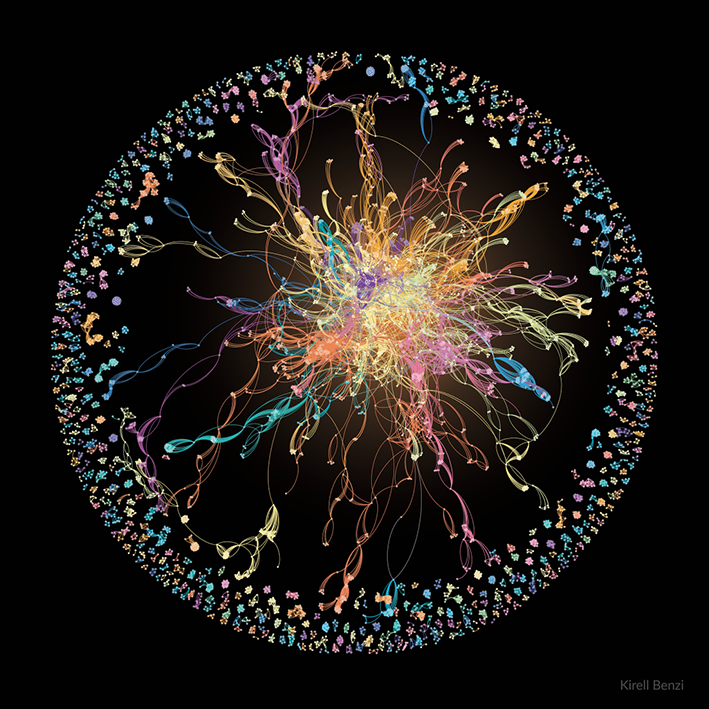
The featured image shows the network of Montreux Jazz musicians:

“This network shows with whom musicians of the festival play with, revealing two different categories of artists. At the border of the ring, we have the artists who only perform with their band, forming many disconnected communities. On the opposite, those who jam with everyone, the stars of the festival, are well-connected and are naturally located in the center of the ring. One of the brightest stars was George Duke, the champion of appearances at the festival with 53 concerts. In the center in orange, he faces the legendary guitarist Santana in purple.”


Categories
Cities Europe Geography Graph analysis History MAPS Networks Simulation Vizualization

ORBIS: the Stanford Geospatial Network Model of the Roman World

The system calculates the distance from a city to another one, according to faster path, or lower cost.

https://orbis.stanford.edu/

Go to “Mapping ORBIS”, It draws the path and create many different maps and graphs (in “Map gallery”). It’s a pity that the Emperors did not have this system 🙂


Categories
Art Books Cities Geography Graph analysis Networks Vizualization

Art and Geography

Three years ago, a friend of mine who is a genius artist (Catherine Bolle), asked me to do geography on her biography. She told me many things about her life, during some few sundays afternoon in the Beaurivage Hotel in front of the lake in Lausanne. It took one year to build the data and think about the pictures to produce. Then to build them and interpret with a nice text.

C_ROZENBLAT_BOLLE_PARCOURS

IMAGE_BOLLE

Categories
Cities Communication Economy Environment Geography Graph analysis MAPS Networks SCIENCE Simulation Social network Society Vizualization World

When Networks Network

The magazine Science underline the huge advance made in network analysis. Networks interact, create cascading effects……

read more in Science

Categories
Cities Geography Graph analysis Research project Simulation Social network Society Vizualization World

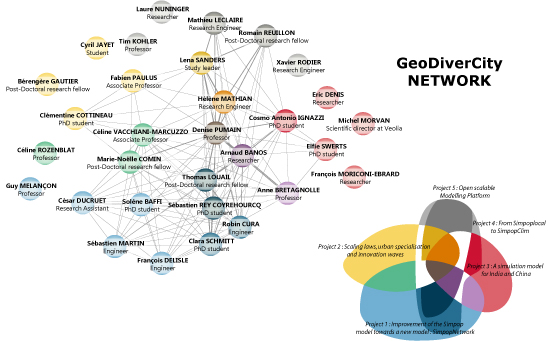
New Blog for the ERC project GeoDiverCity

https://geodivercity.parisgeo.cnrs.fr/blog/

Categories
Graph analysis Social network

Degree centrality and variation in tie weights

A nice and simple method to take into account both weights and dispersion of ties: by Tore Opsal

Method and examples