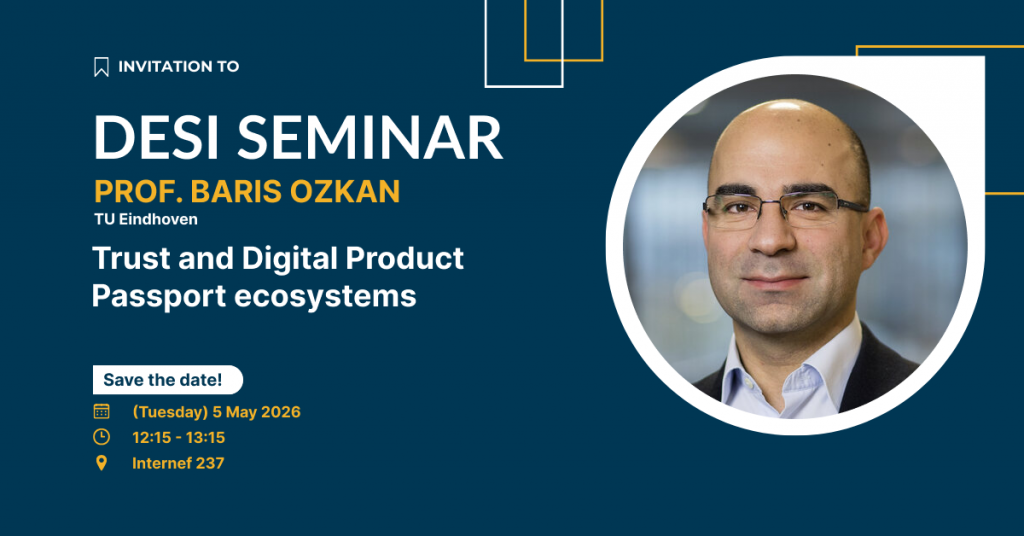
We are excited to announce that Prof. Baris Ozkan from TU Eindhoven, will be delivering a seminar on Trust and Digital Product Passport ecosystems.
Abstract: Digital Product Passports have emerged as key instruments for advancing circular economy transitions and regulatory compliance within the EU. Rather than being static, one-off compliance artefacts, DPPs function as dynamic ecosystem connectors that evolve throughout product lifecycles, requiring continuous data sharing and coordination among diverse actors, including manufacturers, suppliers, logistics providers, regulators, consumers, and recyclers. This lifecycle perspective highlights that DPP implementation entails the emergence of complex, multi-actor data-sharing ecosystems—contexts in which trust becomes a foundational enabling mechanism.
Yet a significant gap persists between this operational reality and current practice. DPP development has been predominantly shaped by top-down regulatory imperatives and technology-enablement (e.g. interoperability) agendas, rather than grounded in the trust requirements and operational realities of diverse DPP ecosystem participants. This requires an approach that conceptualizes trust not as a static trait but as a dynamic phenomenon that must actively travel and evolve across diverse DPP stakeholders, creating both opportunities for sustainable value cocreation and fragilities that cannot be resolved by regulatory frameworks alone.
In this seminar, a forthcoming interdisciplinary research project involving 10+ institutional and industry partners is introduced. The project draws on perspectives from requirements engineering, information systems, and organisational behaviour, and is aimed at bridging this gap. An interactive discussion will be held, and participants’ diverse perspectives, ideas, and insights will be welcomed to further refine and enrich the project concept and research direction.
Short Bio: Baris Ozkan works as an Assistant Professor at Eindhoven University of Technology, in the Department of Industrial Engineering & Innovation Sciences (IE&IS), subgroup Information Systems. His research interests center around Service Systems Engineering with a specific focus on the development of value co-creative methods and tools for the design and configuration of business processes, business services, business models and digital platforms. He has a background in business process management, requirements engineering, process maturity assessment, and quantitative software management. In his research, Baris adopts a design science research approach, draws on the theories of the social and management sciences to identify design requirements, and employs quantitative and qualitative empirical research methods including Bayesian inference and Grounded Theory.