
What if artificial intelligence could help us read between the lines of the past? From Peirce’s philosophy to the stories of the Montreux Jazz Festival, these projects explore how machines can enrich our memory, decode our emotions, and revive forgotten words. A deep dive where AI becomes a tool of interpretation, rather than a mere automaton.
Artificial intelligence at the service of culture, language and emotions
Davide Picca’s current research harnesses AI as a hermeneutic tool to examine cultural, textual, and emotional forms. Far from a purely technical approach, his work aims to enrich interpretive methods within the humanities. Two major projects illustrate this direction.
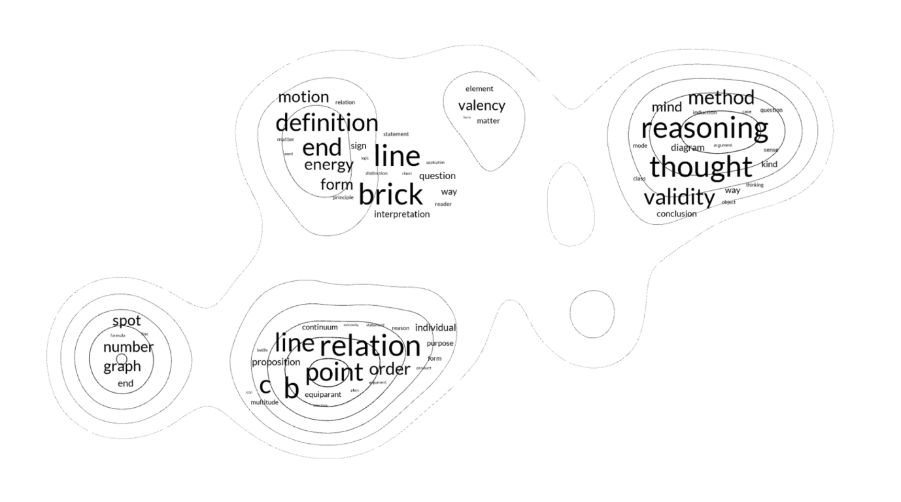
The first project, titled Peirce interprets Peirce, focuses on the computational analysis of philosopher Charles S. Peirce’s manuscripts, an archive comprising over 100,000 pages. Based on a collaboration between the University of Lausanne, RWTH Aachen University, the Bibliotheca Hertziana, the University of Groningen, and Harvard University, this initiative proposes an automated method for exploring semantic relationships within fragmentary philosophical texts. The pilot study centered on the manuscript PAP (Prolegomena for an Apology to Pragmatism).
The methodology is organised into three stages: transcription and recognition of handwritten texts, semantic extraction, and then cartographic visualisation.
Davide Picca is also actively engaged in exploring issues of cultural memory through the archives of the Montreux Jazz Festival. This interest is reflected in a broader inquiry into how the narratives of artists, organizers, and audiences can be captured, indexed, and interconnected using artificial intelligence. By working with recordings, interviews, and cultural metadata, he investigates how to reconstruct living memory ecosystems that weave together emotion, historical context, and the circulation of voices.
More broadly, his research is rooted in a continuous inquiry into the affective dimensions of language and culture. He is particularly interested in how emotions are expressed, structured, and interpreted in literary texts, and in the possibility of modeling them through computational methods. This approach encompasses both classical manuscripts and intangible heritage, with a focus on how narratives, styles, and symbolic forms shape our collective memory. Through this work, he presents a vision of AI as a vehicle for cultural resonance, capable of articulating meaning, emotion, and historicity.
Prospects
In these projects, AI does more than analyze data—it becomes a tool for shaping meaning, capable of bridging lexical, cognitive, and narrative levels. This approach places the humanities at the center of the conversation on automation, raising not the question of what AI can do, but what it ought to do to support our interpretation of the world.
A lecturer at the University of Lausanne, Davide Picca explores the links between the humanities, AI and cultural memory. He is active in teaching, research and heritage projects.
Faculty of Arts
LLM, NLP, Digital Humanities
