
Article written by Nour Bartou, instructional designer, Centre de Soutien à l’Enseignement
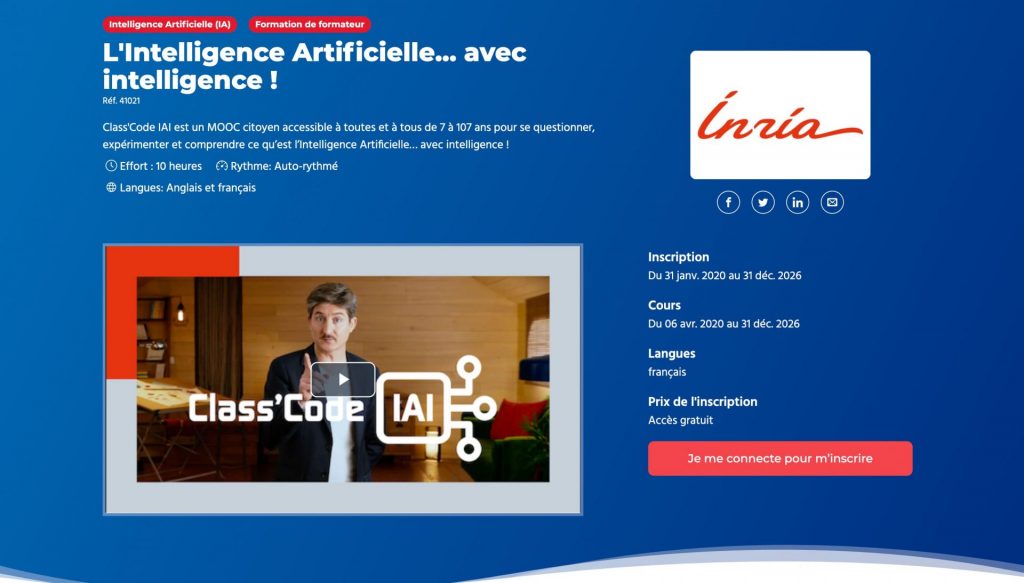
The course is available online at: https://www.fun-mooc.fr/fr/cours/lintelligence-artificielle-avec-intelligence/
In a context where artificial intelligence is rapidly transforming our professional and educational environments, it is becoming essential for teachers to develop a structured and critical understanding of these technologies. It is with this in mind that I completed the MOOC “Artificial Intelligence for and by Teachers”, offered by Inria and delivered on the FUN-MOOC platform (France Université Numérique).
This MOOC is primarily aimed at teachers and trainers who wish to better grasp the foundations of AI, its societal impacts, and its pedagogical implications. It offers a broad overview, ranging from technical principles (how algorithms work, machine learning, deep learning) to ethical, social, and educational issues, including hands-on classroom experiments.
3 things I liked
1. A comprehensive and structured approach
One of the major strengths of this MOOC lies in the breadth and coherence of its content. The different modules are linked in a progressive and structured manner, enabling learners to build a solid understanding of the field.
The course is dense. It is more akin to a long-distance effort than a quick training session: more marathon than sprint. This density requires planning one’s commitment over time. The few repetitions observed between chapters actually contribute to this logic of consolidating knowledge in a complex and evolving field.
2. A strong pedagogical and operational dimension
Beyond the theoretical contributions, the MOOC offers numerous pedagogical activities that can be directly used in the classroom. These suggestions cover different age groups and offer varied resources for addressing AI with students.
This “turnkey” dimension is a real added value. The course is not limited to raising awareness about technological issues: it concretely supports teachers in the pedagogical transposition of the concepts covered.
3. An active community and an engaging format
Each module has a dedicated forum, encouraging exchanges among participants. The discussions are dynamic and often enriched by feedback from teachers in various contexts.
The presence of trainers is noticeable through their contributions and responses, which reinforces the sense of support.
The final assessment method also deserves mention: it involves a concept mapping (mind mapping) exercise submitted for peer review. This format, particularly relevant for a dense MOOC, allows learners to structure their learning, step back, and discover the perspectives offered by other participants. Time-consuming, certainly, but pedagogically very rewarding.
3 things I liked less
1. A significant time investment
The announced duration (approximately 10 hours for reviewing the content) seems optimistic. On its own, the careful reading of resources and watching of lectures already requires a significant amount of time.
The assessment quizzes are precise and demanding. They require sustained attention to all the resources provided, including those that might be considered supplementary. Certain technical concepts, briefly mentioned in the content, can be the subject of specific questions. Careful revision is therefore necessary to validate the modules with confidence. All in all, for proper assimilation of the course, a timeframe of approximately 15 hours seems more reasonable.
2. An abundance of resources
The diversity of materials (articles, lectures, videos, activities) is undeniably a strength. However, this richness can sometimes give the impression of a very heavy course. Some lectures are long, and certain external resources require registration on other platforms or link to partially accessible articles.
Even though most of the content is centralised, these elements can weigh down the experience.
3. Sometimes outdated technical references
Given the extremely rapid evolution of the AI field, some references to technological advances may appear slightly dated. Some perspectives presented as emerging are now widely established, or even outdated.
Nevertheless, the conceptual foundations and the reflections proposed remain relevant and structuring.
Why recommend this MOOC?
Despite the demands it imposes, this MOOC provides a solid and relevant training for teachers wishing to go beyond a superficial approach to artificial intelligence.
It offers:
- A structured understanding of technical principles;
- A critical analysis of societal and educational impacts;
- Concrete pedagogical tools for the classroom.
It is particularly aimed at those who wish to engage in long-term reflection and develop an informed stance in the face of digital transformations.
In short, this is not a quick introduction, but a medium- to long-term course. Provided it is approached with a realistic schedule and regular commitment, this MOOC is a valuable resource for supporting the evolution of teaching practices in the age of artificial intelligence. The MOOC is entirely free and leads to the award of an open badge upon request.