
Article written by Nour Bartou, Instructional Designer, Centre de Soutien à l’Enseignement
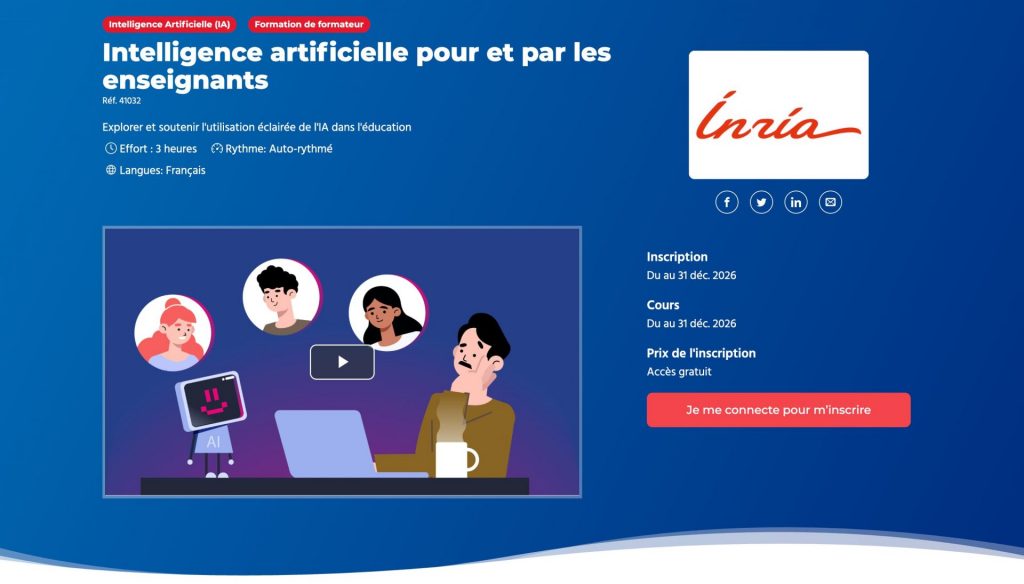
The course is available online at: https://www.fun-mooc.fr/fr/cours/intelligence-artificielle-pour-et-par-les-enseignants-ai4t/
In a context where artificial intelligence is progressively challenging educational practices, it is becoming essential for teachers to have clear and accessible reference points. The MOOC “Artificial Intelligence for and by Teachers”, offered on the FUN-MOOC platform (France Université Numérique), is an excellent introduction to the subject.
Announced as lasting approximately three hours, this course offers a structured introduction to the foundations of AI: operating principles, the role of data, model training, algorithmic bias, responsibility, and social impacts. It is primarily aimed at teachers wishing to acquire a solid foundational understanding of artificial intelligence, with no particular technical prerequisites.
3 things I liked
1. A clear and structured introduction to AI
The MOOC covers a wide range of essential concepts in a compact and accessible format. The fundamentals of how artificial intelligence works are presented in a progressive and pedagogical manner. The concepts are explained clearly, without excessive simplification or unnecessary jargon.
The course is truly “beginner friendly”: it provides solid foundations, both on technical aspects and on ethical and societal dimensions. In a short time, participants gain a coherent overview, essential for confidently engaging in current discussions about AI in education.
2. Engaging interactive activities, particularly the Class’Code activities
Throughout the MOOC, short, concise, and very well-designed pedagogical videos introduce and explain key concepts. The production quality is polished, the pacing well-controlled, and the length of sequences suited to efficient consultation. The presentations are clear, structured, and pedagogically relevant.
The formats of the proposed videos are varied, adapting to the content being conveyed. The balance between conceptual explanations and concrete examples promotes understanding, without weighing down the material, sometimes with touches of humour.
3. Interactive modules
The so-called “Class’Code” modules are arguably one of the most interesting features of the course. These are interactive modules that allow participants to concretely experiment with certain AI mechanisms.
Through these progressive activities, participants manipulate data, observe the effects of model training, and explore the consequences of certain choices. This experimental approach facilitates the understanding of sometimes abstract concepts, such as the influence of data on results or the emergence of bias.
Learning takes place through action, which helps to demystify artificial intelligence.
For teachers, these activities also serve as a source of inspiration for considering classroom adaptations.
3 things I liked less
1. A duration to be put in perspective
While the announced duration is three hours, it mainly corresponds to watching the videos and consulting the content.
However, if one wishes to complete all the proposed activities and take the time to absorb the concepts, the actual investment significantly exceeds the estimated time. It is therefore advisable to plan an additional hour.
2. An environmental angle barely addressed
The MOOC addresses social, ethical, and responsibility issues related to artificial intelligence in a relevant manner. However, the question of the environmental impact of AI technologies is scarcely developed.
In a context where ecological concerns occupy an increasingly prominent place in public and educational debate, a more in-depth examination of this aspect would have been a valuable addition.
3. An underutilised final case study
The course ends with an interesting case study, designed to mobilise the knowledge acquired. In principle, this is an excellent idea for consolidating learning.
However, this activity is not truly corrected. Its validation relies on a single multiple-choice question, which can be answered by trial and error. This considerably limits its formative value.
This is arguably a partially missed opportunity. A peer assessment, detailed feedback, or the provision of an answer key after submission would have greatly enhanced the impact of this final activity.
Why recommend this MOOC?
This MOOC is an excellent introduction to artificial intelligence for a teaching audience.
It combines:
- Pedagogical clarity,
- Diversity of approaches (technical, ethical, societal),
- Practical activities promoting experimentation.
Its short format makes it particularly suited to those who wish to quickly familiarise themselves with the issues of AI without investing a lot of time in a long and demanding course.
Provided you allow a little more time than the three hours announced to fully exploit the activities, it represents a relevant resource for developing an initial professional understanding of artificial intelligence.
In short, a structured, accessible, and engaging introduction, ideal for initiating an informed pedagogical reflection on AI.
The MOOC is entirely free and leads to the award of an open badge upon request.