
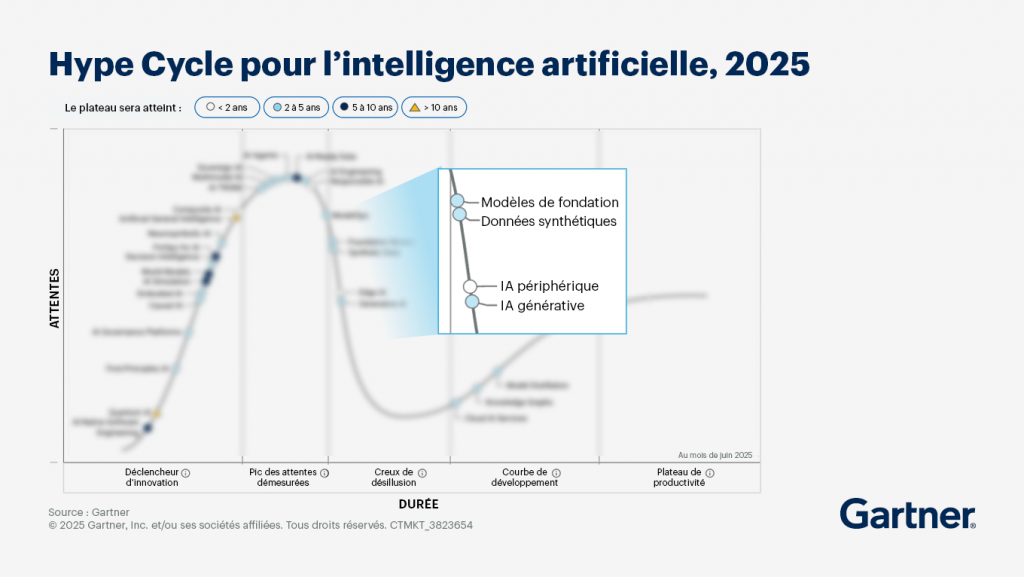
Artificial intelligence is entering a new era. According to Gartner’s latest Hype Cycle 2025 published in July 2025, attention is gradually shifting from enthusiasm for generative AI to a more pragmatic search for benchmark innovations and large-scale implementation.
The message is clear: AI continues to advance, but in a more mature and structured way. The companies that will succeed are those that can look beyond the hype and focus on responsible, secure implementation that delivers real added value.
Generative AI in the trough of disillusionment
The conclusion is clear: generative AI is entering the ‘trough of disillusionment’. After the initial euphoria, companies are beginning to better understand its real potential, but also its significant limitations.
The figures speak for themselves: despite average investments of $1.9 million in 2024, less than 30% of AI executives say their CEOs are satisfied with the return on investment. This disappointment can be explained by several factors:
- Difficulty in demonstrating concrete value for the company
- Unrealistic expectations among less advanced companies
- Shortage of qualified professionals for more mature organisations
- Governance issues: hallucinations, bias, fairness
- Regulatory constraints hindering adoption
Two emerging technologies at the forefront
The 2025 Hype Cycle identifies two key technologies that are reaching the peak of inflated expectations:
1. AI-compatible data
This is the new priority area. To move to large-scale AI, companies need to evolve their data management practices. The problem? 57% of companies believe their data is not ready for AI. Without data tailored to specific AI use cases, business objectives remain out of reach and risks increase.
AI agents
These autonomous or semi-autonomous software entities use AI techniques to perceive, decide and act in their environment. Thanks to advances in generative AI, multimodal understanding and composite AI, they can now perform complex tasks.
However, their complexity makes them vulnerable: issues with access security, governance, and above all, a lack of confidence in their ability to function without human supervision. The potential impact of errors is a legitimate concern for businesses.
The emergence of native AI software engineering
A major new development this year is the inclusion of AI-native software engineering in the Hype Cycle. This refers to a set of practices optimised for using AI-based tools in application development.
Today, engineers mainly use AI assistants for coding and testing—a form of augmented AI rather than autonomous AI. But the future is clear: AI will become integral and native to most engineering tasks.
This change will profoundly transform the role of developers, who will focus on tasks requiring critical thinking, ingenuity and empathy. But beware: bias, hallucinations and non-determinism remain major challenges that prevent complete trust.
Leading technologies for sustainable AI
Companies are turning to technologies that enable the production of sustainable and scalable AI:
AI engineering: a core discipline for consistently and securely creating and developing a portfolio of high-value AI solutions.
ModelOps: expected to reach productivity plateau, it standardises and scales AI projects by focusing on governance and management of the entire lifecycle of AI models and advanced analytics.
Key takeaways
The 2025 Hype Cycle marks a shift towards pragmatism. After the experimentation phase, it is now time for large-scale implementation with:
- Stable and continuous investment in AI
- A focus on benchmark innovations rather than hype
- Special attention to data preparation
- A more realistic approach to the potential of generative AI
- An increased need for governance and security
Gartner produces more than 130 annual Hype Cycles covering over 1,900 innovations, helping leaders navigate technological complexity and prioritise their AI investments.
Source : https://www.gartner.fr/fr/articles/hype-cycle-pour-l-intelligence-artificielle