Tag: Farid Saleh

  • Why did some ancient animals fossilize while others vanished?

    Why did some ancient animals fossilize while others vanished?

    crevette
    Cretaceous fossil shrimp from Jbel Oum Tkout, Morocco registered at the Museum d’histoire naturelle de Marrakech (© Sinéad Lynch – UNIL).

    Why do some ancient animals become fossils while others disappear without a trace? A new study from the University of Lausanne, published in Nature Communications, reveals that part of the answer lies in the body itself. The research shows that an animal’s size and chemical makeup can play an important role in determining whether it’s preserved for millions of years—or lost to time.

    Fossils are more than just bones; some of the most remarkable finds include traces of soft tissues like muscles, guts, and even brains. These rare fossils offer vivid glimpses into the past, but scientists have long puzzled over why such preservation happens only for certain animals and organs but not others.

    To dig into this mystery, a team of scientists from the University of Lausanne (UNIL) in Switzerland turned to the lab. They conducted state-of-the-art decay experiments, allowing a range of animals including shrimps, snails, starfish, and planarians (worms) to decompose under precisely controlled conditions. As the bodies broke down, the researchers used micro-sensors to monitor the surrounding chemical environment, particularly the balance between oxygen-rich (oxidizing) and oxygen-poor (reducing) conditions.

    The results were striking and have now been published in Nature Communications . The researchers discovered that larger animals and those with a higher protein content tend to create reducing (oxygen-poor) conditions more rapidly. These conditions are crucial for fossilization because they slow down decay and trigger chemical reactions such as mineralization or tissue replacement by more durable minerals.

    “This means that, in nature, two animals buried side by side could have vastly different fates as fossils, simply because of differences in size or body chemistry,” affirms Nora Corthésy, PhD student at UNIL and lead author of the study. “One might vanish entirely, while the other could be immortalized in stone” adds Farid Saleh, Swiss National Science Foundation Ambizione Fellow at UNIL, and Senior author of the paper. According to this study, animals such as large arthropods are more likely to be preserved than small planarians or other aquatic worms. “This could explain why fossil communities dating from the Cambrian and Ordovician periods (around 500 million years ago) are dominated by arthropods,” states Nora Corthésy.

    These findings not only help explain the patchy nature of the fossil record but also offer valuable insight into the chemical processes that shape what ancient life we can reconstruct today. Pinpointing the factors that drive soft-tissue fossilization, brings us closer to understanding how exceptional fossils form—and why we only see fragments of the past.

    Source

    N. Corthésy, J. B. Antcliffe, and F. Saleh, Taxon-specific redox conditions control fossilisation pathways, Nature Communications, 2025

    Research fundings

    SNF Ambizione Grant (PZ00P2_209102)


    Questions to Nora Corthésy,
    principal author of the study at UNIL

    Why did you choose shrimps, snails and starfish to conduct your study?

    These present-day animals were the best representatives of extinct animals we had in the lab. From a phylogenetic (relationship between species) and compositional point of view, they are close to certain animals of the past. The composition of the cuticles and appendages of modern shrimps, for example, is more or less similar to that of ancient arthropods.

    How can we know that animals lived, then disappeared without a trace, if we have no evidence of this?

    When studying preservation in the laboratory, it becomes possible to distinguish between ecological and preservational absences in the fossil record. If an animal decays rapidly, its absence is likely due to poor preservation. If it decays slowly, its absence is more likely to be ecological, that is, a true absence from the original ecosystem.  Our study shows that larger, protein-rich organisms are more likely to be preserved and turned into fossils. We can therefore hypothesize that smaller, less protein-rich organisms, which have very little chance of dropping their redox potential, may not have been fossilized due to preservational reasons. It is therefore possible that some organisms could never have been preserved, and that we may never, or only with great difficulty, be able to observe them. Nevertheless, all of this remains hypothetical, as we are unable to travel back in time millions of years to confirm exactly what lived in these ancient ecosystems.

    What about the external conditions in which fossils are formed, such as climate?

    The effect of these conditions is very complicated to understand since it is nearly impossible to replicate ancient climatic conditions in the laboratory. Nevertheless, we know that certain sediments can facilitate the preservation of organic matter, giving clues as to which deposits are the most favorable for finding fossils. We also know that factors such as  salinity and temperature, also play a role in preservation. For example, high salinity can increase an organism’s preservation potential, as large amounts of salt slow down decay in a similar way to low temperatures. Our study here focuses solely on the effect of organic matter and organism size on redox conditions around a carcass. It is therefore one indicator among others, and there is still a lot that needs to be done to understand the impact of various natural conditions on fossil preservation.

  • New fossil site of worldwide importance uncovered in southern France

    New fossil site of worldwide importance uncovered in southern France

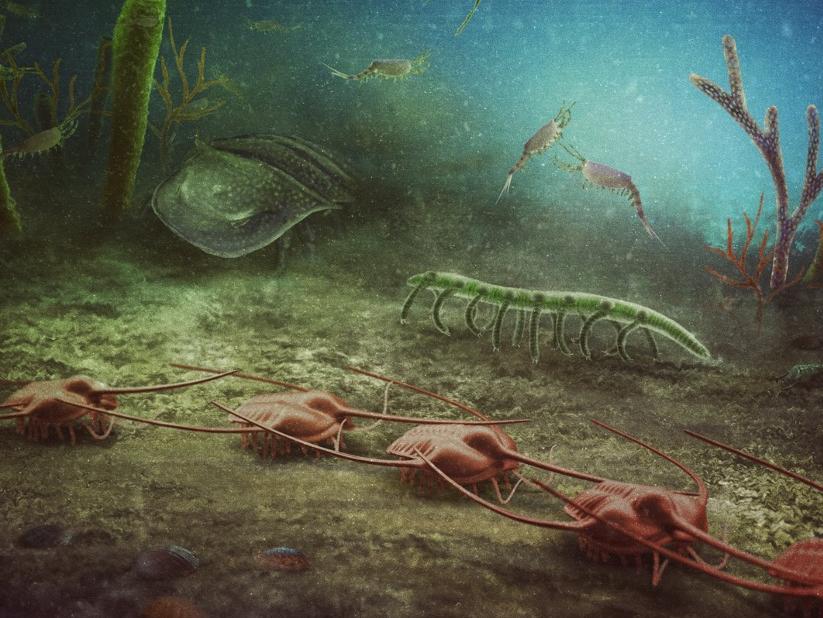
    Artistic reconstruction of the Cabrières biota (© Christian McCall)

    Farid Saleh, Institute of Earth Sciences

    Nearly 400 exceptionally well-preserved fossils dating back 470 million years have been discovered in the south of France by two amateur paleontologists. This new fossil site of worldwide importance has been analyzed by scientists from the University of Lausanne, in collaboration with the CNRS and international teams. This extraordinary discovery provides unprecedented information on the polar ecosystems of the Ordovician period.

    Paleontology enthusiasts have unearthed one of the world’s richest and most diverse fossil sites from the Lower Ordovician period (around 470 million years ago). Located in Montagne Noire, in the Hérault department of France, this deposit of over 400 fossils is distinguished by an exceptionally well-pre- served fauna. In addition to shelly components, it contains extremely rare soft elements, such as digestive systems and cuticles, in a remarkable state of preservation. Moreover, this biota was once located very close to the South Pole, revealing the composition of Ordovician southernmost ecosystems.

    At the Faculty of Geosciences and Environment at the University of Lausanne (UNIL), scientists have collaborated with the CNRS and international teams to carry out the first analyses of this deposit, known as the Cabrières biota. The results are published in Nature Ecology & Evolution.

    Ordovician climate refugia

    Analyses of the new biota reveal the presence of arthropods (a group that includes millipedes and shrimps) and cnidarians (a group that includes jellyfish and corals), as well as a large number of algae and sponges. The site’s high biodiversity suggests that this area served as a refuge for species that had escaped the high temperatures prevailing further north at the time.

    “At this time of intense global warming, animals were indeed living in high latitude refugia, escaping extreme equatorial temperatures,” points out Farid Saleh, researcher at the University of Lausanne, and first author of the study. “The distant past gives us a glimpse of our possible near future,” adds Jonathan Antcliffe, researcher at the University of Lausanne and co-author of the study.

    For their part, Eric Monceret and Sylvie Monceret-Goujon, the amateurs who discovered the site, add with enthusiasm: “We’ve been prospecting and searching for fossils since the age of twenty,” says Eric Monceret. “When we came across this amazing biota, we understood the importance of the discovery and went from amazement to excitement,” adds Sylvie Monceret-Goujon.

    This first publication marks the start of a long research program involving large-scale excavations and in-depth fossil analyses. Using innovative methods and techniques, the aim is to reveal the internal and external anatomy of the organisms, as well as to deduce their phylogenetic relationships and modes of life.

    Reference

    F. Saleh, L. Lustri, P. Gueriau, G. J.-M. Potin, F. Pérez-Peris, L. Laibl, V. Jamart, A. Vite, J. B. Antcliffe, A. C. Daley, M. Nohejlová, C. Dupichaud, S. Schöder, E. Bérard, S. Lynch, H. B. Drage, R. Vaucher, M. Vidal, E. Monceret, S. Monceret and B. Lefebvre, The Cabrières Biota (France) provides insights into Ordovician polar ecosystemsNature Ecology & Evolution, 2024

  • Towards a more inclusive and ethical paleontology

    Towards a more inclusive and ethical paleontology

    Farid Saleh, Institute of Earth Sciences

    Dr Farid Saleh is a paleontologist specializing in the formation of fossil deposits. In August 2023, he begins his Ambizione project at ISTE on the preservation of Cambrian fossils dating back over 500 million years.

    As Diversity Officer at the Palaeontological Association, he is actively involved in initiatives to promote diversity. His international experience – in Lebanon, France, Morocco and China – has enabled him to reflect on changing practices in the field of paleontology. He tells us how he hopes to foster collaboration and inclusion in his own work.

    You’re in charge of diversity at the Palaeontological Association. How did you come to take on this role?

    In 2018, the Palaeontological Association carried out a study on diversity among its members1. The results revealed that several communities were under-represented, particularly people from ethnic minorities and disadvantaged backgrounds. As a result, the association decided to appoint a Diversity Officer to develop an equality and diversity strategy and action plan.  

    I got the job, which I’m holding for three years, until the end of 2023. My experience as a Lebanese researcher who has worked in France, China and now Switzerland gives me a good understanding of the visions of the Global South and historically privileged European countries.

    What were your first actions as diversity officer at the Palaeontological Association?

    For example, we raised the issue of the living conditions of some members, which were not taken into consideration. The association’s membership fees, although very low, represent a large sum for someone whose salary has been reduced by the economic crisis, as is the case in Lebanon, or for students from certain regions. We have therefore reduced the price for people from low-income countries. 

    We have also introduced a new system for awarding ” Undergrad Research Bursaries”, to avoid bias in evaluation and increase the diversity of applicants. The principle is that of a random lottery, but with priority given to under-represented communities. Let me explain: the committee checks that the candidate projects are feasible and that the costs are justified. If these criteria are met, the projects are entered into the draw. Candidates also have the option of entering their nationality, ethnicity, sexual orientation and so on. This data, if provided, remains confidential. But it is used in the drawing of lots to favour under-represented communities.

    The Paleontological Association has also been working on a Code of Conduct2, which applies to all its members in the course of their professional activities. This code aims to “create an inclusive and diverse environment within palaeontology and to protect members from harassment and discrimination”. Members are expected to “promote a culture of scientific and research integrity, respect, fairness, and inclusivity and avoid conflicts of interest.”

    Finally, an international mentorship system now enables juniors to be guided in their career path and job search by a more experienced person. The support of scientists from different institutes around the world will help reduce inequalities in access to quality supervision and expertise.

    As a scientific discipline, paleontology has inherited a colonial history that has long excluded local communities in certain countries from the building of their collections. What has changed in the way the profession has taken account of inclusion issues?

    The situation has improved considerably over the last ten years. In the past, paleontologists considered it normal to collect material in a distant country, bring it back and publish the data, without taking into account the people and the region of origin of the samples. 

    The desire to integrate local communities and the importance of documenting the origin of fossils in research have emerged. These are really radical changes, because when I started my thesis in 2017, nobody was talking about these ethical issues. I myself was not very aware of these topics.

    Some countries, such as Brazil and China, now have laws banning the export of fossils (some even date back to the 80s). In Morocco, where I work a lot, the political will to protect our heritage is increasingly present.Countries with large fossil collections, such as Switzerland, France and the UK, are also putting in place regulations and principles to clarify field interactions linked to acquiring and working with fossils. Some countries are still lagging behind on these issues, particularly when it comes to the restitution of geological heritage, but the situation is improving and awareness is international.

    Of course, the restitution of fossils is costly, and it takes time to set up the infrastructures needed for their proper preservation on site. Morocco, for example, is in the process of building new museums to accommodate the large number of Moroccan fossils, in addition to the existing ones. To increase local expertise too, scientists are starting to work with local communities, involving them in research and training students.

    Publishers also play a role in changing practices. Some require proof of the origin of fossils, asking for export permits, the name of the person who collected them, etc. This is also a guarantee for them, as scientific papers have sometimes been retracted, for example because the authors were unable to demonstrate the legal provenance of their fossils, or because the fossils were illegally registered outside their country of origin.

    As part of your work as Diversity Officer, have you also worked on issues of gender or LGBT+?

    The diversity study carried out at Palaeontological Association showed that the LGBT+ community was not under-represented among its members, which is very good news. So we haven’t carried out any projects in this area for the time being. Nevertheless, we strive to create a supportive and secure environment in all our meetings, events, and sponsored activities. Any form of discrimination or harassment against members of the LGBTQ+ community is strictly unacceptable and is completely prohibited per our Code of conduct3.

    On the other hand, women are still in the minority. The association is now encouraging better representation of female researchers. My personal experience has also made me think about these issues. When I wrote my first scientific article, there were four co-authors – all men, none women. And yet, in my laboratory in Lyon at the time, I could easily have knocked on the door of the office next door to seek the advice of several female paleontologists. However, I considered our work to be of sufficient quality.

    But once the article was published, I had the opportunity to present it at a seminar, and a female expert I knew well gave constructive and useful criticism that could have improved our work! I’ve now got into the habit of presenting my results at conferences before publishing them. This approach allows me to refine them further and take a step back. Although some people argue that we should be wary of the risk of spoliation by revealing unpublished results, I consider these risks to be minimal compared to the benefits I derive from the valuable advice I receive. 

    Interacting with a large number of people allows me to discover databases and offers me new and different perspectives. I want to avoid building walls around myself, and I’m convinced that a diversity of viewpoints enriches our understanding.

    During your own fieldwork, which partners do you work with? In which countries?

    During my thesis, I worked on the Moroccan site of Fezouata, well known for its exceptionally preserved and diverse fossil assemblages. In Morocco, it’s often local people who collect the fossils. We work closely with Mohamed Ben Moula, a professional fossil collector. It was he who discovered the Fezouata formation, arguably Morocco’s most important fossil site, in the late 90s. The Paleontological Association recognized the value of his work and expertise by awarding him the Mary Anning Prize4 in 2017. Ce prix récompense les amateur·rices en paléontologie, mais dont la contribution a eu un impact important dans le domaine. This award recognizes amateurs in paleontology, but whose contribution has had a significant impact on the field.

    I then worked for two years with China, for a postdoc. And I never touched a Chinese fossil! It was a special situation, because it was during the COVID pandemic and I was working remotely. But you should know that in China, it’s almost impossible to export fossils. This is due to very protective laws and a very strong local infrastructure and expertise. So I was able to carry out my project from my place of confinement.

    In addition to collaborating with international amateurs and paleontologists, it’s also important for me to train local people, so that they in turn can make the most of their geological heritage. When we were in the field last May in Morocco, for example, we helped a motivated student to collect data and put together a solid thesis project in Switzerland.

    What advice would you give young researchers to promote inclusiveness?

    A fundamental principle to which I attach great importance is that of fostering collaboration and making it visible. It’s a principle I’d like to pass on to young researchers. One way of putting it into practice is to include in the list of authors of an article all the people who made that article possible.

    For me, this principle is of the utmost importance. According to some scientists and journals, a person only deserves to be a co-author if he or she has contributed to the “scientific” aspect. But is writing a paragraph or changing the discussion more deserving than discovering fossils? In my opinion, a scientific article is the fruit of the accumulation of various skills: from the person who found the fossil, prepared it and allowed it to be exported, to the person who analysed it or wrote up the results.

    As you can see, my papers often comprise a long list of contributors! For example, the colleagues who helped us obtain export permits are included in my thesis publications. Without them, the thesis wouldn’t have happened, and I’m grateful for their help. And although it’s not yet widely accepted, I’m not the only paleontologist to include amateurs in scientific articles. This shows that, in the field, their role is increasingly seen as essential. I think their inclusion also reveals the importance of the human aspect in paleontological research, over and above the scientific aspect: don’t forget that samples have a history, that they come from somewhere. What’s more, there is sometimes a lack of local academic paleontologists with whom to collaborate. This is partly due to our colonial past. Thinking about broadening the scientific community and valuing each other’s work is essential to advancing expertise in middle- and low-income countries.

    Farid Saleh, Institute of Earth Sciences

    Dr Farid Saleh is a taphonomist: he studies the degradation (physical, chemical, biological) of organisms in nature. On fossil deposits, this means trying to resolve these questions: to what extent do the fossils found reflect the original ecosystems? To what extent are they biased by preservation? If animals A and B are found in a fossil site, does that really mean they were the only ones present? Or did other animals live at that time, but their traces have not come down to us? 

    He is particularly interested in the first complex ecosystems – dating back over 520 million years. After studying in Lebanon and writing his thesis in Lyon, Farid Saleh now works at ISTE. To carry out his project, he has set up numerous international collaborations, with France, Morocco, China, Australia, Canada and the United States.

    Notes

    1. The results and recommendations of the diversity study are on the Palaeontological Association’s website ↩︎
    2. Find the Code of Conduct on the Palaeontological Association’s website ↩︎
    3. The Palaeontological Association’s Code of Conduct expresses its commitment to creating a diverse and inclusive environment. « The Palaeontological Association will not discriminate on the basis of race, colour, ethnic origins, immigration status, religion, age, marital status, parental status, sex, sexual orientation, gender identity or expression, socioeconomic background, educational background, or disability. » ↩︎
    4. Mary Anning (1799-1847), after whom the Palaeontological Association’s amateur prize is named, was a pioneering, self-taught paleontologist and fossil collector. Anning’s discoveries – such as early ichthyosaurs, plesiosaurs and pterosaurs – helped change our view of Earth history. To this day, her discoveries form an important part of the UK’s major collections. ↩︎