

Cette publication est également disponible en :
 Français
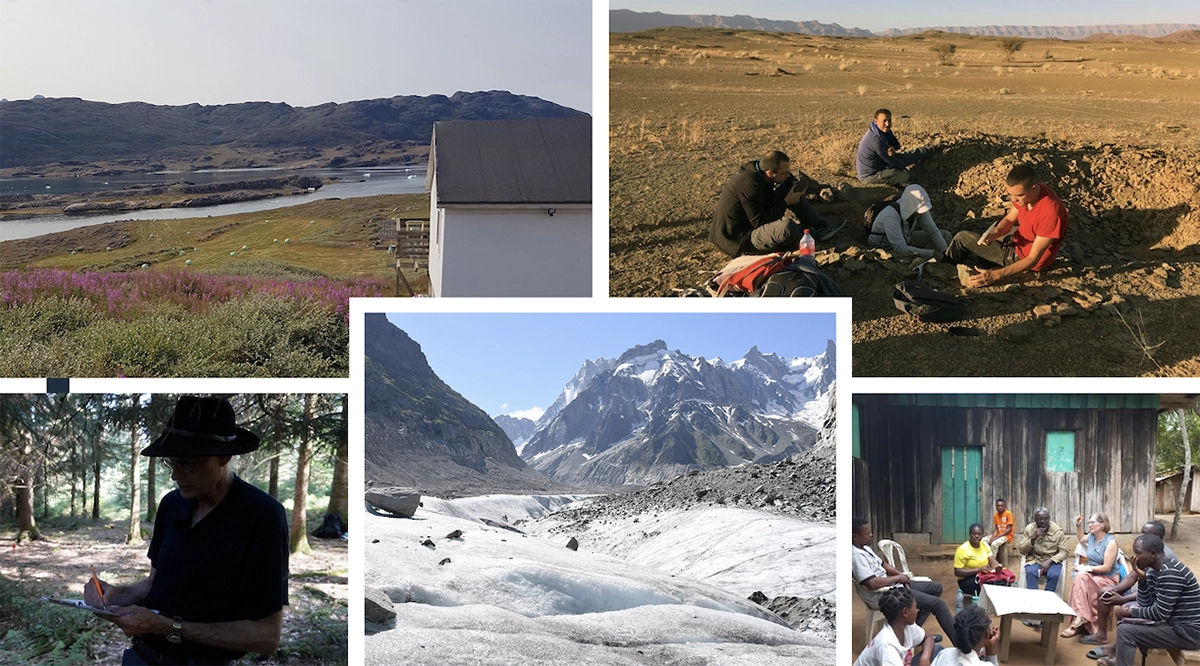
What is parachute science? Parachute science can be defined as an extractive research practice in which external researchers exploit local resources without recognizing or integrating local expertise and infrastructure. During a workshop recently co‑facilitated by members of the FGSE and the UNIL Equality Office, participants explored this concept and the major ethical issues it raises. Here we bring together the reflections from this day and avenues for more equitable research.
Looking back on a workshop rich in reflections and tools
The workshop highlighted several approaches to promoting fair collaborations. Testimonies from projects in Europe, the Arctic, and North Africa enriched the discussions.
Power imbalances in research partnerships
Disparities in access to funding, differences in institutional affiliation, academic seniority, gender, ethnicity, and nationality are omnipresent. These factors shape power relations within projects and can perpetuate inequalities.
Several strategies were proposed to mitigate these imbalances. At the institutional level, this could include adapting funding instruments to equitably support partners and ensure access to infrastructure, or creating reporting systems for abuses.
| Resource Interview with Farid Saleh, Ambizione Assistant Professor at ISTE and Diversity Lead at the Palaeontological Association. |
Scientific production: Toward equitable recognition
A classic example of parachute science is when a research team collects field data— often with the essential intellectual and cultural mediation of local assistants —then returns to its home institution to analyze and publish alone.
Co‑authorship is one way to make partners’ contributions visible and to break with colonial norms—norms that dictate that only those who lead the research can produce knowledge, while local people (informants, contacts, participants) are merely data providers. To counter this tendency, some suggest explicitly naming those who produced or facilitated access to the data, or prioritizing authors with more precarious status.
Anonymizing local informants—a common practice—also contributes to their invisibilization. Discussions emphasized that anonymity should not be systematic: it is preferable to consult people about their preferences rather than deciding for them.
Co‑construction: Toward collective ownership of the project
Promoting more equitable research is not only about making local actors visible in scientific outputs. Ideally, local partners should be involved from the project’s conception stage onwards. This requires bringing together people with sometimes divergent objectives. The process takes time and resources. For it to be effective, the team must learn about local cultures and dynamics, build mutual trust patiently, and not avoid sensitive topics.
More broadly, building equitable collaborations may involve co‑collecting data, co‑interpreting results, and co‑publishing findings. In the long term, this approach pays off and fosters sustainable partnerships.
| Resource for equitable collaborations GRP-Alliance – Guide for Global Research Partnerships – Defining the agenda together to ensure relevance and shared responsibility – Identifying and involving stakeholders and partners from the outset – Jointly defining the common objective and research approach – Clarifying and managing different goals and expectations |
| Best practice guide The TRUST Code – A Global Code of Conduct for Equitable Research Partnerships – Research results must be communicated to local communities and participants in a relevant, appropriate, and easily understandable manner. |
The weight of words: Which terminology should we use?
Parachute science, helicopter science, extractive science, vampiric or toxic science… each term carries specific, sometimes problematic connotations.
Should decolonial terms be replaced with more global ones? Discussions emphasized that these harmful practices are not exclusively linked to colonial history. They can also occur within national borders.
“In Sri Lanka, we talk about the condom theory to describe how some senior researchers appropriate the ideas of their junior colleagues before excluding them from the resulting funding or publications.”
Malith De Silva, PhD Candidate, IGD
| Resource ETH Nadel: Words Matter |
Testimony of collaborative practice – Greenland
Presented by Tamara Gerber, SNSF Senior Researcher, IDYST

The major Swiss project Greenfjord which aims to understand the impact of climate change in southern Greenland, illustrates an approach to research conducted in close collaboration with local communities.
To understand how residents perceive and experience the fjord ecosystem, the team renewed its methods by prioritizing participatory and audiovisual tools: a photovoice contest, collective image analyses, guided itineraries in the fjord, and video workshops involving young people. These tools allow Greenlanders to produce and share their own representations of the territory. By placing local knowledge at the heart of the process, the project strengthens the visual and narrative sovereignty of the communities involved.
Testimony of extractive practice – Georgia
Presented by David Gogishvili, IGD Senior Researcher
David Gogishvili’s experience highlights a frequent issue in certain research projects. In Georgia, where he regularly collaborated with scientific teams as a translator and research assistant, his work was never acknowledged—no thanks, no mention in resulting publications. This complete lack of credit, despite his essential contribution to the research process, is a revealing example of poor academic practice and underscores the importance of fair and transparent attribution. David Gogishvili emphasises the need to acknowledge that such exclusions persist globally and urges us to take an active role in challenging this status quo. Academics from or based in the Global North, who often possess greater funding and significant influence over which research agendas are prioritised, have unique leverage to ensure that all individuals involved are properly credited and meaningfully included in project design from the outset, often with the help of local assistants recognising their labour as essential intellectual and cultural mediation rather than a mere administrative service.
Testimony of co-construction – Morocco-Switzerland
Presented by Andrea Mathez, IGD Graduate Assistant
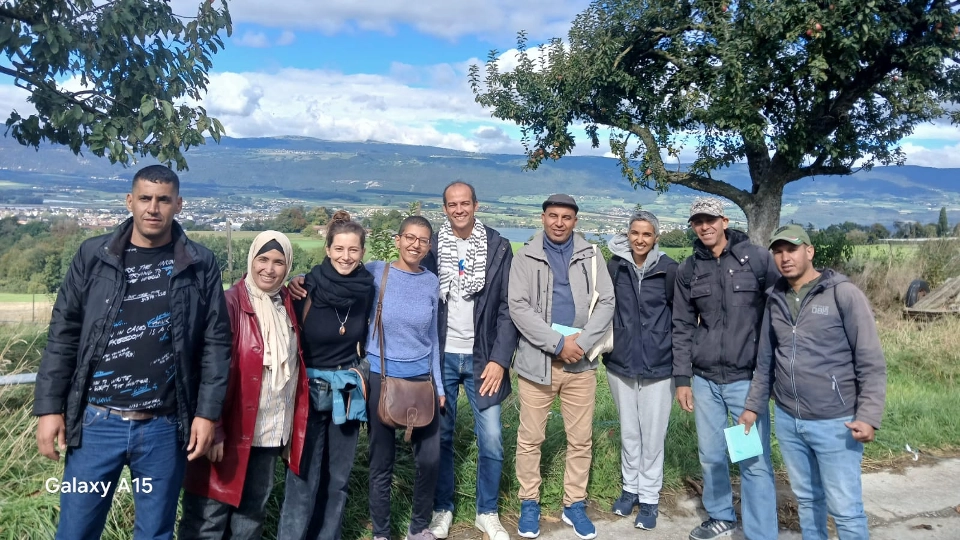
Her research, which explores the conditions for alternative forms of agriculture in Morocco and Switzerland, illustrates an approach based on international collaboration. By inviting eight Moroccan participants to Switzerland for a performative and collective research project, the team sought to create a genuine space for intercultural and transdisciplinary collaboration. For one week in October 2024, researchers, farmers and community leaders from both countries gathered in the canton of Vaud to explore together the challenges and opportunities of small-scale agroecology. This collective immersion, based on working together as well as reflective exchange between peers, is a model for co-constructing knowledge, mutual learning and networking among actors in the field.
To conclude, we asked three questions to Prof. Gretchen Walters, IGD, co‑initiator of the workshop.
How have these decolonial reflections influenced your own way of conducting research on a daily basis?
With every grant or paper I write, I question how to work with my co-authors, how to acknowledge contributions fairly, how to conduct participatory research planning, even if it takes more time. These are things I was already doing, but the workshop confirmed this way of doing things.
Can you give a concrete example of a moment when you had to adapt your methods or posture to avoid reproducing unequal power relations?
Having a grant that values the role of the co-PI in a project is very important for building a strong research team and avoiding unnecessary power relations about budgets. I currently hold an FNS Spirit grant, with my co-PI in Gabon. This particular grant requires a partnership with a researcher in the country where the research takes place and really values the collaboration between the researchers. Prior to the Spirit grant, I had applied to the SNSF “project” instrument, but unfortunately, it is very difficult to have a co-PI, to allocate a budget to their work, or to really have them partners in the project; after a few attempts to write grants with colleagues from different African countries, it became clear that this particular instrument was not adapted to our needs since it placed my colleagues in an inferior position in the grant. Out of principle, I no longer apply to that instrument when working with colleagues in the Global South, since it does not result in a fair and equitable partnership.
What key advice would you give to researchers who want to integrate a decolonial approach into their projects but don’t know where to start?
I encourage you to have frank discussions with your research partners, to understand their experience and to see how to address some of those issues in the research project itself. This could include focusing on specific, regionally situated research partnerships (rather than those based in the north), mentoring students locally rather than only in Switzerland, reading and valuing work by researchers from the countries where the research takes place.
Leave a Reply