

Cette publication est également disponible en :
 Français
By Emilie Crémin, PhD in Geography
This three-year project began on May 1, 2023, and will end in May 2026. The project is implemented by the University of Lausanne (Unil), the University of Liberal Arts Bangladesh (ULAB), the SAJIDA Foundation, Bangladesh, the Indian Institute of Technology Kharagpur (IIT-KGP), West Bengal, and the local NGO SJSM in West Bengal.
Funded by Solution-oriented research for development Programme (SOR4D), Swiss National Foundation (SNF), Swiss Agency for Development and Cooperation (SDC)
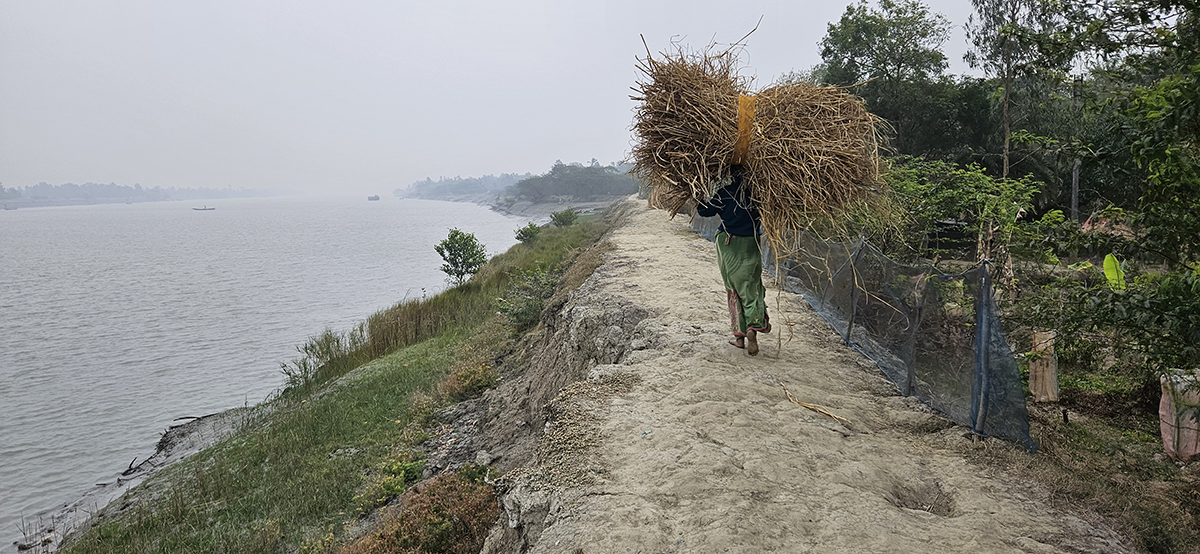
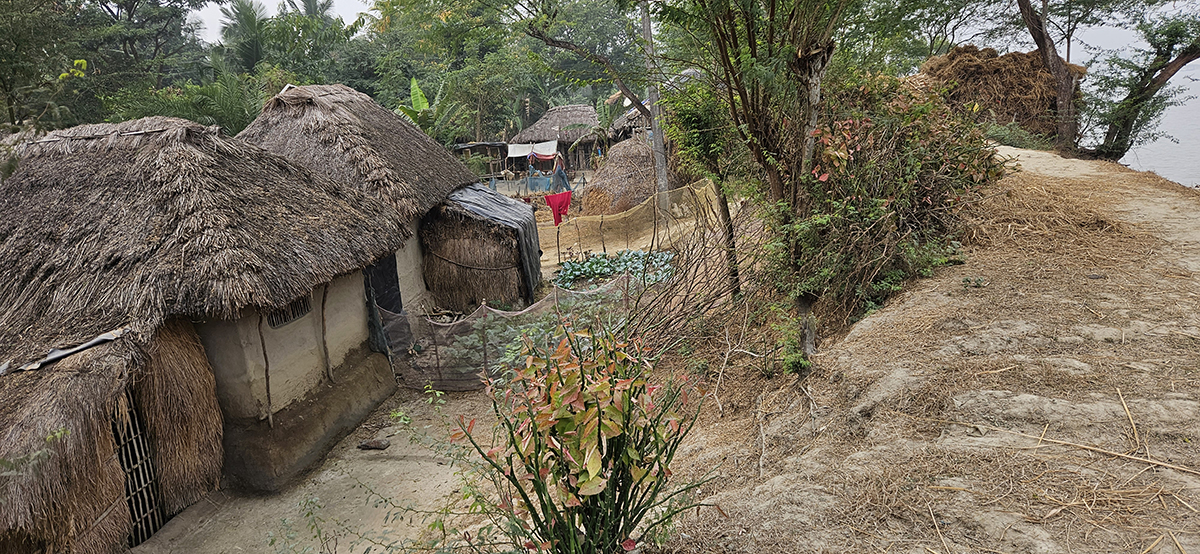
The inhabitants of the coastal and deltaic zone of the Sundarbans, subject to the tides and fluvial dynamics of the Ganges-Brahmaputra-Meghna delta, adjacent to the Sundarbans mangrove forests in India and Bangladesh, are highly exposed to multiple hazards, including cyclones, salinisation, and socio-economic marginalisation.
The delta inhabitants, exposed to these hazards, have developed local resilience mechanisms through their knowledge of geophysical dynamics and their situated ecological knowledge. However, the failure of state-built flood protection systems, political tensions, and market pressures regularly threaten their livelihoods.
The Social Resilience in the Sundarbans – Eliciting Need-Based Grassroot Action Through Cross-Group Engagement (ENGAGE4Sundarbans) – project aims to support contextualised adaptation practices to strengthen social resilience. This support is provided through co-developing socio-ecological adaptation solutions.
Main research questions
- In a transboundary context, how is the coastal and deltaic zone of the Sundarbans perceived as a “landscape of risk”? What risk factors are identified by different groups of stakeholders and by individuals living in the delta? The analysis of perceptions is based on an understanding of the positionality of multiple actors, including state agents, NGOs, elected officials, but also of individuals of widely varying ages, castes, classes, genders, ethnicities, and religions.
- To what extent can the co-design and co-implementation of a wide range of contextualised adaptation practices, developed over time and space and rooted in the lived realities and cultural belief systems of the delta, contribute to disaster risk reduction in the delta?
- How can transdisciplinary strategies for the co-production and implementation of knowledge, with high-impact short-, medium-, and long-term solutions, within the framework of interactive and adaptive (cross-border) governance, strengthen social resilience?
Systemic Approach and Methodology
Our methodological approach follows two steps:
Historical and ethnographic explorations
The research team uses a set of complementary, multimodal, participatory, and interactive methods to implement this two-step methodology.
Initially, the research team, composed of historians (IIT-KGP, ULAB, Unil), reviewed the environmental history of the delta using archival material to understand the evolution of different perspectives and interpretations of the Sundarbans’ “landscape of risks,” as presented by state and non-governmental actors, as well as various members of local communities, since the 18th century. Historical approaches (archival reading and analysis, oral history techniques, and memory mapping exercises) enabled a qualitative exploration of climate risks and community responses to livelihoods in the delta and in the specific study area.
Simultaneously, the project’s geographers developed a map of climate risks and the impacts of disasters on inhabited areas of the Sundarbans, locating state-run infrastructure. Participatory mapping aims to represent the spatial perceptions of different stakeholders (engineers, NGOs, and residents). Participatory GIS and pedestrian transects were used to gather local-scale information on existing resources and socio-ecological infrastructure.
Ethnographic studies, employing conventional methods (group discussions, case studies, interviews with key informants, etc.) and participatory methods (informal conversations in the field, multi-stakeholder field workshops, participatory systems mapping, etc.), as well as innovative and visual methods (case studies, ethno-visual narratives in the form of photojournalism, participatory videography, etc.), enabled the project teams to map and document situated adaptation strategies. They thus identified a set of institutional arrangements, adjustments, and socio-cultural traditions that shape these practices and evolve over time.
The team also conducted a household survey in the two study areas. This survey involved interviewing a sample of 350 households per polder, our two research sites. The survey was carried out by community members, mostly women, engaged in the project. The interviewers were trained by the research team and later shared their experiences in a filmed documentary titled “Pala gan,” a popular storytelling piece available on the project website.
Pilot projects (inland fish farming and integrated agriculture) at the translocal project sites
While the conventional approach to adapting to hydrological dynamics has long relied on polder development, engineering solutions, and the supervised relocation of communities, our team proposes conducting “living laboratory” experiments that build on existing contextualised adaptation practices to strengthen social resilience, reduce multiple risks, and offer alternatives to rural exodus.
By supporting two communities in the delta, one in India and the other in Bangladesh, the transdisciplinary team proposed conducting experiments in fishing in the canals and integrated agriculture in the polders. The approach aims to stimulate contextualised adaptation mechanisms to strengthen social resilience in and around the delta. This approach fosters the participation and mobilisation of multiple stakeholders, with lasting benefits for the transboundary Sundarbans.
The project is grounded in a transdisciplinary commitment, involving researchers, local NGOs, public administration officials, elected representatives, and residents, to design high-impact strategies and define (post)development interventions on the ground, thereby creating opportunities for cross-border learning through bilateral exchanges in the Sundarbans.
Contributors
- Indian Institute of Technology, Kharagpur: Mukherjee Jenia, Souradip Pathak, Swarnadeep Bhattacharjee, Shreyashi Bhattacharya, Anuradha Choudry, Aishik Banerjee, Raktima Ghosh
- University of Liberal Arts Bangladesh (ULAB): Selim Samiya, MD Faisal Imran, Atia Faieruz, Sawda Yeasmin, Razin Saleh Alam, Ummey Habiba Iqbal
- SAJIDA foundation: Nurul Islam Biplob , Mahmuda Akhter, Mohammad Budrudzaman, Gazi Inzamam Uz Zaman Bruny
- SJSM: Tapas Mondal, Debjyoti Mondal, Ujjala Barman, Tapan Mondal, Samaresh Mondal
- IGD Unil: René Véron [web] [email], Emilie Cremin [web] [email]
Leave a Reply