

Cette publication est également disponible en :
 Français
Thesis defended by Clotilde Trivin, February 13, 2026 – Institute of geography and durability (IGD).
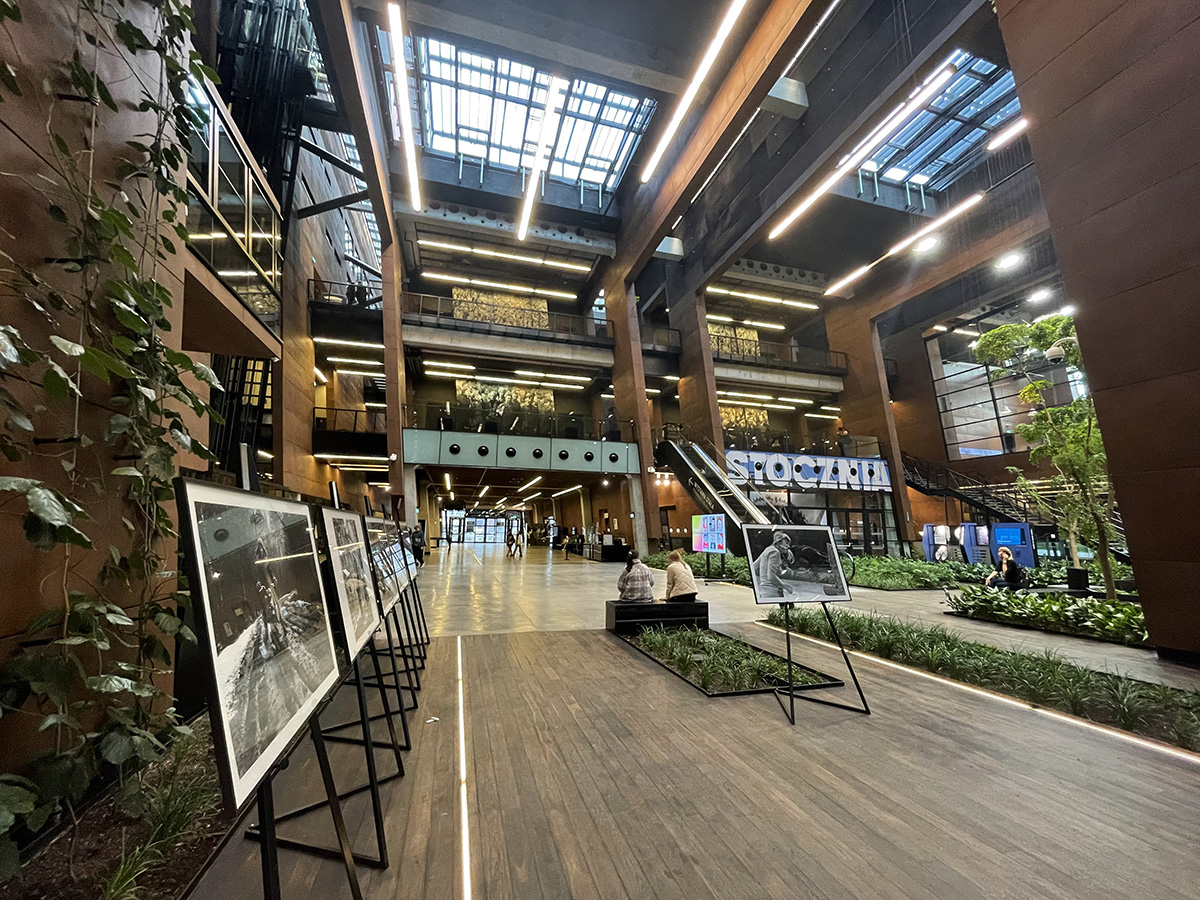
Across many Western cities, former industrial areas have been redeveloped through striking cultural buildings – museums, galleries and performance spaces designed to symbolise renewal. These projects, inspired by the much-publicised ‘Bilbao effect’, aim to boost local economies and urban identities through architectural spectacle. Yet behind their iconic forms and global visibility lie complex, everyday relationships between people, materials and places. This thesis explores those relationships through the case of the European Solidarity Centre (ECS) in Gdańsk, Poland, an iconic cultural centre sustaining the heritage of the Polish Solidarity movement and built on the grounds of the former Lenin Shipyard where the movement started.
The research investigates how the ECS becomes iconic not only through design or reputation but through the practices, emotions and material encounters that sustain it in everyday life. Rather than treating iconic buildings as fixed symbols of success, the thesis examines how they are constantly made and remade through the relations between humans, materials and their urban surroundings. To explore this, I develop the concept of ‘bigness’. ‘Bigness’ refers to the ways iconic cultural buildings expand beyond their physical structure, taking on social, political and emotional weight that connects them to broader urban, national and global processes. It describes how such buildings overflow – how their meanings, affects and material presences extend into the city and everyday life. Yet ‘bigness’ is also fragile: it must be continually maintained through work, attention and affective engagement.
The thesis builds on seven months of ethnographic research conducted between 2022 and 2023 at the ECS and the surrounding shipyard. I walked with employees, guides, artists, local residents and stakeholders in the redevelopment of the shipyard area; I joined events and daily routines, observed interactions with the building, and recorded sensory and emotional impressions through mapping, photography and autoethnographic notes. These methods made it possible to trace how people experience the ECS through touch, sound, movement and atmosphere – and how these experiences contribute to its bigness. Empirically, the study reveals three intertwined dynamics. First, it shows that bigness is produced through everyday practices that connect the ECS to multiple scales – local, national, European and global. People enact these scales through gestures and stories: people link the building to European ideals of freedom; situate it within memories of the shipyard’s industrial decline; navigate between local histories and international expectations. These scaling practices continually reshape the ECS’s iconicity, revealing that its ‘big’ status is not given but made through ongoing negotiation. Second, the thesis explores the sensory and affective dimensions of ‘bigness’. Participants describe feeling awe, pride, discomfort or melancholy when encountering the building’s monumental steel walls, echoing halls or views over the shipyard. Through these encounters, the ECS’s materialities become active participants in experience: they evoke emotion, memory and imagination. This demonstrates how iconicity is not only visual or symbolic but deeply embodied, arising through affective relations between bodies and materials. Third, the research examines how ‘bigness’ interacts with processes of creation and ruination in Gdańsk’s post-industrial landscape. These contrasts reveal the paradoxes of culture-led regeneration: the same projects that promise revitalisation also produce absences and exclusions. By paying attention to what decays, disappears or remains unfinished, the thesis shows how ‘bigness’ depends on the coexistence of presence and absence, creation and destruction.
The building’s iconicity is therefore not stable but continually negotiated within a terrain of loss, transformation and uneven urban development. Through these analyses, this research invites a more grounded understanding of iconic architecture. It shows that buildings like the ECS are not just symbols of urban success or instruments of regeneration but living entities that shape and are shaped by the people and environments around them. By tracing how ‘bigness’ is felt, sustained and sometimes undone in everyday life, the thesis reveals how cities remember their pasts, negotiate their presents, and imagine their futures through iconic cultural buildings.
Leave a Reply