The Data Stewardship Biomed Unit (DSBU) is the faculty service responsible for the operational implementation of the FAIR principles (Findable, Accessible, Interoperable, Reusable) and Open Research Data (ORD) practices in the management and sharing of research data produced within the FBM UNIL–CHUV.
DSBU services support the faculty’s institutional policy for research data management by promoting the traceability, scientific reproducibility, regulatory compliance, and international visibility of research data generated through research projects.
1. Scope of DSBU FAIR / ORD Services
The services provided by the DSBU cover the entire lifecycle of research data, including:
- documentation(README files) and structuring of data;
- metadata management and standardization;
- preparation of datasets for FAIR sharing and Open Research Data;
- support for sharing datasets in recognized FAIR data repositories;
- use of the HORUS Dataset Catalog (CHUV) for sharing metadata associated with sensitive clinical research datasets when the data themselves cannot be made directly accessible;
- long-term preservation and archiving of data.
Details
The DSBU provides scientific and technical support, including:
- targeted workshops for research groups;
- individualized follow-up tailored to researchers’ needs (link).
Dataset Structuring and Organization
The DSBU provides guidance on:
- organizing and hierarchizing data according to FAIR standards;
- implementing clear and sustainable naming conventions for files and folders.
Selection of Open File Formats
The DSBU provides recommendations regarding:
- the use of open file formats for FAIR sharing and long-term preservation.
Integration and Optimization of DataSquid©DSBU for Data Sharing
Services include:
- installation and configuration of DataSquid©DSBU (link);
- optimization of the tool according to the types of data produced;
- Progressive integration of metadata flows from FBM research platforms into external repositories aligned with FAIR principles.
Enriched and Standardized Metadata
The DSBU ensures:
- automated extraction of internal metadata from imaging data files
(.FCS, .DICOM, .LIF, .ND2, .CZI, .LSM, etc.) using our tool FAIR Bioimage Metadata Extractor©DSBU ; - harmonization and standardization of metadata according to current disciplinary standards and ontologies;
- semi-automated generation of FAIR-compliant README files for comprehensive dataset documentation.
FAIR Compliance and Regulatory Alignment
The DSBU performs:
- verification of dataset compliance with FAIR principles;
- alignment with the requirements of the Swiss National Science Foundation (SNSF), Horizon Europe, scientific journals, and the institutions UNIL/CHUV.
Support for Data and Metadata Sharing
The DSBU supports research teams and assists with metadata curation for the sharing of datasets in recognized repositories, including:
Generalist FAIR Repositories
- Zenodo – FBM UNIL–CHUV Community (link)
Institutional CHUV Repository
- HORUS Dataset Catalog for sensitive, non-de-identifiable data (link)
Disciplinary FAIR Repositories
Examples include:
- ENA – European Nucleotide Archive
https://www.ebi.ac.uk/ena - EGA – European Genome-phenome Archive
https://ega-archive.org - BioImage Archive – EMBL-EBI BioImage Archive
https://www.ebi.ac.uk/bioimage-archive - IDR – Image Data Resource
https://idr.openmicroscopy.org - EMPIAR – Electron Microscopy Public Image Archive
https://www.ebi.ac.uk/empiar - EMDB – Electron Microscopy Data Bank
https://www.ebi.ac.uk/emdb - MetaboLights – MetaboLights Metabolomics Repository
https://www.ebi.ac.uk/metabolights - EBRAINS – EBRAINS Research Infrastructure
https://www.ebrains.eu
Support for Scientific Publication
The DSBU provides:
- adjustment of datasets in response to reviewers’ feedback;
- drafting or validation of the Data Availability section;
- verification of the links between the scientific publication, DOI, and dataset;
- recommendations aimed at maximizing data visibility and citation.
Ethical Compliance and Management of Sensitive Data
Within the framework of FAIR sharing, the DSBU ensures:
- indexing and dissemination of metadata for sensitive clinical research datasets linked to CHUV publications, while ensuring data security and regulatory compliance.
- compliance with the ethical and regulatory requirements of the responsible bodies
(CER-VD, CHUV Legal Services, CHUV Sponsor Office, etc.); - verification of the compliance of patient consent forms;
- risk assessment associated with the processing and sharing of sensitive data;
- compliance with the recommendations of the Biomedical Data Science Center regarding data de-identification and the assessment of whether data may be shared openly or under restricted access.
Funder Validation and Contractual Aspects
The DSBU provides support regarding:
- SNSF FAIR and Open Research Data requirements;
- preparation for European audits or SNSF compliance checks;
- data-sharing licenses (CC-BY, CC0) and copyright issues;
- compliance with Data Transfer and Use Agreements (DTUA) issued by CHUV or UNIL legal services and the PACTT Knowledge Transfer Office.
Scientific Visibility and Data Valorization
The DSBU contributes to enhancing the value and visibility of research data through:
- indexing of CHUV datasets in the HORUS Dataset Catalog (CHUV);
- automated indexing of FBM UNIL/CHUV datasets in researchers’ UNIL profiles via IRIS.
2. Research Data Categories Subject to DSBU FAIR / ORD Service Fees
The following section defines the categories of research data for which DSBU FAIR and ORD services are provided under a cost-recovery model.
2.1 Experimental Data
- raw data generated by the FBM core research facility (e.g., imaging, microscopy, in vivo imaging, behavioral, biochemical, electrophysiology, flow cytometry/FACS, genomics, transcriptomics, proteomics, metabolomics, mass spectrometry,…)
- raw data produced by FBM research laboratories, internally or within the framework of external collaborations.
2,2 Clinical Research Data
- raw data originating from CHUV platforms or generated within clinical research projects (e.g., clinical, demographic, interventional, medical imaging data,…);
- clinical data intended for FAIR sharing or controlled dissemination of metadata.
2,3 Secondary Data
- secondary data used for the analyses, results, and conclusions of a scientific publication.
These provisions apply in particular to data:
- underpinning the conclusions of a scientific publication;
- produced within projects funded by the SNSF or the European Union.
3. Economic Model and Financial Conditions
The services provided by the DSBU are based on a mixed economic model, combining institutional faculty support with a contribution from research groups.
The model clearly distinguishes between:
- activities forming the institutional baseline and covered by FBM/UNIL institutional support.
- activities eligible for SNSF reimbursement and covered by research groups;
3.1 Institutional Support from FBM
Certain activities that are essential for compliance and preservation in research data management fall under the structural support of the FBM and are funded by the faculty.
The FBM finances structural activities including, in particular:
- development, maintenance, and evolution of DSBU tools, including
DataSquid©DSBU, DeepScan©DSBU, FAIR Bioimage Metadata Extractor©DSBU, and FAIRShare Explorer©DSBU(link); - creation and validation of DMPs (DSW–ELIXIR);
- activities associated with short- and long-term storage (LTS);
- curation of data and metadata when researchers leave the institution;
- helpdesk, ticket follow-up, and technical support;
- FBM and CHUV doctoral training
(RDM, FAIR, archiving, research integrity).
These tasks constitute the non-reimbursable baseline infrastructure supporting collective operations and are integrated into the faculty budget.
3.2 Costs covered by research groups
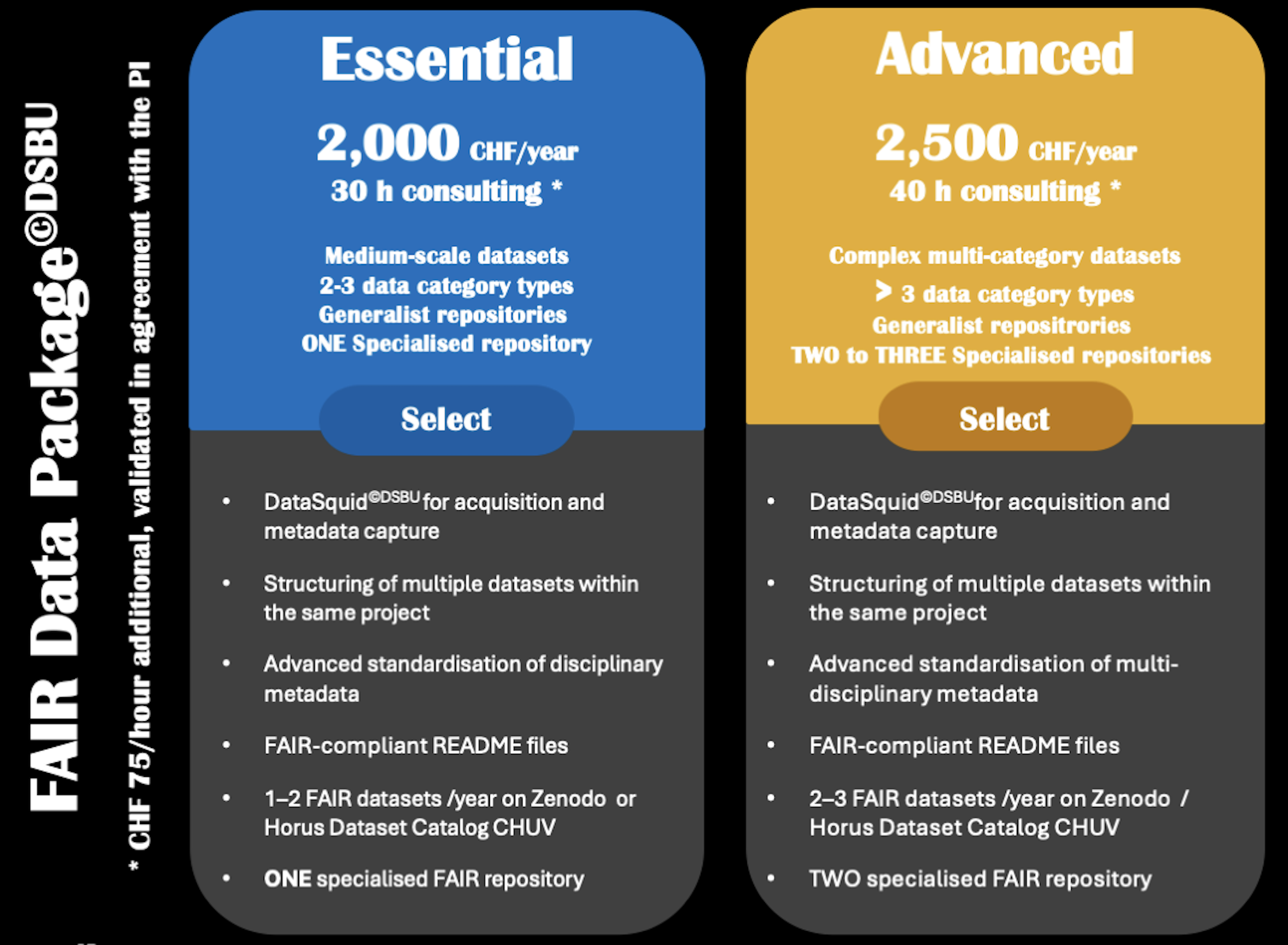
The FAIR Data Package©DSBU covers the contribution from research groups within the mixed funding model. It includes the services provided by the DSBU that are funded by researchers and are eligible for reimbursement by the Swiss National Science Foundation (SNSF).
The FAIR Data Package©DSBU provides research groups with comprehensive support through the data stewardship infrastructure, including tools, expertise, scientific guidance, and assistance with FAIR data management and data sharing.
The two service packages FAIR Data Package©DSBU— ESSENTIAL and ADVANCED — differ only in terms of:
- the volume of data to be processed;
- the number of datasets to be structured and shared;
- the diversity of data types;
- the number of FAIR consulting hours included.
Subscription to one of the paid service packages (FAIR Data Package©DSBU) is expected for any project submitted to SNSF or to European funding schemes.
This expectation may be waived if a member of the research group fulfills the role of data scientist, provided that their data stewardship qualifications are assessed and validated by the DSBU at the time of the budget request.
3.3 Services Included in the annual FAIR/ORD service packages – FAIR Data Package©DSBU
Two service levels are available depending on the complexity and volume of datasets generated by the project through annual service packages.
| Service package | Annual cost | Consulting hours | FAIR datasets deposition supported per year | Repository support | Suitable for |
| Essential FAIR Data Package©DSBU | CHF 2,000 / year | Up to 30 hours | 2–3 datasets | Generalist repositories (Zenodo – FBM UNIL–CHUV Community, Institutional CHUV Repository), (HORUS Dataset Catalog), and ONE disciplinary FAIR repository | Projects producing moderate dataset volumes with limited disciplinary specialization |
| Advanced FAIR Data Package©DSBU | CHF 2,500 / year | Up to 40 hours | 4–5 datasets | Generalist repositories (Zenodo – FBM UNIL–CHUV Community, Institutional CHUV Repository), (HORUS Dataset Catalog), and up to TWO disciplinary FAIR repositories | Complex or multi-technology projects generating multiple categories of datasets |
Within these packages, the DSBU provides support for structuring research data and metadata in accordance with FAIR principles, enabling the deposition of two to five datasets per year in repositories depending of the level covered by the package, including generalist repositories and, where relevant, at least one specialized repository.
Support for deposition in:
- Generalist FAIR Repositories
- Zenodo – FBM UNIL–CHUV Community (link)
- Institutional CHUV Repository
- HORUS Dataset Catalog for sensitive, non-de-identifiable data (link)
- Two types of disciplinary FAIR Repositories
- Examples include:
- ENA – European Nucleotide Archive
https://www.ebi.ac.uk/ena - EGA – European Genome-phenome Archive
https://ega-archive.org - BioImage Archive – EMBL-EBI BioImage Archive
https://www.ebi.ac.uk/bioimage-archive - IDR – Image Data Resource
https://idr.openmicroscopy.org - EMPIAR – Electron Microscopy Public Image Archive
https://www.ebi.ac.uk/empiar - EMDB – Electron Microscopy Data Bank
https://www.ebi.ac.uk/emdb - MetaboLights – MetaboLights Metabolomics Repository
https://www.ebi.ac.uk/metabolights - EBRAINS – EBRAINS Research Infrastructure
https://www.ebrains.eu
- ENA – European Nucleotide Archive
Details for Essential and Advanced FAIR Data Package©DSBU
Essential FAIR Data Package©DSBU
CHF 2,000 / year – access to DSBU services including up to 30 hours of specialized consulting
The Essential package is intended for projects producing several types of data and requiring enhanced support for FAIR structuring and sharing.
Suitable for:
- multi-technology projects;
- 2 to 3 categories of life sciences data (e.g., imaging, microscopy, in vivo imaging, behavioral, biochemical, electrophysiology, flow cytometry/FACS, genomics, transcriptomics, proteomics, metabolomics, mass spectrometry) or clinical data (e.g., clinical, demographic, interventional, and medical imaging data);
- medium dataset volumes;
- sharing in generalist and specialized FAIR repositories.
Services included:
- structuring of several datasets within the same project;
- advanced standardization of disciplinary metadata;
- preparation of detailed README files;
- FAIR and legal checks prior to deposition or publication.
Support for data sharing:
- preparation and sharing of 2 to 3 FAIR datasets per year;
- support for deposition in:
- Generalist FAIR Repositories
- Institutional CHUV Repository
- One type of Disciplinary FAIR Repositories
Advanced FAIR Data Package©DSBU
CHF 2,500 / year – access to DSBU services including up to 40 hours of consulting
The Advanced package is designed for complex projects or projects with high data production, involving several experimental techniques and major acquisition flows.
Suitable for:
- complex multi-technology projects;
- more than 3 categories of data categories of life sciences data (e.g., imaging, microscopy, in vivo imaging, behavioral, biochemical, electrophysiology, flow cytometry/FACS, genomics, transcriptomics, proteomics, metabolomics, mass spectrometry) or clinical data (e.g., clinical, demographic, interventional, and medical imaging data);
- groups producing a large number of datasets;
- intensive acquisition flows generated by technological platforms.
Services included:
- full structuring of complex and multimodal datasets;
- advanced curation of disciplinary metadata;
- drafting of detailed README files for multi-technology projects;
- full FAIR compliance check prior to submission.
Support for data sharing:
- preparation and sharing of 4 to 5 FAIR datasets per year;
- support for deposition in:
- Generalist FAIR Repositories
- Institutional CHUV Repository
- Two types of disciplinary FAIR Repositories
Additional Hours
Services exceeding the number of hours included in the package are billed at CHF 75 per hour, subject to prior validation by the Principal Investigator (PI) responsible for the project.
3.4 SNSF Reimbursement Eligibility
The data stewardship activities included in the FAIR Data Package©DSBU correspond to the types of costs that are eligible for funding by the SNSF.
Researchers are expected to include the costs of the FAIR Data Package©DSBU in their grant budgets under the budget line: “Material costs: Costs for granting access to research data (Open Research Data)“.
3.4.1 SNSF Funding Available (up to CHF 10,000)
The SNSF supports researchers in making the data generated by their projects accessible with funding of up to CHF 10,000 per project (link).
SNFS Eligible costs for making research data accessible:
- Costs for data preparation (e.g. cleaning up data, creating metadata and anonymising data)
- Costs for publication in scientifically recognised, digital data repositories.
The data repositories must fulfil the FAIR principles (see Checklist (PDF) and Clauses 2.13 and 11.8 of the General implementation regulations for the Funding Regulations). The SNSF does not cover any costs for commercial data repositories.
Details of budget clauses 2.13 and 11.8:
2.13 Material costs: costs for granting access to research data (Open Research Data) 28
(Article 28 paragraph 2 letter c of the Funding Regulations)
1 The costs of enabling access to research data that was collected, observed or generated under an SNSF grant are eligible if the following requirements are met:
- The research data is deposited in recognised scientific, digital data archives (data repositories) that meet the FAIR 29 principles and do not serve any commercial purpose.
- the costs are specifically related to the preparation of research data in view of its archiving, and to the archiving itself in data repositories pursuant to letter a.
2 All costs charged to the grant must be linked to archiving of data that is thematically related to research that was funded by the SNSF.
- The maximum charge per grant is generally CHF 10,000.
- The costs must be taken into account at the time of submission of the application. 30
28. Amended based on the decision of the National Research Council of 21 March 2017, in force since 1 April 2017.
29. The FAIR principles stand for Findable, Accessible, Interoperable and Reusable (Wilkinson, M. D. et al. The FAIR Guiding Principles for scientific data management and stewardship. Sci. Data 3:160018 doi: 10.1038/sdata.2016.18 [2016]).
30. Amendment of 12 April 2023, in force with immediate effect.
11.8 Open Research Data 67
(Article 47 of the Funding Regulations)
1 All data collected and generated during the course of the research on which publications are based must be shared, provided no legal, ethical, intellectual property or other clauses prevent this. This data should be made available as soon as possible, at the latest together with the relevant scientific publication, and should be archived in recognized scientific data repositories that meet the FAIR data principles.
2 In specific cases, the SNSF reserves the right to require grant recipients to share all data relevant for further research, regardless of any link to a scientific publication.
3 A data management plan (DMP) must be submitted in accordance with SNSF guidelines.
67. Amended based on the decision of the Presiding Board of the National Research Council of 22 March 2022, in force with immediate effect.
The services provided within the FAIR Data Package©DSBU correspond to these eligible activities and include, in particular:
- preparation and curation of datasets;
- creation and structuring of metadata;
- drafting of README documentation files;
- validation and deposition of datasets in a recognized FAIR repository.
3.4.2 Important: Budget Should Be Requested at Submission
FAIR Data Package©DSBU costs are expected to be included in the grant budget at the time of submission, as SNSF regulations do not allow additional funding requests after the proposal has been submitted or awarded.
Researchers planning to submit SNSF or European grant proposals are therefore strongly encouraged to contact the DSBU early during the proposal preparation phase.
If no prior consultation with the DSBU has taken place before submission, the requested package should be considered provisional, as the final level of service and associated costs will be reassessed during the preparation of the project’s Data Management Plan (DMP).
4 Procedure for Requesting Funding for Data Stewardship Activities (SNSF)
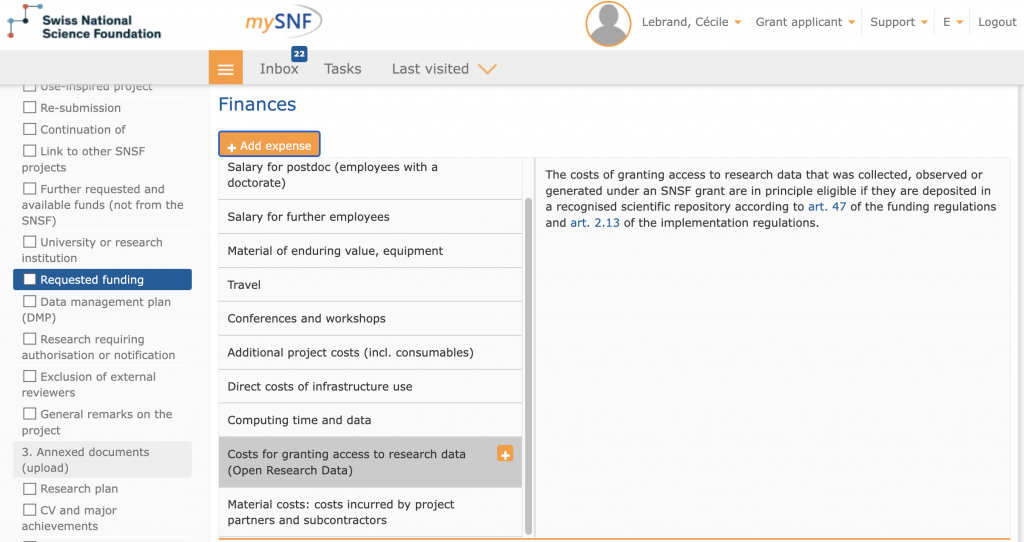
Funding for Data Stewardship activities related to FAIR data sharing and ORD should be requested from the SNSF through the MySNF platform (link).
When preparing the grant application:
- go to the “Request Funding” section in the MySNF database;
- classify the requested budget under the category
“Costs for granting access to research data” (Open Research Data).
For guidance on how to enter this information in MySNF, please refer to the screenshot provided below, which illustrates the relevant section of the submission interface.
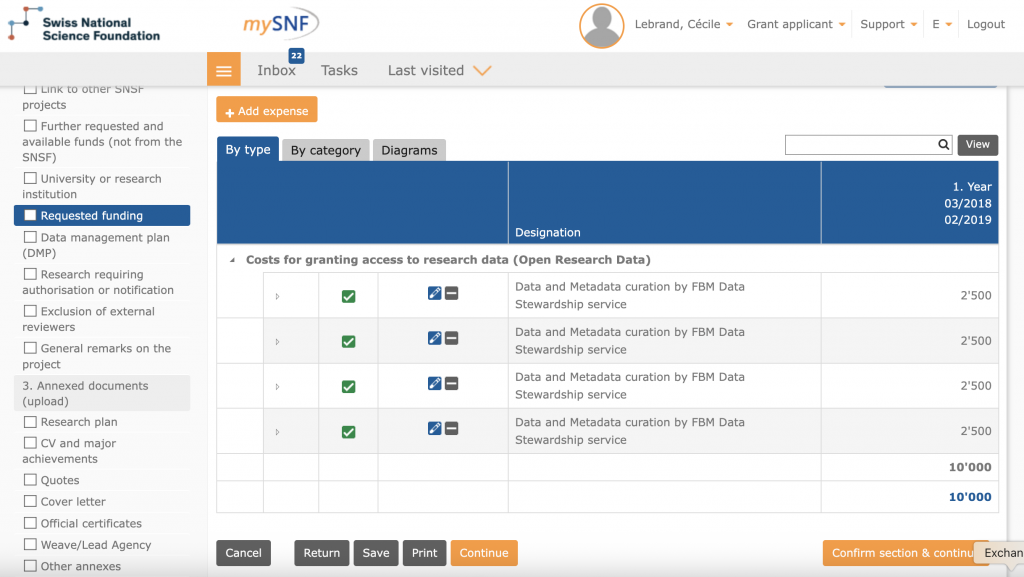
To ensure adequate coverage of FAIR data management activities, it is recommended to request:
- CHF 2,000 or 2,500 per year over four years depending on the level of service coverage provided under the Essentials or Advanced FAIR Data Package©DSBU
- Corresponding to the maximum eligible amount of CHF 10,000 per project.
The requested activity can be described as: “Data and metadata curation by FBM Data Stewardship Service.”
Justification for the SNFS funding: Funds will support Open Science practices and ensure the reproducibility and long-term accessibility of research outputs. This includes support from the Faculty Data Stewardship service for FAIR-compliant research data management, covering data preparation for FAIR/ORD sharing (structuring and quality control), metadata standardization, README documentation, and dataset deposition in SNSF- and Faculty-recommended repositories, including long-term preservation fees.