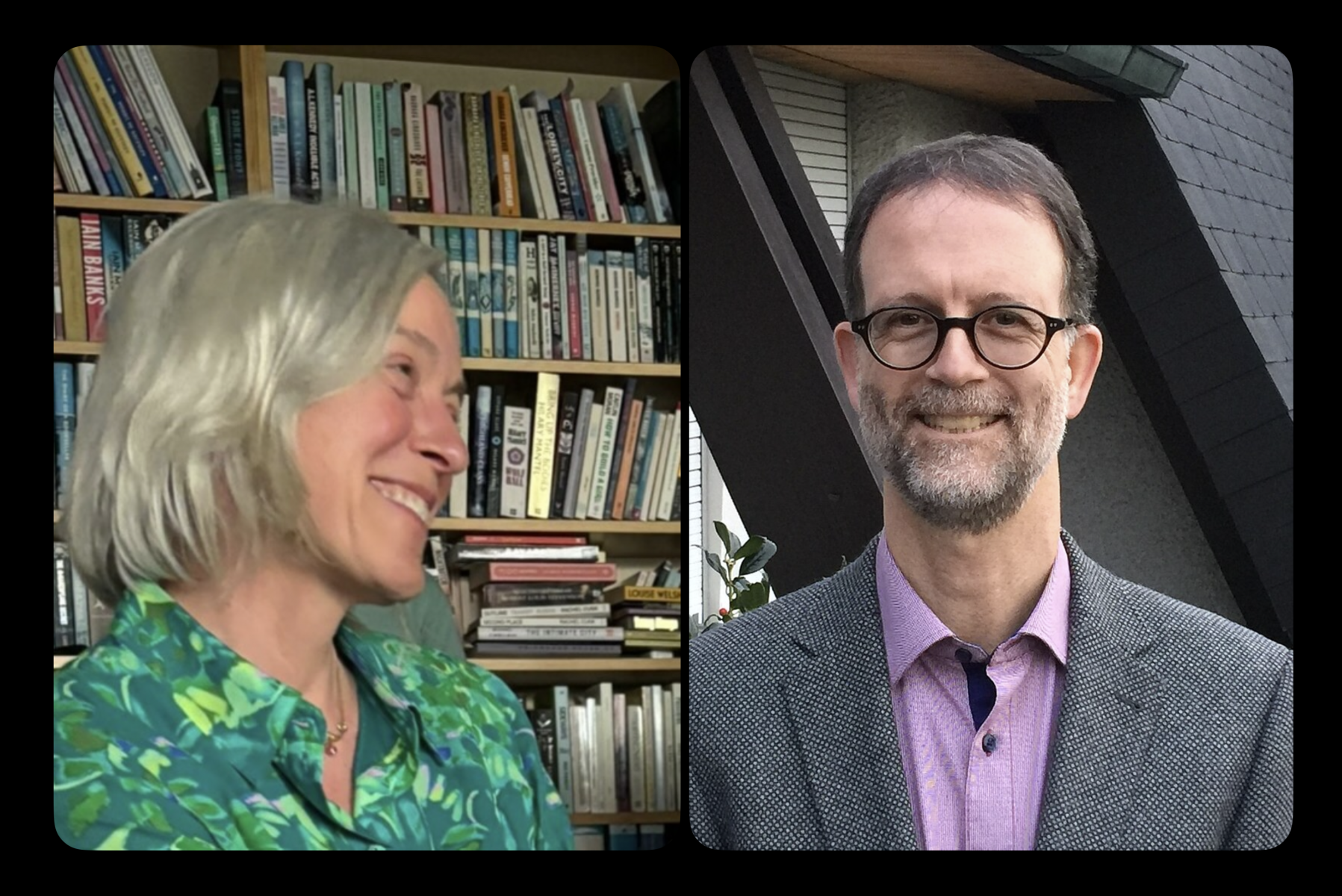
Interviews with Professor Rachel Falconer and Professor Thomas Honegger of Omentië Nolwë’s Organizing Committee
In addition to being the first international conference on J.R.R. Tolkien’s works hosted by a Swiss university, Omentië Nolwë – Zurich Tolkien Conference1 was a multilingual and interuniversity event, organized by the University of Zurich (UZH), the University of Lausanne (UNIL), and the Friedrich Schiller University Jena (FSU). After a successful first edition entitled “Environmentalism in Tolkien’s World: Ecocritical Perspectives on Middle-earth” in March 2025, two members of the Organizing Committee—Professor Rachel Falconer (UNIL) and Professor Thomas Honegger (FSU)—have agreed to be interviewed and, thereby, delve deeper into the facets of ecocriticism and the importance of comparative approaches in the context of the conference.2
A distinctive feature of Omentië Nolwë was the diversity of its speaker panel: beyond representing over six countries between them—including Ukraine, the UK, and the USA—, most of the speakers cannot be narrowly defined as ecocritics and instead approached this ecocritical inquiry from different fields, such as myth studies, philology, feminism, and affect theory. This diversity, both Honegger and Falconer emphasize during our conversations, was particularly enriching as it rendered the speaker panel complementary and interdisciplinary. Combining several thought-provoking approaches, the conference not only illuminated Tolkien’s work from various angles but also created a space for confronting different theoretical frameworks. Honegger remarks that the conference’s corpus was particularly suited for such operations: “Tolkien’s work shows applicability,” he explains, and it can thus accommodate a variety of (eco-)critical approaches and become a means of dialogue.
However, he and Falconer also observe that, despite this mixture of academic cultures, most speakers focused on the ideological and ethical implications of the relationship between characters and their environment, an orientation particularly prominent in the Anglo-American ecocritical tradition (see e.g., Buekens, 2019, § 5-7). Falconer further indicates that, while object-oriented ontology was wholly absent from the conference, several contributions could be linked to material ecocriticism or deep ecology more specifically. This is notably the case in Dr. Alexandra Filonenko’s discussion of archetypes and, perhaps more strikingly, Dr. Patrick Curry’s eco-theory. Indeed, the concepts of enchantment and disenchantment in this theory align with nineteenth century writing that understands nature as a sacred and moral sphere that has value in and for itself, principles to which deep ecologist Arne Naess also aspires. Although deep ecology certainly resonates with Tolkien’s writing, Falconer underlines that the linguistic and religious inflections of his environmental vision diverge from it, and Honegger further notes that the idea of stewardship based on biblical tradition – already proposed in Tolkien studies (Dickerson and Evans, 2011) – is particularly fitting for these texts.
This ethical focus forms a striking contrast to a framework for the discussion of ecological writing often privileged in francophone contexts, namely écopoétique. Ecopoetics as such were certainly first proposed by the Briton Jonathan Bate (2000, p. 75), yet the French tradition distances itself from his approach (Posthumus, 2017, p. 176), and the creation of ecopoetics is sometimes even directly attributed to francophone thinkers (Buekens, 2019, § 7). Francophone scholars thereby distinguish themselves from ecocriticism—which is held to be somewhat dominated by an Anglo-American focus (Posthumus, 2017, p. 19)—and advocate for a less politically engaged approach, preferring to instead focus on aesthetic and stylistic aspects of the literary depiction of the environment (p. 23).3
That Omentië Nolwë would neglect the preferred French perspective in favor of endorsing an Anglo-American orientation furthermore becomes salient through the concepts employed during the conference. Echoing her monograph on the topic—The Map of Wilderland—, Dr. Amber Lehning’s talk, for instance, engaged with the concept of wilderness, which certain francophone scholars identify as distinctly North American and inapplicable to the French context (Buekens, 2019, § 5). Similarly, various speakers repeatedly used the term environment and variations thereof – the prominence of which is also noticeable in the conference’s title –, a notion that is widespread in Anglo-American ecological thinking but generally rejected in francophone contexts as inherently anthropocentric (Posthumus, 2017, p. 13-15).
While the conference’s lack of French speakers might have contributed to this theoretical orientation, Falconer mostly attributes it to the current political evolution in the world: though certainly aesthetic, Tolkien’s environmental vision is characterized by a deeply ethical dimension, which renders a political reading inevitable in today’s context. Honegger, in turn, ascribes this predominance to the fact that most ecocritical publications on Tolkien in English simply stem from this tradition. He also underlines that the Organizing Committee is eager to invite French scholars to the conference’s next editions since putting the specific discourses of French tradition in dialogue with other theories would be particularly valuable for establishing a common ground for discussion.
He moreover remarks that comparative literature is highly relevant in the context of an event like Omentië Nolwë as it creates a space for exploring and understanding the relationship between humans and the environment across various cultures and the critics’ unique theoretical perspectives. Falconer equally points out that the ways of living with the Earth shown in Tolkien’s writing need to be confronted through different ecocritical readings. By multiplying our perspectives, she points out, “our comfortable ideas about the destruction of the environment become complicated”: we can thus challenge our settled Western notions about valuing nature and ask, for instance, whether the geography of Tolkien’s environmental war involves a colonial legacy. Given the intercultural and multilingual appreciation for Tolkien’s work, comparative approaches are also central to discovering cultural or even linguistic specificities of the ecocritical understanding of his environmental vision and, by extension, ecocriticism itself. Such comparative perspectives thus make it possible to contribute to the debate on the climate crisis in a meaningful way as a humanities scholar, which is also one of the goals Falconer pursued when joining the Organizing Committee at the end of last year.
Works Cited
- Bate, Jonathan, 2000, The Song of the Earth, Cambridge (MA), Harvard UP.
- Bouvet, Rachel and Stephanie Posthumus, 2016, “Eco- and Geo-Approches in French and Francophone Literary Studies”, in Hubert Zapf (ed.), Handbook of Ecocriticism and Cultural Ecology, Berlin and Boston, De Gruyter, p. 385-412.
- Buekens, Sara, 2019, “L’écopoétique. Une nouvelle approche de la littérature française”, ELFe XX–XXI. Études de la littérature française des XXe et XXIe siècles, n. 8, https://doi.org/10.4000/elfe.1299.
- Dickerson, Matthew and Jonathan Evans, 2011, Ents, Elves, and Eriador. The Environmental Vision of J. R. R. Tolkien, Lexington, University of Kentucky Press.
- Posthumus, Stephanie, 2017, French Écocritique, Toronto, University of Toronto Press.
Footnotes
- The conference has since been renamed and will henceforth be known as Tolkien Conference Switzerland. ↩︎
- As the interviews have been conducted personally and remain unpublished, all references to them—whether as quotation or paraphrase—will not bear parenthetical citations. ↩︎
- For an overview of écopoétique and French écocritique – the latter remaining unaddressed in this brief paper – please see Bouvet and Posthumus (2016, p. 385-392). ↩︎