|
|

|
|
|
|
|
|
|
Facility News
|
The Biopole antenna has officially moved to the SE-C Building 🥳 ! We still have to work out the kinks but we are operational and happy to welcome you in our new FCF space where scientific dreams and peak research are made ! Every users should already have access to the building so in case it doesn't work for you, contact support.gestaccescle@chuv.ch.
|
|
As we have moved to a new building and it feels like a new beginning, we thought it might interest our users, old & new, to see some popular mugs make a return. So for the next few months, we will bring back the mugs that were appreciated by you !
|
Limei Wang won the mug this month, Congratulations to you !
|
Each month, we will ask you 3 questions about the newsletter topic. If you win, you can enter the lottery to win a unique mug designed by the FCF team !
Please take few minutes to answer the quiz HERE.
|
|
|
|
|
FACS Tips
|
Glow Big or Go Home
|
|
|
We often hear people say, “This fluorophore is really bright,” or “That one is quite dim.” These are important observations when designing panels, as they can significantly influence our choices. For example, bright fluorophores should typically be paired with rare markers, while dimmer ones are best reserved for strongly expressed markers like CD45.
|
But what does it actually mean for a fluorophore to be bright or dim, and what determines that brightness?
|
In short, it depends on two main factors:
|
- Extinction Coefficient (ε) - How strongly a fluorescent molecule absorbs light at a particular wavelength
- Fluorescence Quantum Yield (Φ) - How efficiently the absorbed light is converted into emitted light
- Brightness = Extinction Coefficient (ε) x Fluorescence Quantum Yield (Φ)
Each fluorophore’s unique values for these two factors determines its overall brightness.
|
PE for instance is known as a very bright dye. It has an Extinction Coefficient of 1,960,000 cm-1M-1 and a quantum yield of 0.84. Put these together and you get the following brightness score:
|
PE = 1,960,000 cm-1M-1 x 0.84 = 1,646,400
|
PE is an example of a fluorophore that contains multiple fluorochromes, the fluorophore is the larger umbrella structure which contains these individually fluorescing fluorochrome subunits. PE with its multiple embedded chromophores within the single protein formation, give it a higher extinction coefficient in general compared with organic fluorophores such as AF647 or FITC that rely on just a single chromophore per molecule. For something like FITC it is a singular fluorophore with no subunit fluorochromes. Here’s how those compare:
|
|
AF647 = 270,000 cm-1M-1 x 0.33 = 89,100
|
|
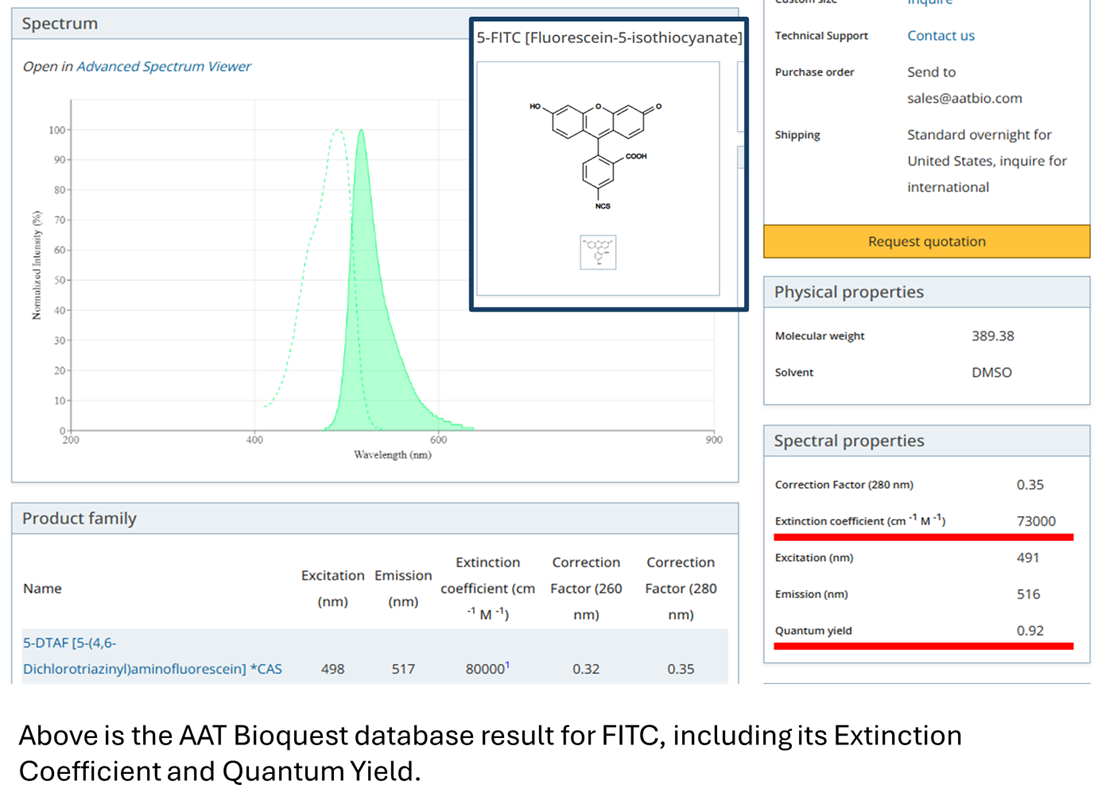
FITC = 73,000 cm-1M-1 x 0.92 = 67,160
|
|
|
|
|
Counter to PE, Pacific Blue is known to be a particularly weak dye, it has an Extinction Coefficient of 46,000 cm-1M-1 and a quantum yield of 0.78.
|
Pacific Blue = 46,000 cm-1M-1 x 0.78 = 35,880
|
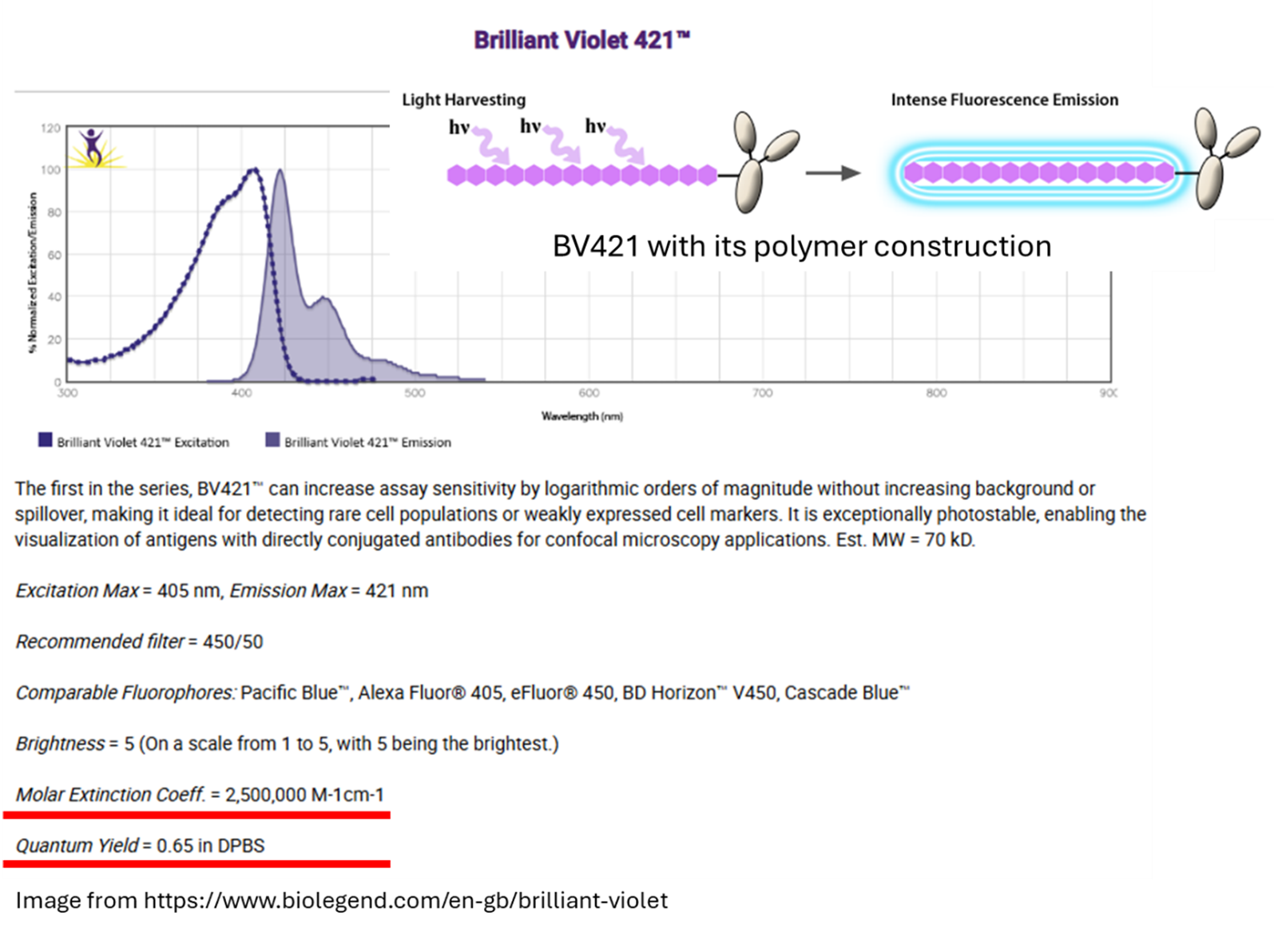
One area where this simple calculation becomes more complex is with polymer dyes like BV421. BV421 is exceptionally bright, but unlike PE or AF488, it is not a single fluorescent molecule. Instead, it has a polymer backbone with multiple fluorophores attached. These subunits work cooperatively, funneling the emission energy toward a single emitter. This design amplifies the signal far beyond what would be expected based on the quantum yield of a single subunit alone.
|
|
|
The result of this means that, while the quantum yield of the core fluorophore is known, it’s not necessarily comparable because the design of the polymer amplifies the signal beyond a single fluorophore's quantum yield. As the subunits work cooperatively, amplifying signals down the polymer backbone, the polymer’s extinction coefficient is much larger than that of a standard organic dye. This is why dyes like BV421 get reported as a relative brightness compared to things like PE or APC.
|
Biolegend lists the Extinction Coefficient (ε) x Fluorescence Quantum Yield (Φ) as 2,500,000 cm-1M-1 at 405 nm and 0.65.
|
Many companies are expanding their dye offerings by developing new polymer dyes. BD’s Horizon Brilliant series now includes Brilliant Blue in addition to the Brilliant UV and Violet lines. Thermo Fisher offers the SuperBright series, Bio-Rad has the StarBright dyes, and Thermo Fisher also produces the NovaFluor series. These new dyes not only push brightness higher but also aim to minimize spillover, expand spectral capabilities, and improve stability and resistance to degradation.
|
|
That said, polymer dyes aren’t the only area of innovation. VioBright from Miltenyi, and RealBlue and RealYellow from BD respectively, are newly produced multimer dyes. RealBlue and RealYellow are purposefully advertised as replacements for PerCP and PE tandems on account of the fact that they no longer have the same degree of cross laser excitation as you would see in the legacy fluorochromes. Beyond more complex fluorochrome creation, Biolegend has also explored more simple existing organic fluorophores for options, which have been released in the form of Spark fluorophores such as Spark Blue 550 and Spark NIR 685
|
|
|
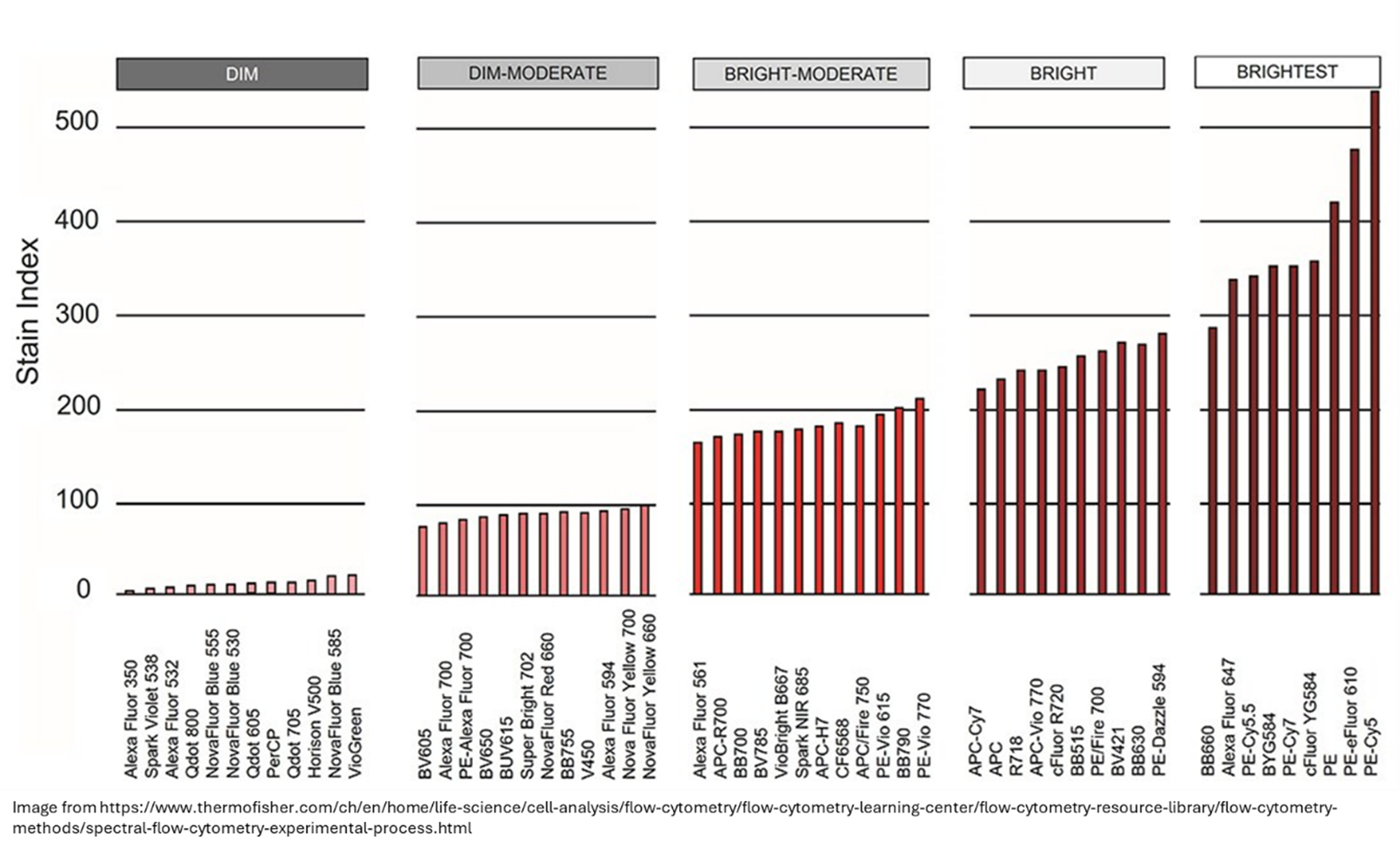
It’s important to say that these brightness calculations are theoretical, real-world performance can be affected by factors such as photobleaching, illumination power, degradation, etc, so in practice the brightness may not actually meet what is expected. For instance, 3 to 6 molecules of FITC are generally anticipated to be conjugated to each antibody, improving it’s brightness from just 1 single molecule. Even then there is variation from lot to lot, fluorophore to fluorophore.
|
In the end it is the brightness of the antibody conjugated to the fluorophore that is what is important. This is why we rely on the staining index to make our final decisions for staining concentrations for our panels. This is also why it’s necessary to update our single stains frequently as these brightness standards are ever changing with time.
|
|
Brightness calculations still have their value when making panel design decisions for where to put high and low expression markers, but real world testing will always be necessary to confirm. If you ever want to look into the brightness of a marker yourself, you can consult the database at AAT Bioquest. Here you can find listed Extinction Coefficient values (https://www.aatbio.com/resources/extinction-coefficient) along with Fluorescence Quantum Yield (https://www.aatbio.com/resources/quantum-yield). If you would like to know more about the fluorophores you’re using or what changes could improve your future experiments, or if you have any additional questions, make sure to reach out to the FCF team for support.
|
|
|
|
|