|
|

|
|
|
|
|
Facility News
We have good news for you this month 🎉!
|
First, the new Cytek Aurora 3 is officially available. It is located in the P2 room at the Agora. If you would like to be trained, please contact Danny Labes or Mariela Castelblanco Castelblanco.
|
Second, there will be a new Cytoflex LX machine by the end of the year at the Agora. We know that those machines are really appreciated and we are happy to provide more options for bookings !
|
|
|
|
As in previous years the Flow Cytometry Facility (Biopole 3 and Agora/CHUV labs) will be officially closed from 6.00pm Friday December 20th 2024 through to 12.00 noon on Monday 6th January 2025. During this time there will be no FCF support or training, and no possibility to organize repairs as the service engineers from all companies are also on vacation until January 6th 2025.
|
There will be no sorting service at either site from 6pm Friday December 20th 2024 until 12.00 on January 6th 2025. Please plan your experiments accordingly.
|
Analytical Flow Cytometers
|
All analytical flow cytometers will be available for use by experienced users with valid access cards in both the Biopole 3 (AA31 and BA32) and the Agora/CHUV (227 and 233) labs during this time. However, no staff will be available for troubleshooting or help with setting up experiments. Please only use the machines if you really need to. Bookings should be made as usual on the IRIS booking system.
|
Please note that the November 2024 billing will include all FCF use up to and including December 15th 2024. The January 2025 billing will include December 16th to December 31st 2024 bookings as well as all of January 2025.
|
|
We also take this opportunity to wish you all ‘Happy Holidays’ !
|
|
|
|
In this month FACS Tips, Kevin found an interesting new website that helps you find the right reagents for your experiments !
|
|
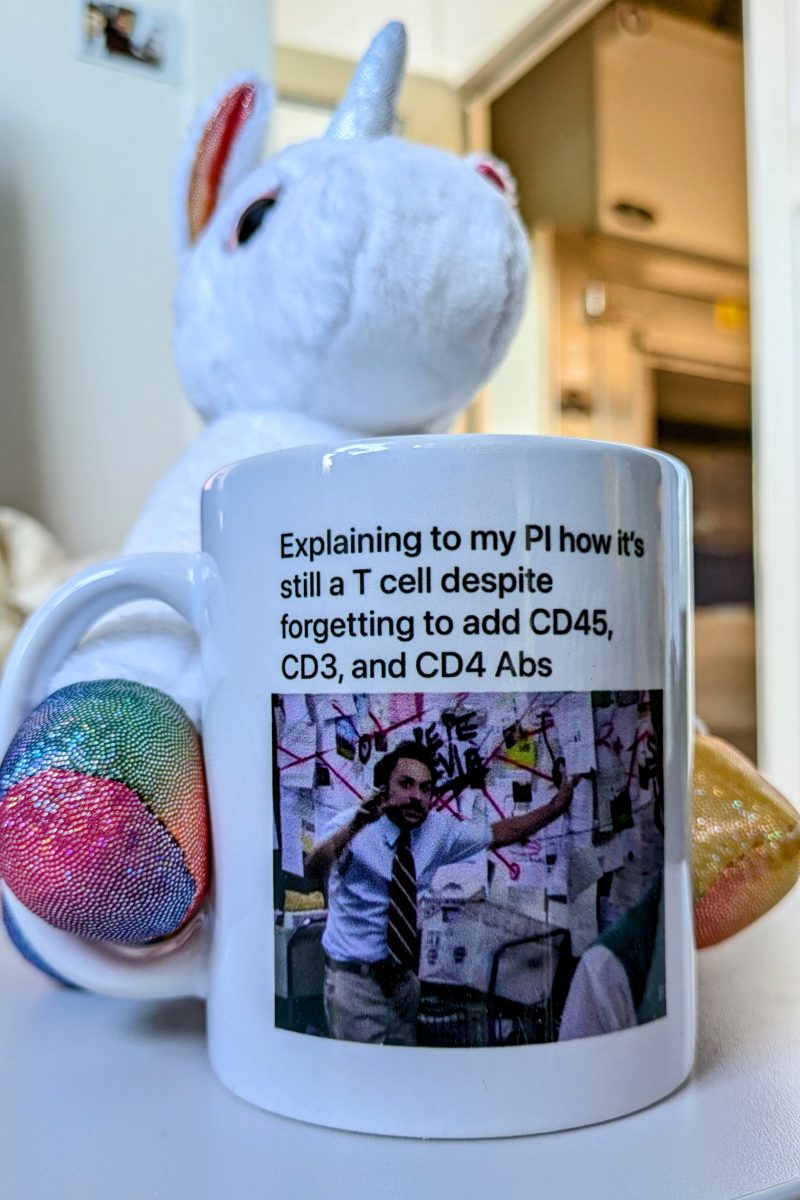
Alexandre Koloschenko won the mug this month, Congratulations to you !
|
|
Each month, we will ask you 3 questions about the newsletter topic. If you win, you can enter the lottery to win a unique mug designed by the FCF team !
Please take few minutes to answer the quiz HERE.
|
|
|
|
|
FACS Tips
|
BenchSci: The Reagent Finder
|
A difficult question we can get here in the facility will be a user request for our opinion on the best antibody to meet a certain experimental condition. For example, do we know a reliable FOXP3 marker to identify T reg cells in mouse lung samples. Unfortunately, unless this is within our personal experience, our usual approach is to search the literature and see what past researchers have used. We can’t guarantee if a reagent will work until it’s tested. In general, finding the right antibody can be tricky when experiments extend beyond basic immunophenotyping into more complex and unique situations.
|
|
However, there are a growing number of advanced solutions to help with this task. For example, EasyPanel offers the Smart Buyer and Antibody Search tools to help source reagents. Recently, I came across another platform that could be very useful: Selector, part of the Ascend platform by BenchSci. This tool leverages a vast database to help you quickly find the appropriate reagents for your project. Best of all, it's free for academic users.
|
|
|
|
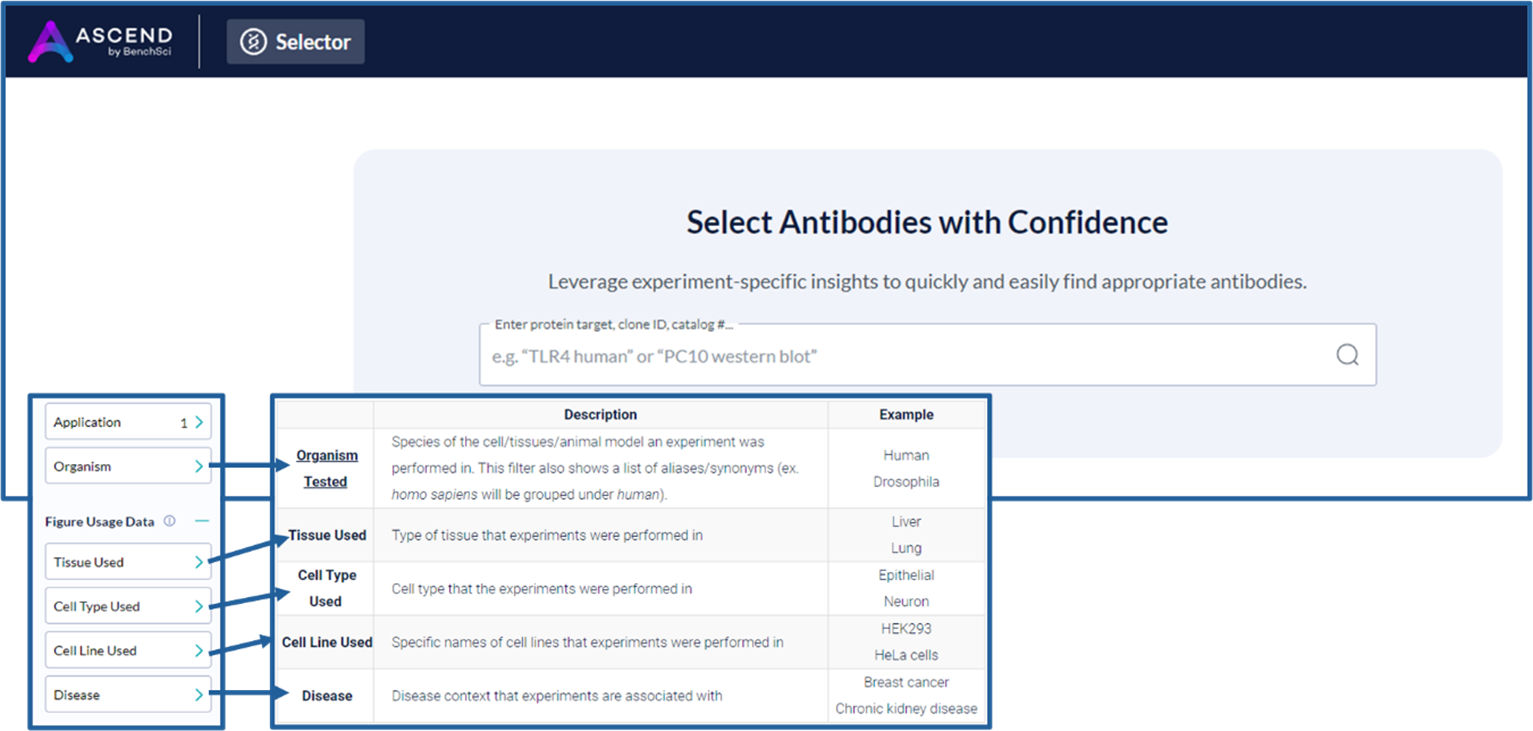
Selector works by allowing users to search for a protein target of interest and filter by application, such as flow cytometry, along with 16 additional filter options to quickly parse through the database to find the reagents relevant to your project. According to their website, this database contains over 22 million scientific publications from open and closed access publishers and has links to over 80 million products, making it a comprehensive resource.
|
|
|
|
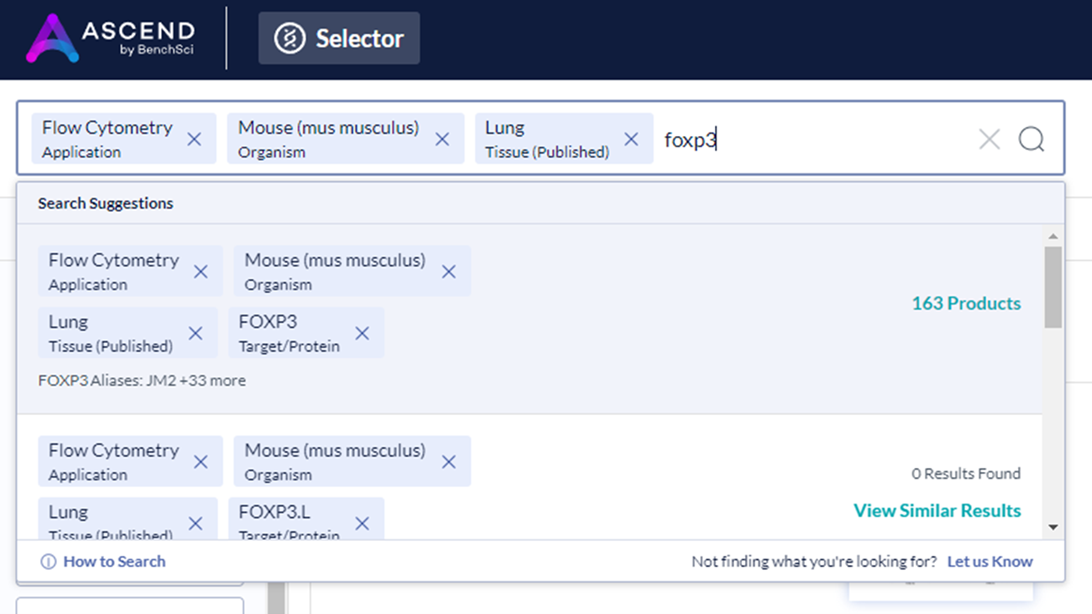
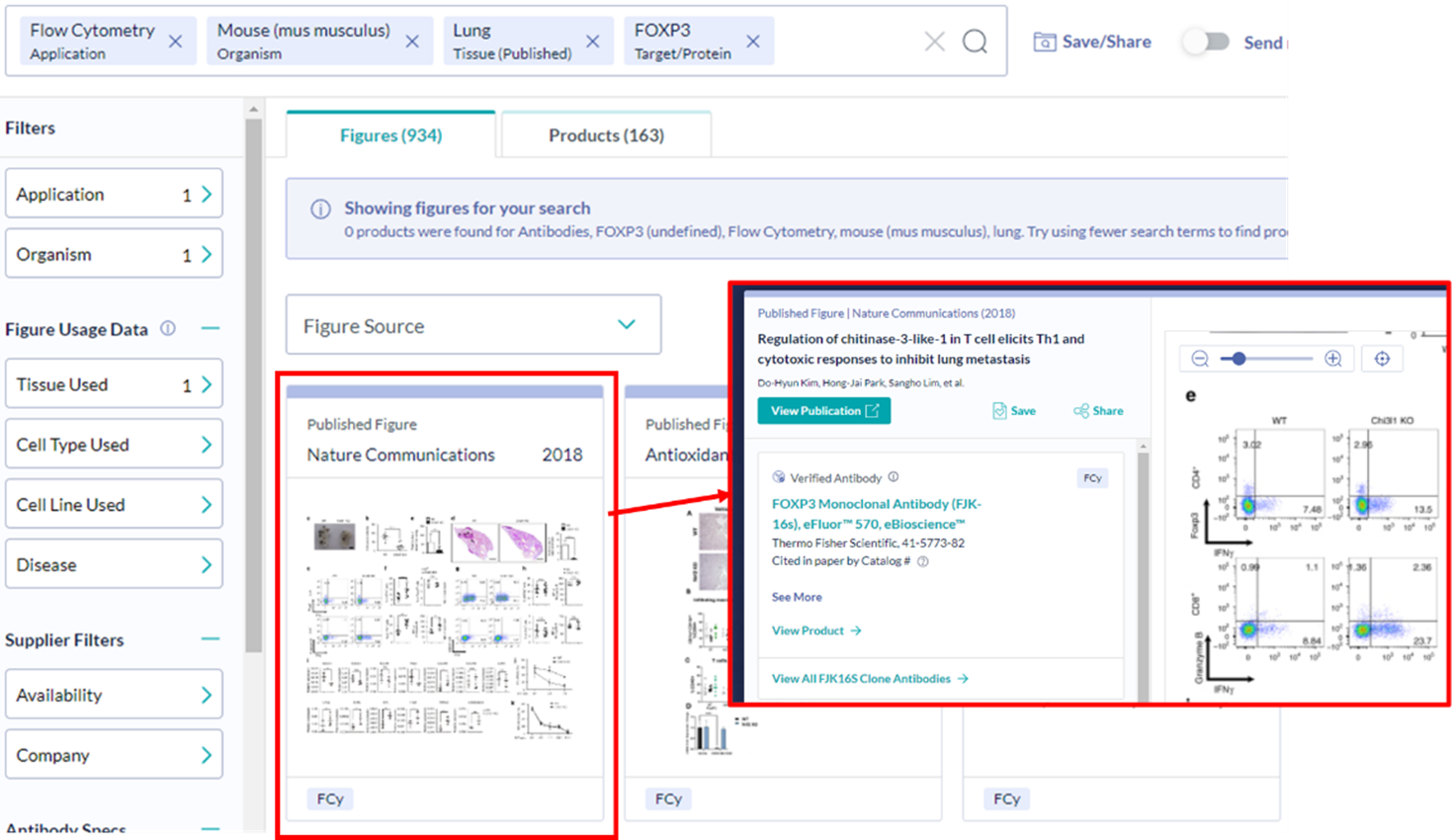
If we revisit the FOXP3 query, I can set the application to Flow Cytometry, Organism to Mouse, Tissue to Lung, and Target to FOXP3. With the search we get an accumulation of a Figures tab with 934 hits (Each thumbnail represents a figure that matches your search criteria) and a Products tab with 163 hits. If we just take the first Figure link from the best match sort, we can quickly pull up the staining profile figure published for this antibody in a linked Nature Communications paper. Along with this, there’s a link to the vendor's webpage for the product. Their interface is clean and seems quite user friendly. You can quickly change your search topic or scroll through all the options. Admittedly, giving 934 figure hits is much too overwhelming if you had to evaluate each one, and hopefully a reliable antibody can be determined within the first.
|
|
|
|
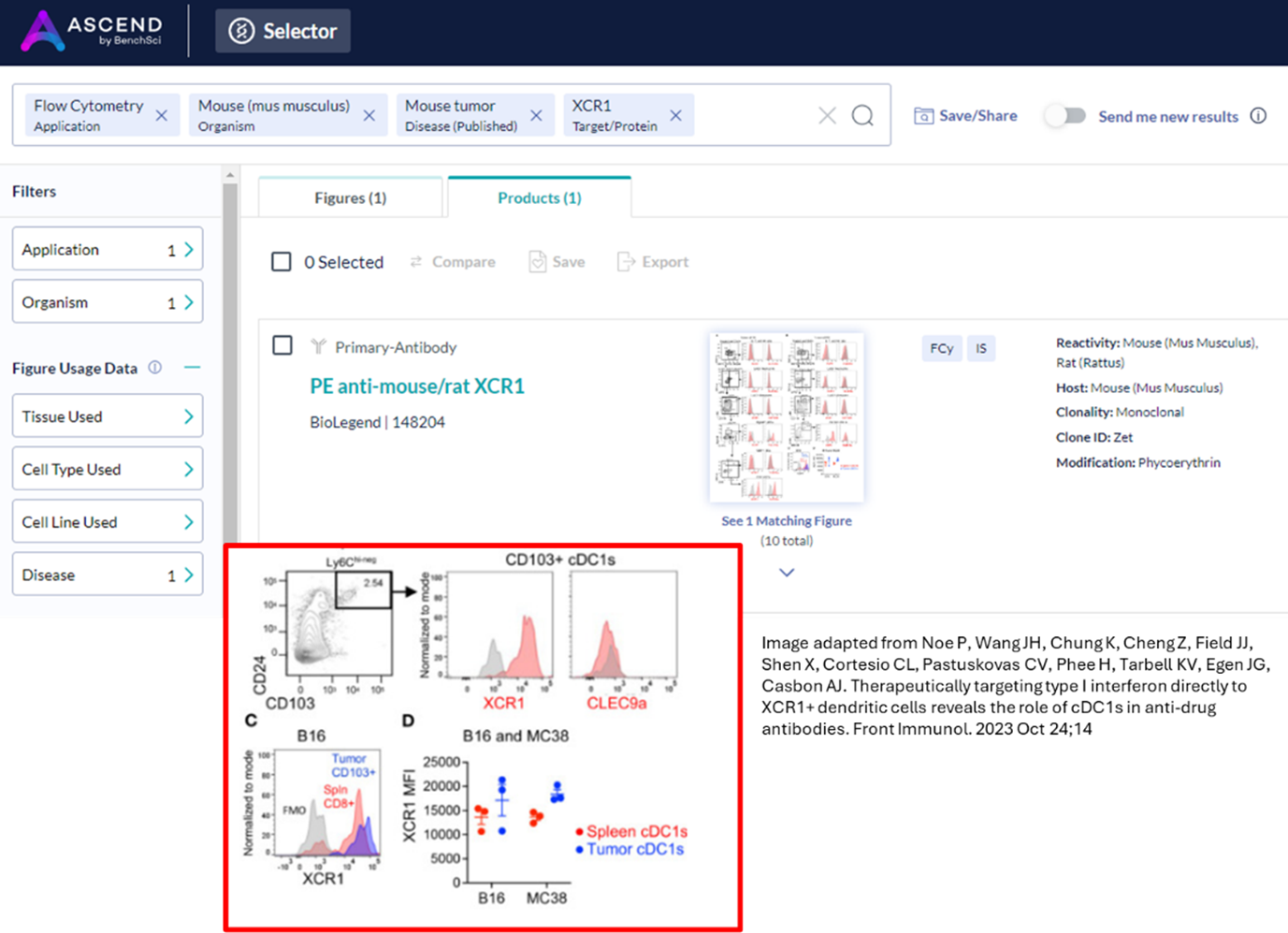
Another example here is a search for XCR1 staining in a mouse tumor model. It got one publication hit, but it’s quite nice. It directly displays the figure with a histogram for the XCR1 staining, and we can quickly link to the Frontiers in Immunology paper from which it was published to get more details on how it was used. And again, we have a link to the vendor if it’s an antibody we would like to purchase.
|
|
|
This is certainly not the software I would use for panel building, EasyPanel is much better suited for something like that. Rather, I see this platform being useful for finding the best key markers for complicated panels or tissue types upon which a panel could be built around. In this sense I can imagine these two platforms complimenting each other quite well. On top of that, Ascend Selector platform isn’t limited to flow cytometry experiments. If you’re in need of a microscopy or western blot antibody it can also help you there. Their website is full of guides for more in depth explanations for how to use the program, and you can register your account with an @unil.ch email address.
|
At the moment just the Selector feature I’ve discussed here is freely available, however they have several other tools currently available only to industry customers that sound interesting. This includes the following:
|
|
• Navigator: Helps formulate research questions by exploring connections between proteins, pathways, and diseases from the database.
|
|
• Architect: A tool for developing experimental protocols based on literature precedent.
|
• Defender: Identifies risks in preclinical experiments that might lead to downstream issues.
|
Of these, Architect sounds particularly promising for developing experiment protocols, though we’ll need more information as it becomes available.
|
|
If you try Selector, I’d love to hear your feedback—whether it’s useful or not. As always, feel free to reach out to the FCF staff with any questions.
|
|
|
|
|