|
|

|
|
|
|
|
|
|
Facility News
We're officially getting into summer territory now. The ☀️ is hitting us strongly and we feel the dolce vita vibe slowly getting in. You are probably counting the days to your well earned vacation in the next coming months. In the meantime, enjoy our cooled down labs to wrap up your last experiments before the break !
|
In this month FACS Tips, we talk about experimental controls. By this time, you know we love controls at the FCF. And among controls, there's a a master control, the one that rules them all: The FMO. In the following paper highlighted by Kevin, they discuss the use of FMM / FMx as a way to alleviate the burden of setting up the many FMOs to assess your new fancy 35 colors panel. Check it out !
|
|
Valerie Cesson won the mug of the month below, congratulations to you ! Please come by to our office at the SE-C Biopole to pick it up !
|
|

|
This month, no quiz to answer for you. Instead, to get a chance to win the mug of the month please reply to this newsletter by telling us the lovely location you are planning to explore soon for your vacation !
|
|
|
|
|
|
FACS Tips
|
FMx / FMM: Less is More for High-Parameter Panels
|
|
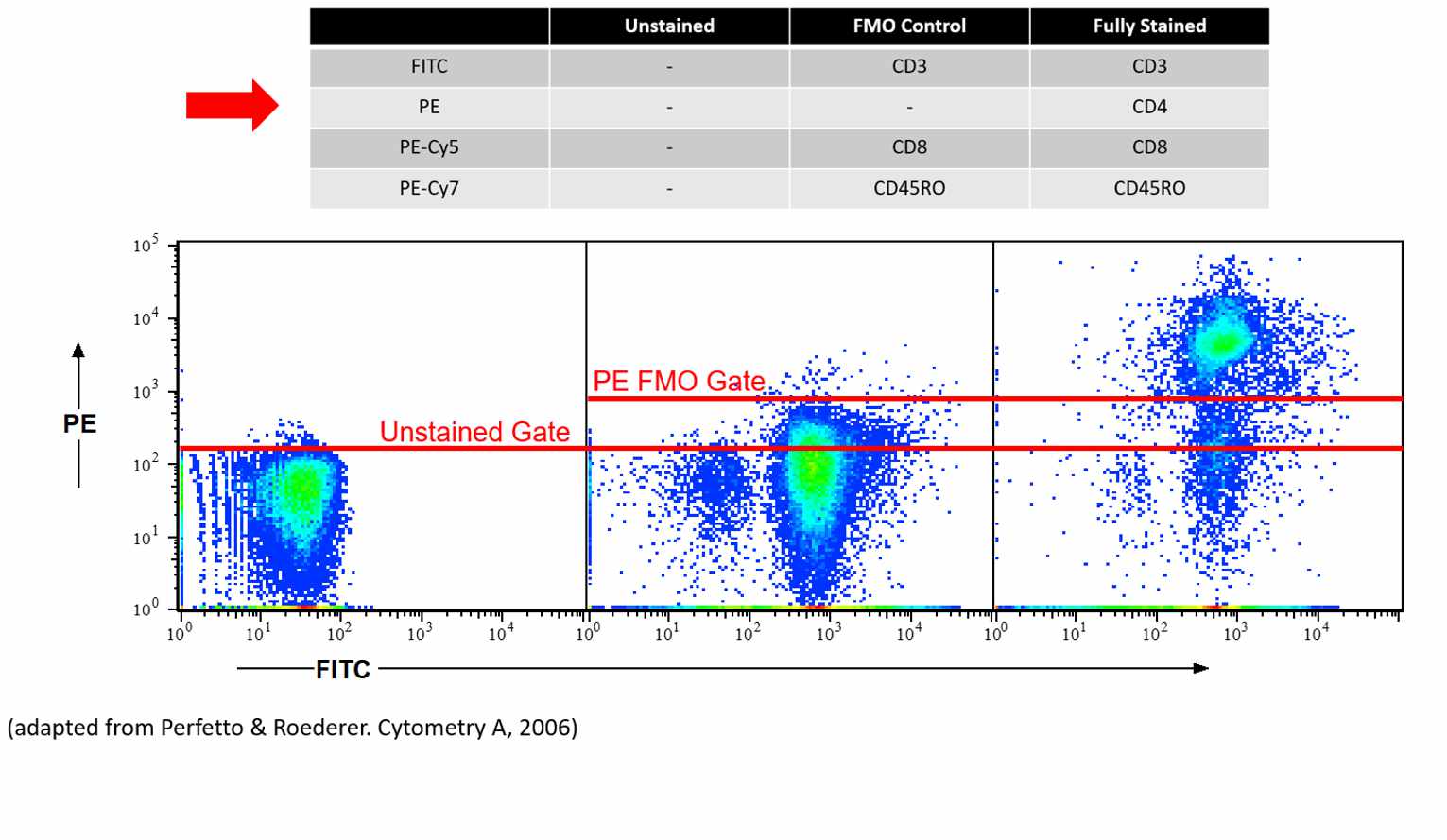
We all know the importance of an FMO. These are critical gating controls that help distinguish true positives from negatives, without them, cell population boundaries become arbitrary. An unstained sample alone is insufficient, as it fails to account for the spillover of other markers into a given channel, which can raise the threshold of positivity beyond what the unstained would suggest. An FMO is superior precisely because it captures the spreading effect of all other fluorophores into that channel, giving a more accurate picture of where true positive fluorescence begins.
|
|
|
The challenge is that as panels grow to 20 or 30 fluorochromes, preparing an FMO for every marker becomes increasingly laborious and expensive. While FMOs are most critical for secondary and tertiary markers with low or ambiguous expression, complex deep-phenotyping panels can have many of these. Enter the FMM, Fluorescence Minus Multiple, also referred to as the FMx, a practical approach to reducing that burden.
|
The concept is straightforward: rather than removing a single fluorochrome, what if you removed 4, 5, or even 6 at once? That could mean six fewer tubes, six fewer aliquots from a precious sample, six fewer antibody cocktails to prepare, and six fewer opportunities for pipetting error. The critical question, however, is which markers can be grouped together while still allowing you to set accurate gates. Since the entire purpose of an FMO is to define correct gating boundaries, poorly planned FMMs can undermine the process entirely. So how do you choose correctly?
|
|
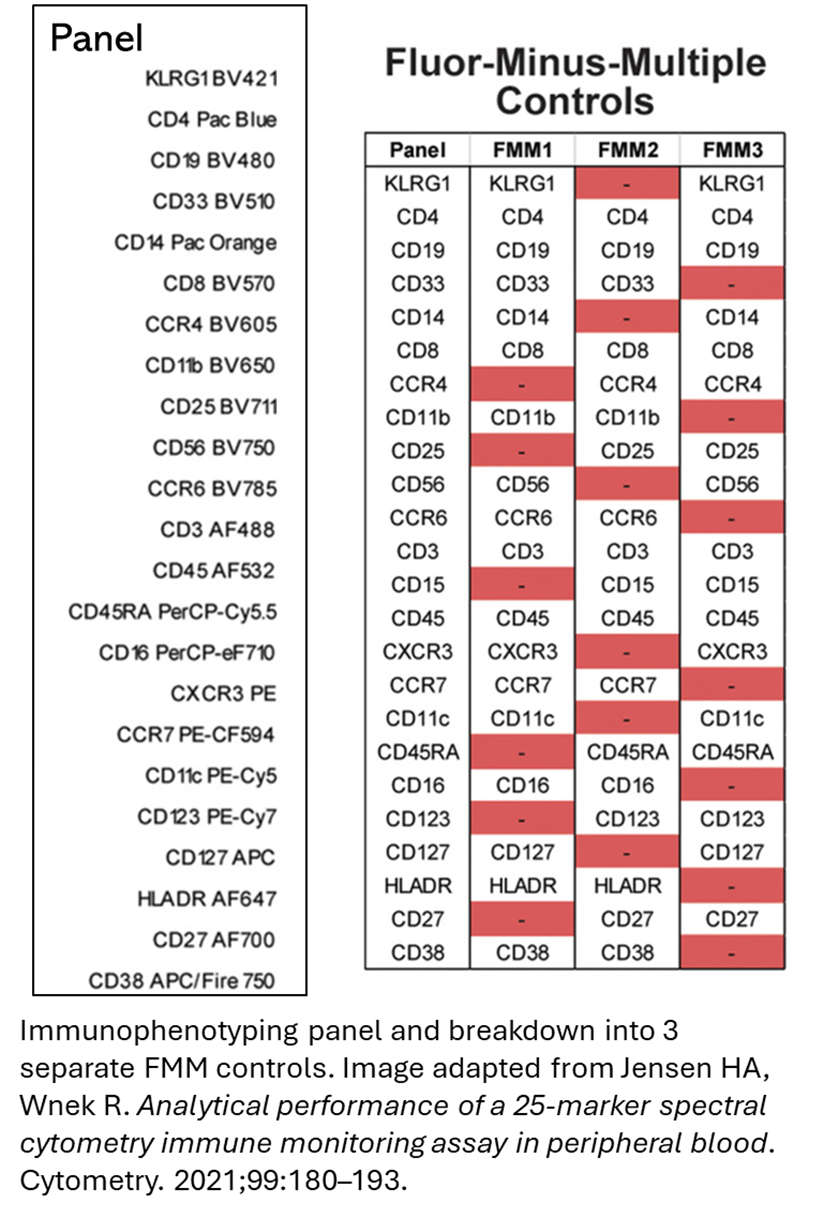
In their paper Analytical Performance of a 25-Marker Spectral Cytometry Immune Monitoring Assay in Peripheral Blood, Jensen and Wnek outline a clear set of guidelines for constructing FMM panels within a 25-color immunophenotyping panel. Acknowledging the impracticality of unique FMOs for every marker, they established rules for consolidating controls into 3 FMM panels:
|
|
- Primary lineage markers with clear separation (CD3, CD4, CD8, CD19, etc.) do not require FMOs.
- Spectrally adjacent fluorophores were distributed across separate FMM panels, ensuring that fluorophores with significant mutual spillover are never omitted together, preserving the ability to accurately define gates.
- Bivariate plot marker pairs were separated across different FMMs to keep gating decisions interpretable.
- Activation markers were spread across the FMMs rather than concentrated in one.
|
|
|
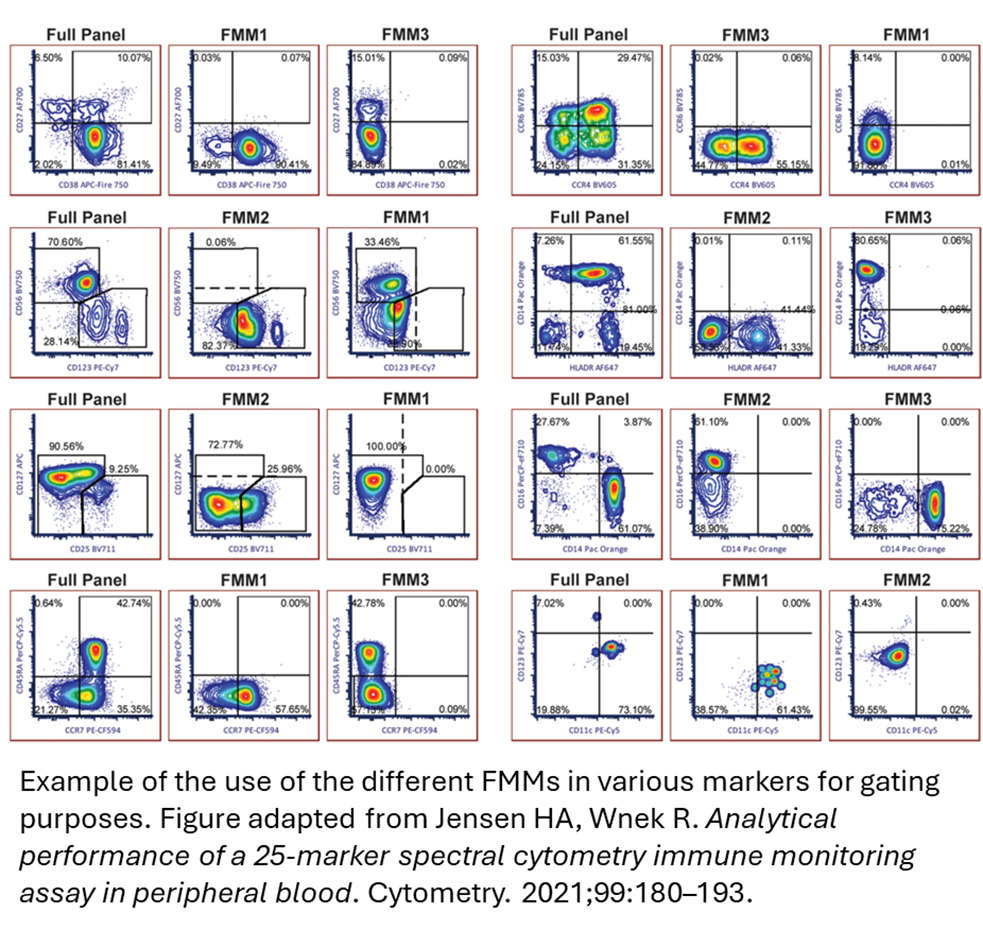
Using these principles, Jensen and Wnek consolidated 19 FMOs into just 3 FMMs, a substantial saving in sample, reagents, and time. That said, combining 6 or 7 FMOs into a single FMM is ambitious and may not be achievable in every experimental context. Even consolidating 2 or 3 FMOs can meaningfully reduce your workload without compromising data integrity.
|
|
|
|
The underlying philosophy is key: an FMO accounts for fluorescence spreading into a channel of interest due to leakage from other fluorophores. This means that in a valid FMM, none of the omitted markers should have meaningful spillover into one another's channels. If they do, you've removed the very signal the control was designed to capture.
|
|
|
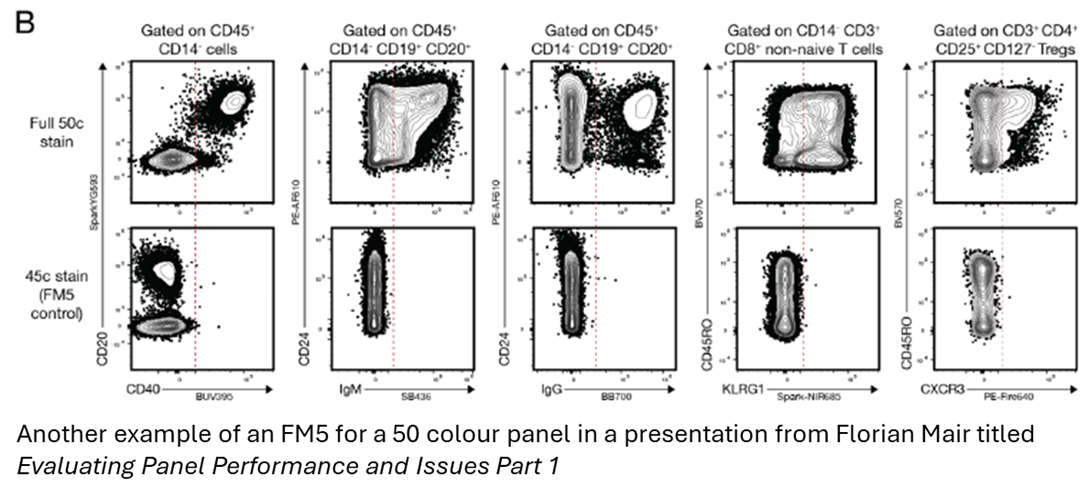
It's also worth remembering that FMOs, whether standard or combined, have limitations. They can quantify spreading into a parameter of interest, assist with troubleshooting unmixing issues, and inform gate placement, but they cannot identify non-specific binding.
|
|
With careful planning, it may be possible to replace 4 or 5 individual FMOs with 1 or 2 well-designed FMMs. But this requires deliberate assessment beforehand. If you'd like help evaluating whether your panel is a candidate for FMM consolidation, speak with FCF staff, we're happy to help.
|
|
|
|
|