|
|

|
|
|
|
|
|
|
Facility News
2025 is about to be over and it is almost time to go home and spend quality time with your loved ones 💕. The same is happening at the FCF as we are finally welcoming our last two machines for the year, the Aurora 4 and Aurora 5 ! We've heard you and we are finally able to provide more options for the spectral flow afficionados at the facility ! Those new machines are Cytek Aurora EVO which means they have some great quality of life upgrades like automatic turn on and turn off. I am sure it will make them popular in no time.
|
|
On a different topic, as I am sure you have noticed, we have moved from IRIS to a new booking system called PPMS. Sadly, this booking sytem makes it difficult for us to create an agenda for the two Analysis Workstations we are providing to the community. As a consequence and for the time being, we will go back to a simple paper agenda next to each station. If you want to book the station you can either book it as you come the FCF or send us an email and we will make the reservation for you. We will work on finding a more practical solution in the near future !
|
|
|
This month, Kevin is highlighting is quick and efficient technique to check your unmixing results.
|
|
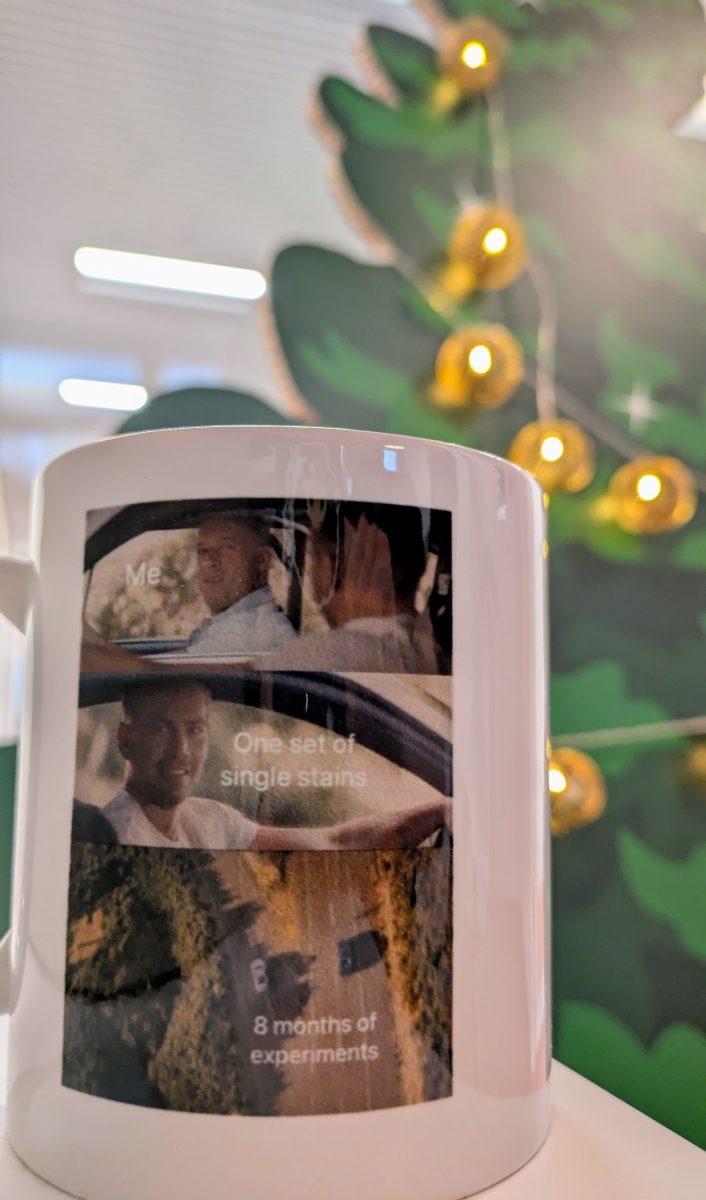
Giovanna Toillier de Macedo won the mug this month, Congratulations to you ! Please come by to our office at the SE-C Biopole to pick it up !
|
For this month, there's no quizz ! Every person replying directly to this newsletter saying they want the mug will have a chance to win the last mug of 2025 ! Good luck to you all !
|
|
|
|
|
FACS Tips
|
Extreme Negatives and Making Positives
|
|
|
|
This month's newsletter will be short and sweet so we can all enjoy what’s left of the year, and if you’re looking for a special gift for a loved one might I suggest the following.
|
|

|
|
|
|
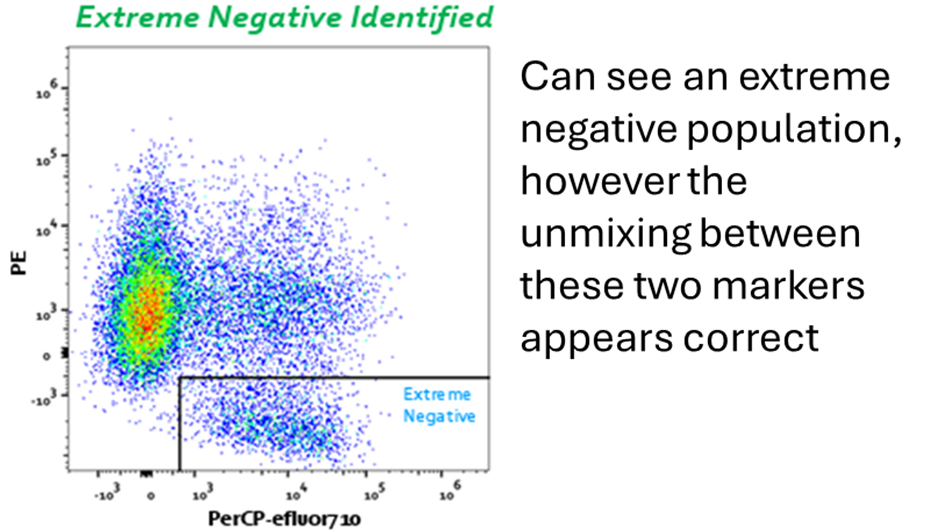
Unmixing, as we’ve learned, isn’t always as straightforward as it seems. Even when we believe we’ve prepared high-quality single-stain controls, we can still run into issues once we analyze our fully stained samples. One common challenge is the appearance of extreme negative populations. In theory, we should never see negative fluorescence values. When we do, it’s usually due to either compensation or unmixing errors, depending on whether we’re using a conventional or spectral cytometer. Pinpointing the source, however, can be tricky.
|
|
|
|
As we work through our hierarchical gating we can sometimes come across these extreme negative populations, but the plot itself with the extreme negative looks correctly unmixed. Therefore, we can tell we have a problem, but we’re not sure yet where it’s coming from. So what should we do?
|
|

|
|
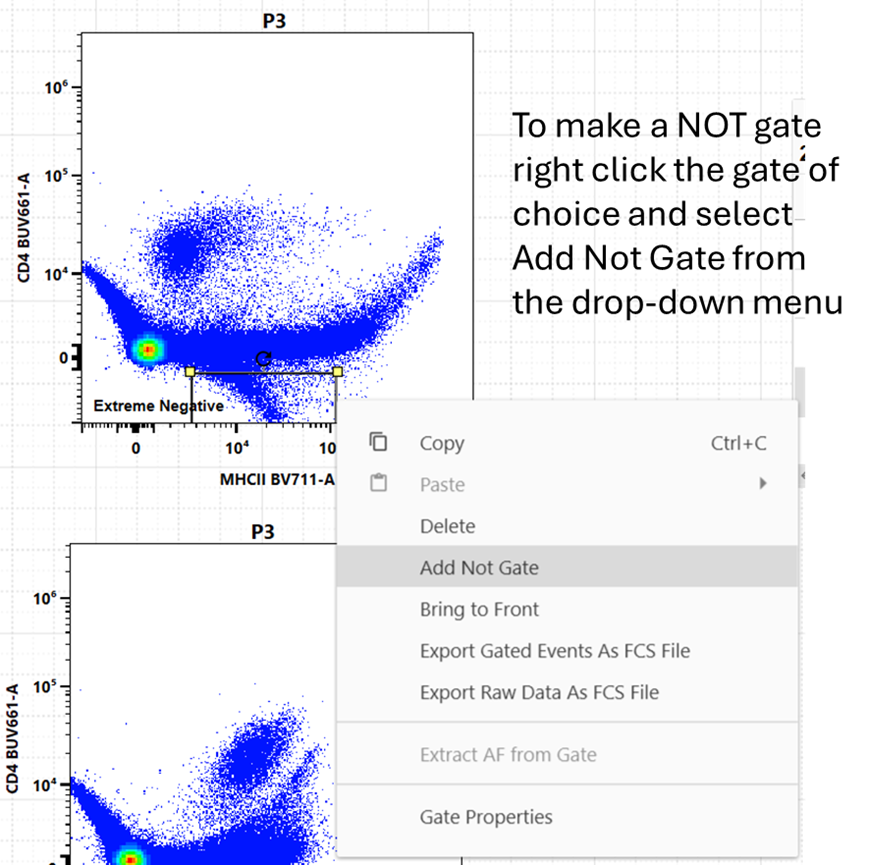
I recently came across a great tip from Kathy Daniels at the Memorial Sloan Kettering Cancer Center, shared through their Flow Post-Its series.
|
|
|
|
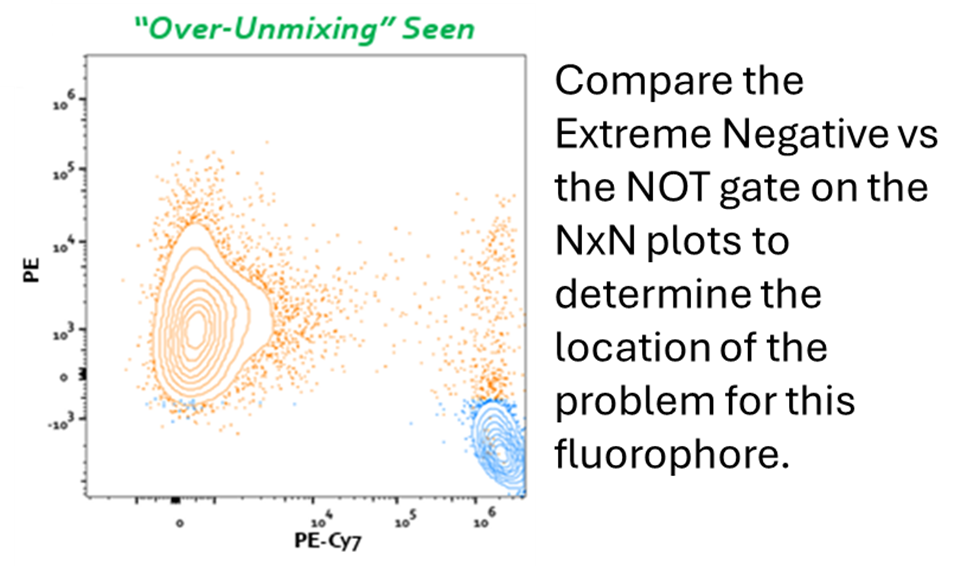
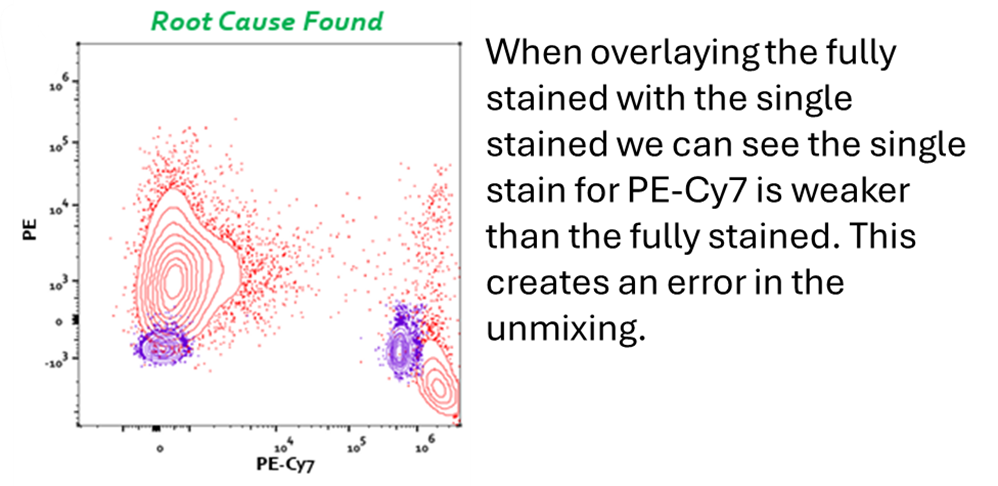
If we gate on the extreme negative cells and then use a boolean gating strategy to get the NOT population of these cells, we can then compare them in a NxN plot. From here we can see that the problem is coming from the interaction of PE and PE-Cy7. The unmixing underestimated the amount of PE in the PE-Cy7 single stain. It is very important when making this assessment using the NxN plots that the plots are properly scaled to make sure all the events are visible. This may mean increasing the plot size either using the automatic or manual scaling through the preferences section of the plot for the SpectroFlo.
|
|
|
If we revisit our three rules of compensation, they are;
|
- Rule 1: Autofluorescence of the positive and negative need to match.
- Rule 2: Single colour and experimental fluorochromes must be the same.
- Rule 3: The single colour controls need to be as bright or brighter than experimental samples.
|
|
In this situation, the single stains have failed the third rule and this has created the problem. It would then be necessary to go back and prepare a new single stain for PE-Cy7 to correct this extreme negative.
|
Additionally, if your panel includes both tandem dyes and their base fluorophores, those should be the first channels you check for unmixing issues. Stray emission from tandems into the base dye channel is common and can vary by lot, making it essential to refresh and verify your single-stain controls regularly.
|
|
There are many excellent Flow Post-Its covering a wide range of flow cytometry topics, so take a look at their page (https://fccf.mskcc.org/flow-post-its). And as always, if you need help with unmixing, feel free to reach out to the FCF staff.
|
|
|
|
|