|
|

|
|
|
|
|
|
|
Facility News
|
This month we are welcoming a new demo machine at the Biopole SE-D building ! The CytoFLEX Mosaic will bring the CytExpert aficionados into the next generation of flow cytometry : spectral flow ! So if you are curious about expanding your panel with additional exotic colors or tired of waiting for the Aurora machines to be free, the FCF team will be happy to support you along the way.
|
|
In this month FACS Tips, Kevin will give you an overview of this new spectral machine and how it can help you improve your experiments !
|
|
Romane Thouenon won the mug this month, Congratulations to you !
|
|

|
Each month, we will ask you 3 questions about the newsletter topic. If you win, you can enter the lottery to win a unique mug designed by the FCF team !
Please take few minutes to answer the quiz HERE.
|
|
|
|
FACS Tips
|
CytoFLEX Mosaic: Spectral Cytometry Redefined
|
|
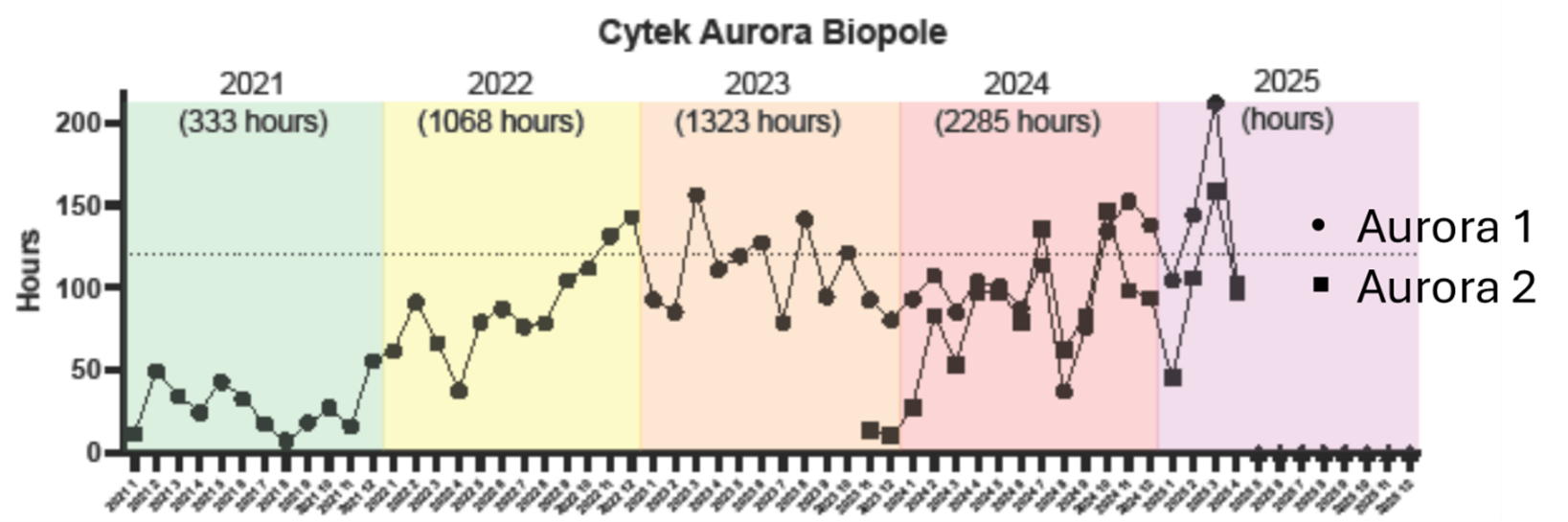
When we first acquired our Cytek Aurora back in 2019, it marked our entry into the exciting world of spectral cytometry. Gone are the days of one-fluorophore-per-detector limitations, small panel sizes, and resolution issues caused by autofluorescence, in exchange we’ve added a few unmixing induced headaches though.
|
|
|
Here at the FCF, you’ve all certainly embraced this shift toward the future of flow cytometry. The Aurora has become one of our most heavily booked instruments, with usage growing year after year. Demand has grown so high that once we're fully settled in the SE-C building, we’ll have five Auroras across our two sites, plus an Aurora Sorter.
|
|
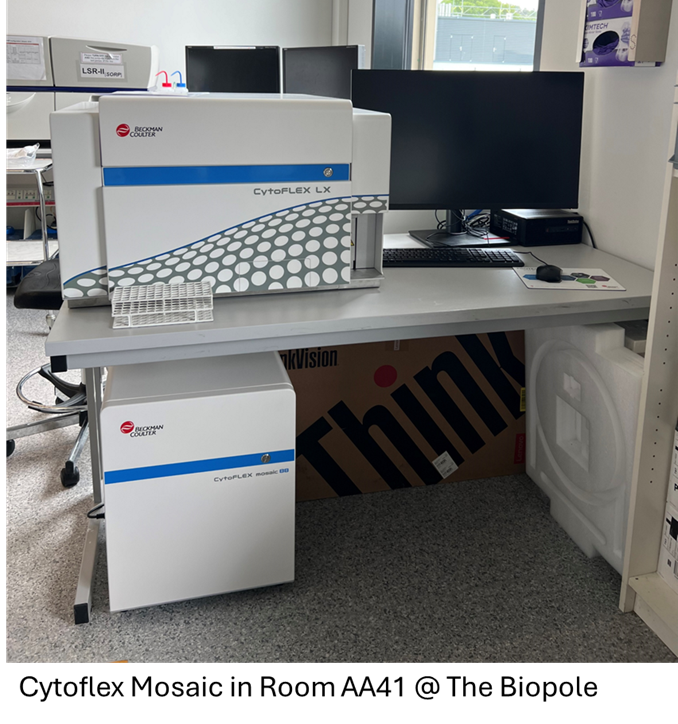
This success has raised the bar for other manufacturers with their own spectral ambitions. The highlight of today's newsletter is Beckman Coulter's answer to the Spectral question in the form of their very sleek looking CytoFLEX Mosaic. Which conveniently enough has just arrived at the Biopole from the Agora for the second half of its demo period.
|
|
|
|
While on the table, it may only appear to be a normal CytoFLEX LX, like the ones we’ve had at the FCF for many years, look underneath though and you’ll find the beating heart of its spectral system in a similarly styled but smaller white box. Beckman has taken an elegant approach by building a modular upgrade. Existing CytoFLEX S and LX systems can be converted to spectral by adding the Mosaic unit and switching some fiber optic cables, a process they say takes just five minutes.
|
|
|
|
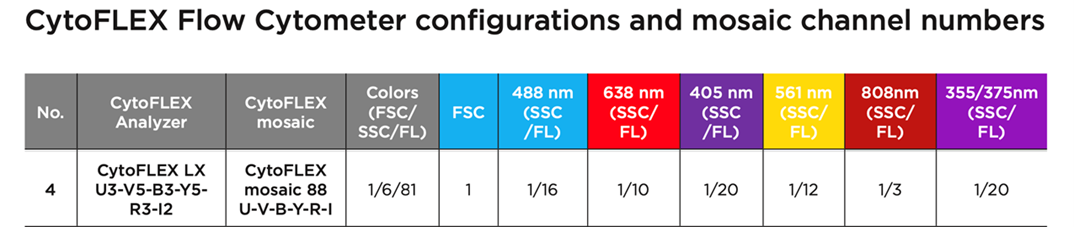
What’s in the Mosaic box, at least the one we have here, is 88 detectors across the 6 lasers system. Interestingly they’ve also added a SSC detector to each laser as well, which as was discussed in our Aurora ESP detection newsletter could be advantageous for small particle analysis in the Violet and UV channels, on top of other label free parameter options. Although the Mosaic uses separate software from conventional CytExpert, the Spectral CytExpert interface retains the same familiar look and feel.
|
|
|
|
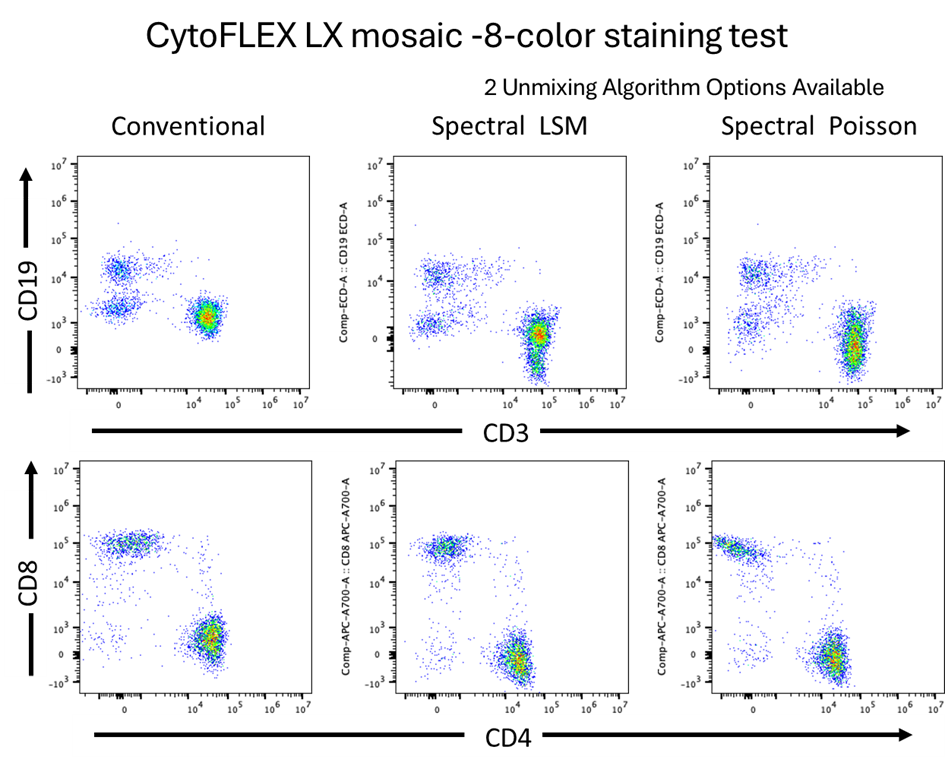
In terms of performance, our on-site testing shows promising results. In an 8-colour panel, the spectral mode outperformed conventional mode for staining index on several markers, with clear resolution across all populations. Thanks to Bastien Dolfi of the Johanna Joyce lab for providing his 25 colour panel for the characterization of murine bone-marrow derived cells, we also assessed the spectral mode in comparison to the Aurora system. We could see a very similar resolution of populations between the two instruments, even in more niche deep subpopulations.
|
|

|
Beckman has included an elaborate autofluorescence subtraction method, with the possibility to extract up to 10 different signatures. Although I’m sure you’ll struggle to find a sample that has more than 3 unique autofluorescent signatures, still the opportunity is there. This would be quite like the Autofluorescence Explorer feature on the Aurora. And while you can’t import previous FCS files like on the Aurora for single stains, the CytoFLEX mosaic keeps the compensation library from its conventional mode, so it is still possible to reuse old single stains within the software.
|
A particular strength I see for this machine will be the ability to better throughput spectral experiments with its more capable plate reader system. The CytoFLEX has long been a popular choice here at the FCF for automated plate-based runs. While the Aurora does provide a plate option, it's more flexible (but flimsy) sample injection line sometimes misses the mark (and quite literally the well). In contrast, the CytoFLEX plate system feels more robust and engineered for reliability. That said, we’d still recommend preparing your single stains in tubes, especially for first-time experiments, while running the full panel in plate mode.
|
When it comes to deciding between the spectral and conventional modes for the CytoFLEX it really comes down to what best fits your personal experiment. More colours, really anything beyond 12, should be done in spectral mode. Experiments with really bright (off scale) fluorescence, like GFP sometimes is, are better run in conventional mode where there is more control over individual detector gains. Heavily autofluorescence samples, especially ones with multiple spectra are best run in spectral mode. These are just general rules though and each experiment can be different so always feel free to ask us at the FCF what mode might work best for your experiment.
|
|
Finally, we’re thrilled to have support from Sintia Winkler, our former colleague and now an application specialist at Beckman Coulter. Sintia is available to help anyone interested in testing the CytoFLEX Mosaic. So, if you're tired of waiting for Aurora availability and think the Mosaic’s plate reader might benefit your workflow, get in touch with us, or contact Sintia (SWINKLER@beckman.com) directly, to book a test run.
|
|
|
|
|