|
|

|
|
|
|
|
|
|
Facility News
|
We're officially starting the fifth year of the FCF Newsletter! When we started this little adventure, we were still in the middle of the COVID pandemic and the Aurora was a strange machine to most of you. It's wild to think of how much have changed in such a short amount of time. The world of Science is constantly evolving and we are doing our best to keep up and help our users ! Thanks for your support through all those years, it's deeply appreciated ❤️
|
|
In this month FACS Tips, Kevin will present the options available to researcher who are interested in small particles studies. Let us know if you are curious to test it out in our facility !
|
|
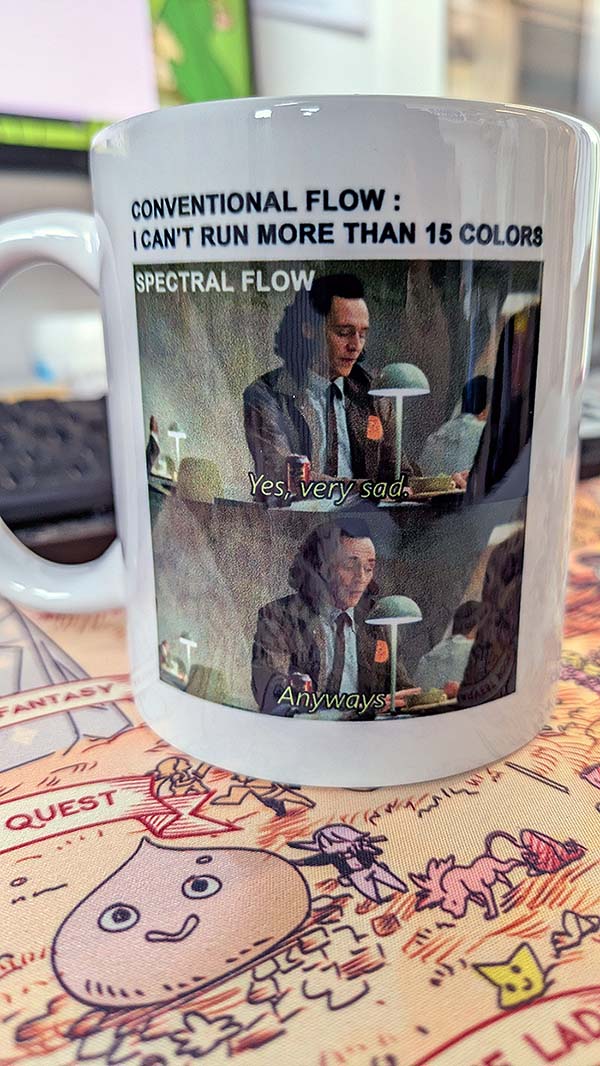
Alessandra Eleonora Carioli won the mug this month, Congratulations to you !
|
|
|
Each month, we will ask you 3 questions about the newsletter topic. If you win, you can enter the lottery to win a unique mug designed by the FCF team !
Please take few minutes to answer the quiz HERE.
|
|
|
|
FACS Tips
|
Small Particle Detection on the Aurora
|
At UNIL, we occasionally face the challenge of analyzing small particles be it bacteria, extracellular vesicles (EVs), or beads. Traditionally, we’ve leaned on the ImageStream for this type of work due to its high-resolution camera and ability to detect dim fluorescence signals. However, the ImageStream has its drawbacks: it’s slow, processes fewer particles, is only staff-operated at the FCF, and if image data isn’t your priority, it comes at a premium cost.
|
|
To address these limitations, Cytek has developed the Enhanced Small Particle Detection (ESP) system for the Aurora, which is now available for use on our Aurora instrument at the Agora.
|
|
|
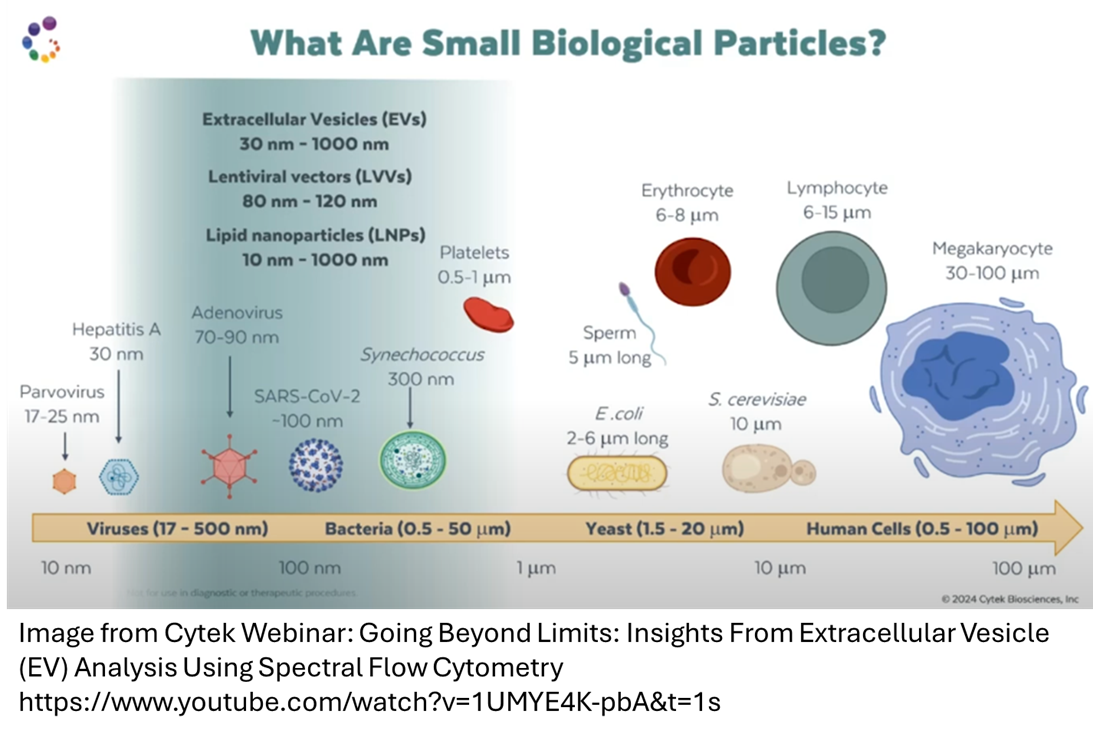
Flow cytometers are typically optimized for cell-sized particles ranging from 1 to 50 µm. These larger particles scatter light forward efficiently, making them easily detectable via Forward Scatter (FSC), the default trigger for most cytometers. However, small particles behave differently: they scatter light less, particularly in the forward direction. As a result, Side Scatter (SSC) becomes the more relevant detection channel. For this reason, it's best practice to change your threshold trigger to SSC when working with small particles.
|
Another challenge is that smaller particles, especially those with low refractive indices, can be indistinguishable from background noise. Most cytometers struggle to resolve particles below 600 nm, and very few can accurately detect those at or below 300 nm.
|
|
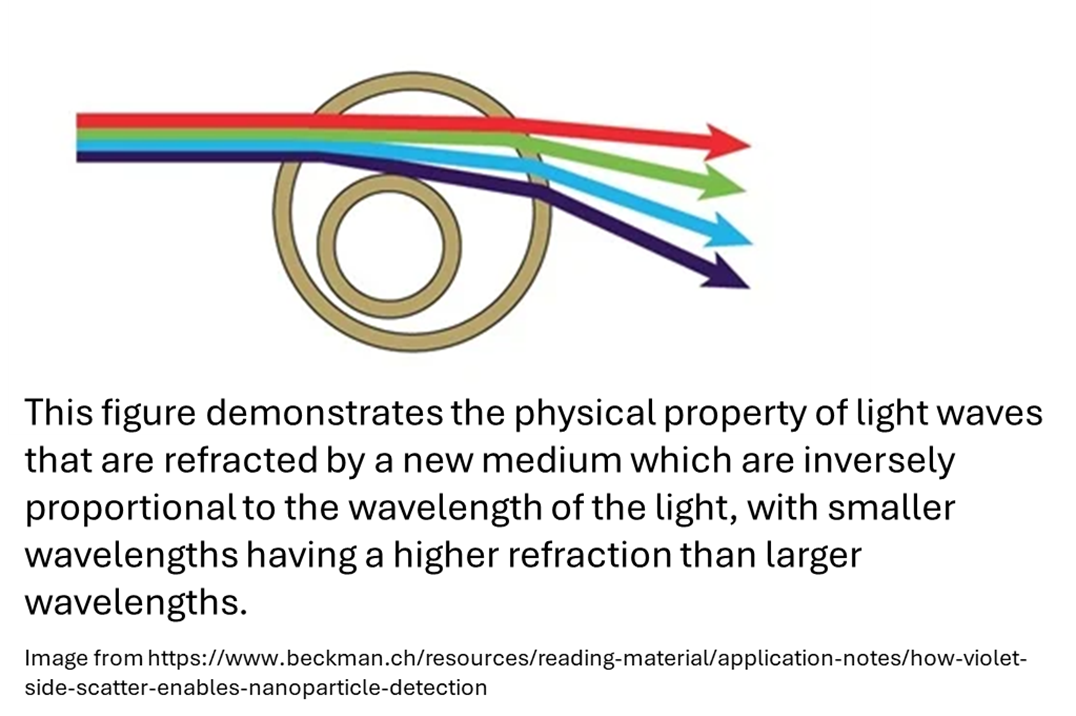
Cytek’s ESP system improves small particle detection on the Aurora by adding an SSC detector to the violet laser, alongside the standard blue laser SSC.
|
|
|
Violet light, with its shorter wavelength, scatters at a greater angle than blue light enhancing the detectability of smaller particles.
|
Additionally, the system increases the amount of light directed to the violet SSC detector from just 4% in a standard setup to 100%. This boosts resolution without compromising your standard blue SSC settings for cell analysis. You can calibrate the violet SSC for small particles while leaving the blue SSC untouched saving time and effort.
|
|
For fluorescence detection, the ESP-equipped Aurora operates identically to the standard version, using Cytek’s spectral detection system. Cytek also claims that a spectral system is beneficial for small particles that may carry quite weak signals as you’re no longer collecting that signal from just one detector but rather 50+ depending on your Aurora system.
|
|
|
|
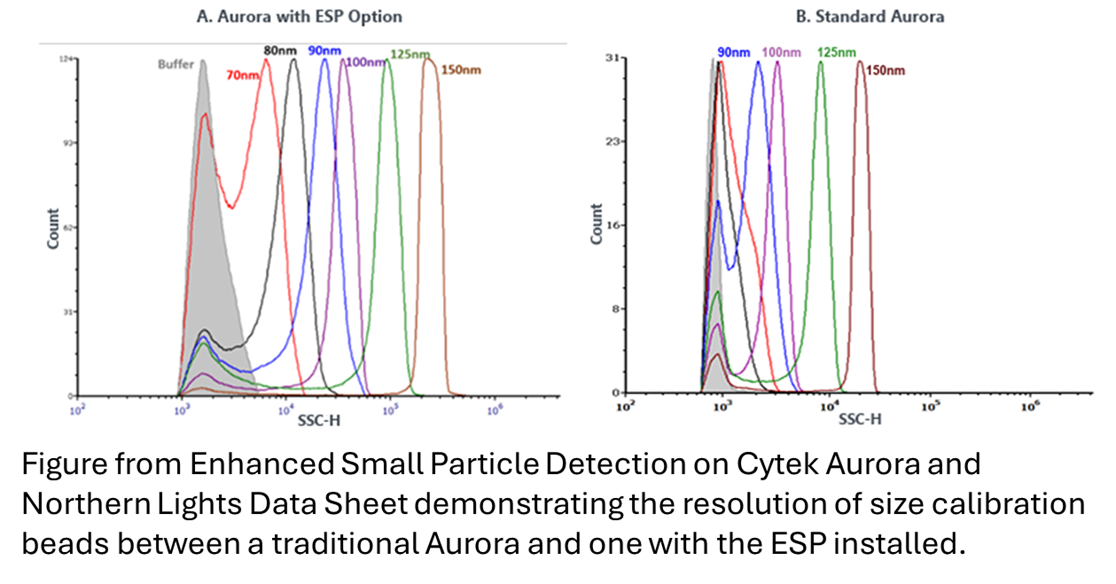
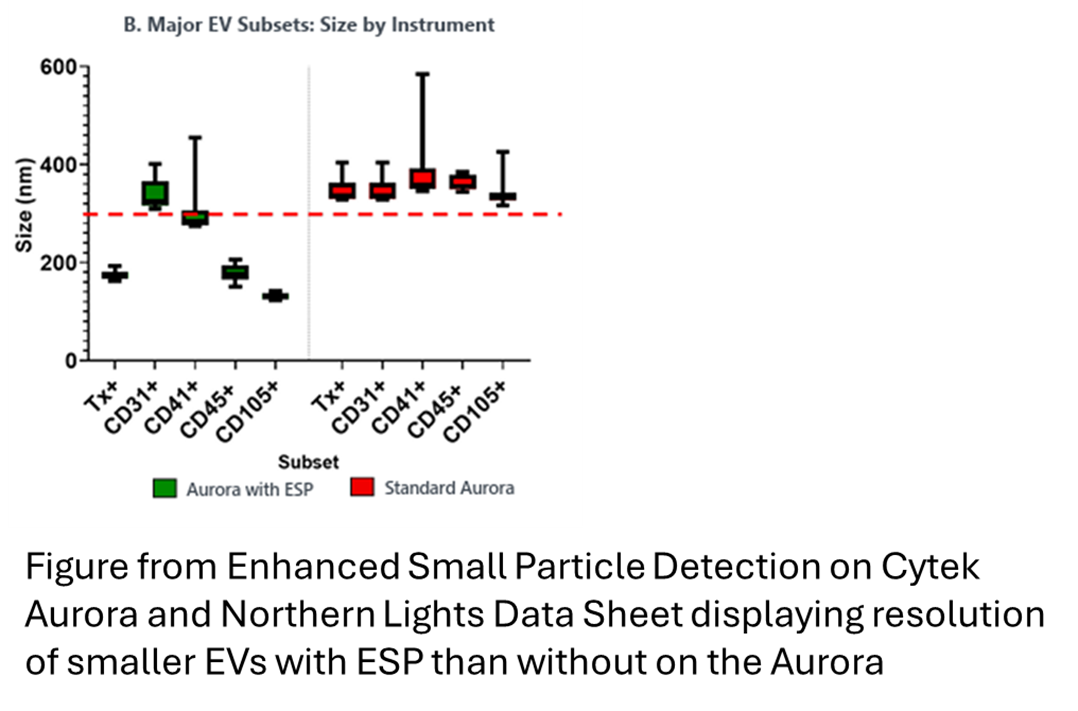
When compared, the Aurora with ESP detection was able to resolve calibration beads down to 70nm by SSC only, while a conventional Aurora was able to resolve the same beads to just beneath 100nm. While calibration beads tend to have a much higher refractive index, test’s on EVs demonstrated a better ability to resolve smaller EVs with the ESP installed vs a traditional Aurora.
|
|
|
The Cytoflex also has a violet SSC option that can be enabled through a configuration change, and they also claim resolution down to 80nm particles (CHECK HERE). The only downside of this is it requires more involved instruments set up to change filters and machine configuration before starting. That said, we can help configure the Cytoflex if it’s your preferred system.
|
|
It certainly helps to have machines optimized for small particle work and increases the range of experiments you can achieve at the FCF. With that said, just the machine alone is only part of the challenge of successful small particle experiment planning. Many titrations and controls are required to know you’re seeing true small particle populations. If you would like to use the Aurora with ESP for future experiments or if you have any additional questions, make sure to reach out to the FCF team for support.
|
|
|
|
|